
Close Menu
    Facebook X (Twitter) Instagram
    SciTechDaily
    • Biology
    • Chemistry
    • Earth
    • Health
    • Physics
    • Science
    • Space
    • Technology
    Facebook X (Twitter) Pinterest YouTube RSS
    SciTechDaily
    Home»Biology»Scientists Discover a New Species of Parasitic Euglenids: Euglenaformis parasitica
    Biology

    Scientists Discover a New Species of Parasitic Euglenids: Euglenaformis parasitica

    By University of TsukubaJuly 18, 2023No Comments2 Mins Read
    Facebook Twitter Pinterest Telegram LinkedIn WhatsApp Email Reddit
    Share
    Facebook Twitter LinkedIn Pinterest Telegram Email Reddit
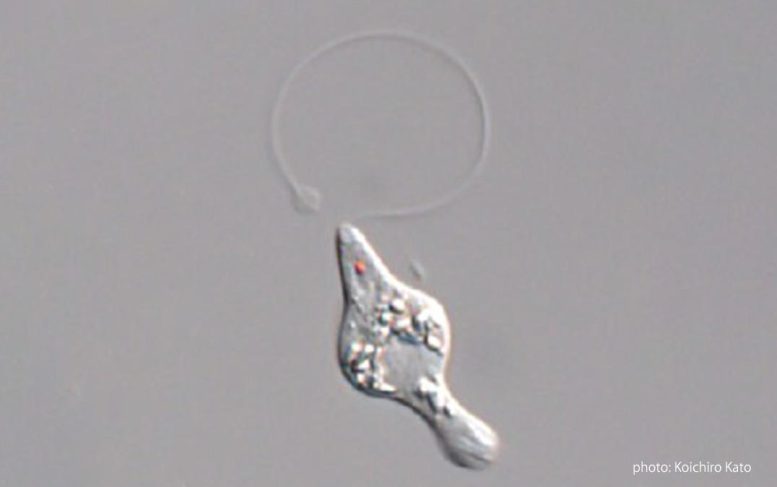
    Euglenaformis parasitica
    Euglenaformis parasitica (Japanese name: Tsukuba–yadori–midorimushi). Credit: University of Tsukuba

    A newly identified parasitic euglenid, Euglenaformis parasitica, sheds light on its evolutionary shift from photosynthesis to animal parasitism.

    Euglenids are recognized for their diverse nutritional methods, encompassing photosynthesis, bacterial predation, and in some cases, animal parasitism. Nonetheless, the records of parasitic euglenids are spare and out-of-date, lacking reliable information on their ecology or taxonomy.

    In a recent study, researchers unearthed flagellates within four animal species—including ostracods and rhabdocoels—gathered from a rice field in proximity to the University of Tsukuba. These animals, which had flagellates in their bodies, died within days, indicating that the flagellate was a parasite. This flagellate displayed active metaboly without flagella inside the host body.

    However, upon leaving the host, it extended its flagella and began to swim. Using electron microscopy and other techniques, the scientists examined the morphology of this flagellate and determined that it exhibited euglenid characteristics. In addition, DNA comparisons between flagellates isolated from all four animal species confirmed that they belonged to the same species.

    Phylogenetic analysis also revealed that this flagellate is a part of the photosynthetic euglenid group, suggesting that the flagellate lost its photosynthetic ability in the course of evolution to become an animal parasite. Comparing this to other previously reported parasitic euglenid flagellates, the scientists deduced that our discovery is a new species. They have named it Euglenaformis parasitica (Japanese name: Tsukuba-yadori-midorimushi).

    Euglenaformis parasitica exhibits a remarkably high infection rate in ostracods, a common species in rice fields. Elucidating the ecology of such parasitic organisms is anticipated to significantly enhance our understanding of rice-field ecosystems.

    Reference: “Taxonomy of a New Parasitic Euglenid, Euglenaformis parasitica sp. nov. (Euglenales, Euglenaceae) in Ostracods and Rhabdocoels” by Koichiro Kato, Kensuke Yahata, and Takeshi Nakayama, 9 May 2023, Protist.
    DOI: 10.1016/j.protis.2023.125967

    Never miss a breakthrough: Join the SciTechDaily newsletter.
    Follow us on Google and Google News.

    New Species Parasites University of Tsukuba
    Share. Facebook Twitter Pinterest LinkedIn Email Reddit

    Related Articles

    Challenging 200 Years of Research: Scientists Discover Bizarre New Insect With Unusual Biology

    Scientists Discover 16 Strange New Species of of Parasitoid Wasp in Vietnam

    Bizarre Branching Worm With Dividing Internal Organs Discovered Growing in Sea Sponge

    Bizarre New Parasitic Species Discovered… on Twitter

    New Parasitoid Wasp Species Discovered That Can Manipulate Spider’s Behavior

    Zombie-Ant Fungus Faces Its Own Deadly, Specialized Parasites

    Microscopic Parasite Toxoplasma Gondii Linked to Personality Changes

    1,000 Hidden Species Found in Australian Outback

    Two New Frog Species are World’s Smallest

    Leave A Reply Cancel Reply

    • Facebook
    • Twitter
    • Pinterest
    • YouTube

    Don't Miss a Discovery

    Subscribe for the Latest in Science & Tech!

    Trending News

    Popular Supplement Ingredient Linked to Shorter Lifespan in Men

    Scientists May Have Found a Way To Repair Nerve Damage in Multiple Sclerosis

    “Totally Unexpected” – Scientists Discover Pancreatic Cancer’s Fatal Addiction

    A Strange Quantum Effect May Explain One of Biology’s Greatest Mysteries

    James Webb Telescope Reveals the Universe’s Hidden Cosmic Web in Stunning Detail

    Scientists Identify Simple Supplement That Greatly Reduces Alzheimer’s Damage

    You May Have a Dangerous Type of Cholesterol Even if Your Tests Look Normal

    Your Blood Pressure Reading Could Be Wrong Because of One Simple Mistake

    Follow SciTechDaily
    • Facebook
    • Twitter
    • YouTube
    • Pinterest
    • Newsletter
    • RSS
    SciTech News
    • Biology News
    • Chemistry News
    • Earth News
    • Health News
    • Physics News
    • Science News
    • Space News
    • Technology News
    Recent Posts
    • NASA’s New AI Processor Is 500x Faster Than Current Space Computers
    • Scientists Find Evidence Earth Is Drifting Through the Ashes of an Exploded Star
    • This Strange Molecular Signature May Be the Best Clue Yet to Alien Life
    • Scientists Say a 40-Year-Old Childhood Obesity Warning May Be Completely Wrong
    • Marijuana Use May Raise Lung Cancer Risk, Researchers Warn
    Copyright © 1998 - 2026 SciTechDaily. All Rights Reserved.
    • Science News
    • About
    • Contact
    • Editorial Board
    • Privacy Policy
    • Terms of Use

    Type above and press Enter to search. Press Esc to cancel.