
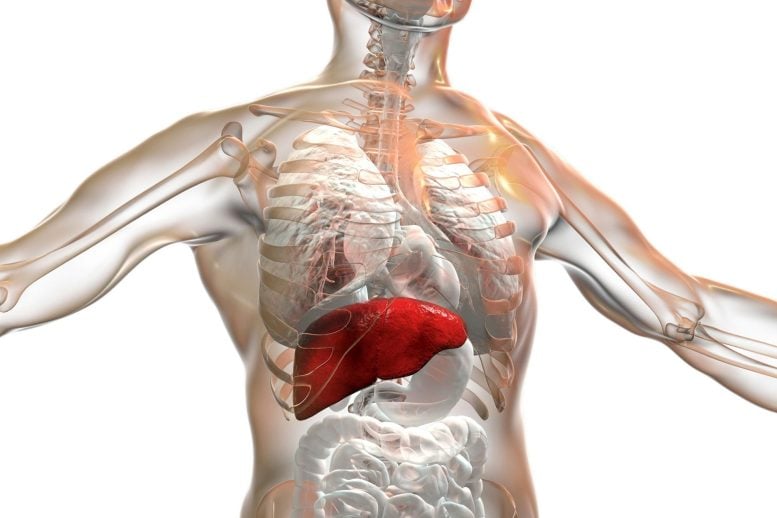
USC researchers show SAB-targeting therapy may reverse fatty liver disease.
About 80 million Americans have fatty liver disease unrelated to alcohol abuse. Nonalcoholic fatty liver disease is associated with obesity and diabetes, and can lead to more severe liver damage such as nonalcoholic steatohepatitis (NASH), cirrhosis and liver cancer. Cardiovascular disease, colorectal cancer and breast cancer actually are the major causes of death in patients with fatty liver disease.
Several drugs in advanced stages of development have failed because of the complexity of the disease, low efficacy, or the toxicity of drugs. Although several clinical trials were conducted in past decades, currently there is no FDA-approved pharmaceutical therapy for NASH.
To understand the complexity of the progression of fatty liver disease, a team of USC scientists explored the molecular mechanism in experimental NAFL/NASH. The project led to the discovery of a plausible therapeutic target gene, SH3BP5, also known as SAB.
SAB’s Role in Mitochondrial Dysfunction and Stress Response
“The finding is the culmination of years of work by the team including USC bioinformatics specialists, pathologist, students, visiting scholars, and collaborators,” said Sanda Win, MD, PhD, assistant professor of research medicine in the GI/Liver division in the Department of Medicine at the Keck School of Medicine of USC.
As Win explains, SAB is an outer membrane protein of mitochondria, which is known as the powerhouse of the cell. The biological function of SAB was not known until the USC researchers first discovered it 10 years ago. SAB is a pivotal protein, and the level of SAB determines the severity of liver damage in an acetaminophen-induced liver injury model and a tumor-necrotic factor (TNF) induced acute liver failure model. SAB is a target of stress-activated kinase (JNK) which then leads to impaired mitochondrial function and an increase in toxic reactive oxygen species. Interestingly, SAB gene activation and protein levels increase in a diet-induced fatty liver and correlate with progression of the disease in experimental models and human fatty liver disease, Win added.
“We could prevent that whole progression by knocking out the SAB gene in the liver early on in these experiments in adult animals that were then fed a high-fat diet,” said Neil Kaplowitz, MD, professor of medicine and the Thomas H. Brem Chair in Medicine at the Keck School.
The project was initiated by a pilot grant to Win funded by USC Research Center for Liver Diseases, and the Donald E. and Delia Baxter Foundation Faculty Fellows Award. The research recently was published in Hepatology, a journal by the American Association for the Study of Liver Diseases.
Antisense Therapy Reverses Established Liver Damage
The mice were fed — overfed, really — a diet of high-fat food pellets with added sucrose and fructose water. The long-term feeding of high-fat, high-sugar diet causes obesity, diabetes, and fatty liver diseases. But even in mice that had been fed the high-fat, high-sugar diet for a year, “if we introduced this antisense targeting the liver cells, when the mice already had established disease with inflammation and fibrosis in the liver, we could reverse the entire thing, normalize their insulin resistance, and markedly decrease the fat accumulation in the liver and also the inflammation and fibrosis in the liver,” Kaplowitz said.
One benefit, Win said, is “we don’t need to delete or knock down, or knock out, the SAB protein entirely. Giving the dose, just to maintain the normal level of SAB prevents or reverses the disease progress.” With the advantage of advanced science in antisense oligonucleotides (ASO), designed and synthesized by collaborators of Ionis Pharmaceuticals Inc., of Carlsbad, California, the team is optimistic about SAB-targeting DNA therapy.
Lifestyle, Antisense Therapy, and Weight Loss
The research shows just how much damage to the liver — from dietary choices — could be avoided through modest changes in behavior. Giving the mice antisense therapy during the first six months actually helped them lose weight. The authors caution that studies involving mice don’t always translate to assumptions about humans.
“There’s no question that many things that have been successful in mice don’t work in humans,” Kaplowitz said. But “our data suggests that this is a really strong potential therapeutic target, and we don’t see any downside to directly interfering with SAB when lowering it.”
About the study
This research was supported by NIH grants R01DK067215 (NK), the Veronica Garrie Budnick Chair in Liver Disease (NK), the Donald E. and Delia Baxter Foundation Faculty Fellows award (SW), a pilot project award (SW) by USC Research Center for Liver Diseases (P30DK048522), and a pilot project grant funding (SW) by the Rodent Metabolic Core of the Saban Research Institute of Children’s Hospital Los Angeles.
Never miss a breakthrough: Join the SciTechDaily newsletter.
Follow us on Google and Google News.