
These newly discovered spinning crystals twist, break, and heal themselves, revealing a strange new side of solid matter.
It may seem hard to believe, but crystals made from spinning components are real. Researchers from Aachen, Düsseldorf, Mainz, and Wayne State University have examined these unusual materials and uncovered a range of surprising behaviors. The crystals can easily split into separate pieces, form unusual internal boundaries, and develop defects that researchers can deliberately influence. Writing in the Proceedings of the National Academy of Sciences (PNAS), the team describes how a unified theoretical approach can be used to predict new properties in systems governed by what are known as “transverse interaction” forces.
Transverse Forces in Materials and Living Systems
“Transverse forces” are not limited to laboratory materials. They can appear in engineered systems such as certain magnetic solids, but they have also been observed in living organisms. In an experiment carried out at MIT, scientists studied groups of starfish embryos and found that their swimming motions affected one another. This interaction caused the embryos to move in circular paths around each other. While the biological role of this behavior remains unknown, both natural and synthetic examples share a key feature: they involve objects that rotate while interacting.
When Spinning Particles Form a Solid
Professor Dr. Hartmut Löwen from the Institute of Theoretical Physics II at Heinrich Heine University Düsseldorf (HHU) explains the unexpected outcome of this collective motion: “A system of many rotating constituent elements exhibits a qualitatively new behavior that is non-intuitive: At high concentrations, these objects form a solid body of rotors, which possess ‘odd’ material properties.”
One of these unusual traits is called “odd elasticity.” In everyday materials, pulling on a solid causes it to stretch in the same direction as the applied force. In an odd elastic material, pulling does not produce stretching at all. Instead, the material responds by twisting.
Crystals That Break Apart and Come Back Together
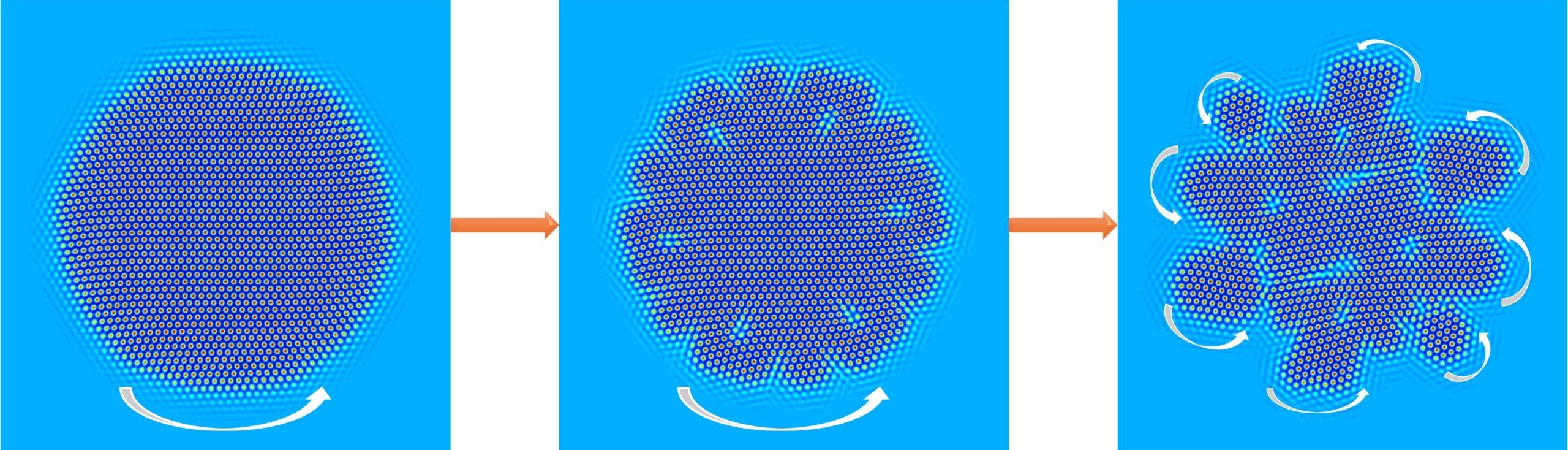
These twisting solids can also fall apart without any external trigger. If the rotating components rub against each other strongly enough, the crystal can split into many smaller spinning fragments. Even more striking is the fact that these pieces are capable of coming back together and reforming the crystal structure.
To explain this behavior, a group led by Professor Dr. Zhi-Feng Huang from the Department of Physics and Astronomy at Wayne State University, together with corresponding author Professor Löwen, developed a theory that connects processes across different length scales. Computer-based model calculations using this framework revealed how these strange materials behave and pointed to possible future applications.
Crystal Growth That Defies Expectations
The researchers found that large crystals dominated by transverse interactions tend to break down into smaller rotating units. At the same time, smaller crystals grow until they reach a specific size limit. This pattern contradicts the usual picture of crystal growth, where crystals steadily become larger when conditions are favorable, i.e. when thermodynamic factors encourage growth.
Professor Huang describes the significance of this result: “We have discovered a fundamental property of nature underlying this process which determines the relation between the size of the critical fragments and their rotation speed.”
Moving Defects and Tunable Properties
Professor Dr. Raphael Wittkowski from the DWI – Leibniz Institute for Interactive Materials and RWTH Aachen University highlights another important finding: “We furthermore demonstrated how defects in the crystals exhibit dynamics of their own. The formation of such defects can be influenced from outside, which allows properties of the crystals to be specifically controlled with a view to usage applications.”
According to co-author Dr. Michael te Vrugt, Assistant Professor at the University of Mainz, the implications go well beyond a single material class. “Our far-reaching theory encompasses all systems evidencing such transverse interactions. Conceivable applications range from colloid research to biology,” he says.
Professor Löwen points to practical possibilities as well: “The model calculations indicate concrete application potential. The novel elastic properties of these new crystals could be exploited to invent new technical switching elements, for example.”
Background: Central and Transverse Forces
In physics, well-known interactions such as gravity between two masses or the Coulomb force between charged particles are classified as central forces. These forces act along the line connecting the centers of two objects and cause them to move closer together or farther apart.
Transversal interactions, by contrast, are a more recently identified phenomenon. In this case, the force between two objects acts perpendicular to the line connecting their centers. As a result, the objects begin to rotate around one another spontaneously, creating the distinctive motion that underlies these newly studied rotating crystals.
Reference: “Anomalous grain dynamics and grain locomotion of odd crystals” by Zhi-Feng Huang, Michael te Vrugt, Raphael Wittkowski and Hartmut Löwen, 17 October 2025, Proceedings of the National Academy of Sciences.
DOI: 10.1073/pnas.2511350122
Never miss a breakthrough: Join the SciTechDaily newsletter.
Follow us on Google and Google News.
12 Comments
Part of the formal definition of a “crystal,” in contrast to an amorphous liquid or glass, is that is has a unique, repeating lattice that has a static form composed of the elements that contribute to its properties, such as density and cleavage. These ‘spin crystals’ may meet the definition of a “quasicrystal,” although the article doesn’t provide enough information to be certain of that. Not all forms of solid matter are crystals. I doubt that these ‘shape shifters’ are truly crystals. They are a new form of matter begging for a definition and a formal name, other than “crystal.”
Please ask researchers to think deeply:
What is the amorphous liquid or glass, crystal’s common background?
Any so-called evidence tainted by human intervention risks distorting our understanding and cognition of the intrinsic dynamics of natural laws.
—— Excerpted from https://zhuanlan.zhihu.com/p/1996561896279667777.
Example 1: Two sets of cobalt-60 are manually rotated in opposite directions, and even without detection, people around the world know that they will not be symmetrical because these two objects are not mirror images of each other at all. However, a group of so-called physicists and so-called academic publications do not believe it. They conducted experiments and the results were indeed asymmetric, but they still firmly believed that these two objects were mirror images of each other, and the asymmetry was due to a violation of the previous natural laws (CP violation). In the history of science, there can never be a dirtier and uglier operation and explanation than this. These people and the so-called academic publications they manipulate no longer know what shame is.
—— Excerpted from https://scitechdaily.com/what-happens-when-light-gains-extra-dimensions/#comment-947619.
Example 2: Please see how the so-called “mystery of θ – τ” is explained: θ and τ are completely identical in all measurable physical properties such as mass, lifetime, charge, spin, etc. However, experimental observations have shown that the θ meson decays into two π mesons, while the τ meson decays into three π mesons, making it difficult for physicists to explain why they are so similar. Physicist Martin Block proposed a highly challenging idea: θ and τ are the same particle, but in weak interactions, parity is not conserved. An easy to understand explanation is the following analogy:: There are two boxes of apples with identical weight, color, and taste. However, when one box is opened, there are two apples, while when the other box is opened, there are three apples. This confuses the old farmer who buys apples. He circled around the orchard and came up with a highly challenging idea: these two boxes of apples are not from the same tree, so they are the same.
—— Excerpted from https://scitechdaily.com/what-happens-when-light-gains-extra-dimensions/#comment-947686.
Topological vortex theory (TVT) calls for a return to the scientific rationality of symmetrical dominant in natural laws.
These newly discovered spinning crystals twist, break, and heal themselves, revealing a strange new side of solid matter. It may seem hard to believe, but crystals made from spinning components are real.
VERY GOOD!
Please ask researchers to think deeply:
1. Is there a mathematical basis for vortex nucleation?
2. Why do crystals spin? Where does its power come from?
Transversal interactions are a more recently identified phenomenon. The force between two objects acts perpendicular to the line connecting their centers. As a result, the objects begin to rotate around one another spontaneously, creating the distinctive motion that underlies these newly studied rotating crystals. Why?
Physics today takes pride in its counterintuitive and counterintuitive nature, and is enthusiastic about proposing various paradoxes. Is this scientific rationality? Why?
Any so-called evidence tainted by human intervention risks distorting our understanding and cognition of the intrinsic dynamics of natural laws.
—— Excerpted from https://zhuanlan.zhihu.com/p/1996561896279667777.
Example 1: Two sets of cobalt-60 are manually rotated in opposite directions, and even without detection, people around the world know that they will not be symmetrical because these two objects are not mirror images of each other at all. However, a group of so-called physicists and so-called academic publications do not believe it. They conducted experiments and the results were indeed asymmetric, but they still firmly believed that these two objects were mirror images of each other, and the asymmetry was due to a violation of the previous natural laws (CP violation). In the history of science, there can never be a dirtier and uglier operation and explanation than this. These people and the so-called academic publications they manipulate no longer know what shame is.
—— Excerpted from https://scitechdaily.com/what-happens-when-light-gains-extra-dimensions/#comment-947619.
Example 2: Please see how the so-called “mystery of θ – τ” is explained: θ and τ are completely identical in all measurable physical properties such as mass, lifetime, charge, spin, etc. However, experimental observations have shown that the θ meson decays into two π mesons, while the τ meson decays into three π mesons, making it difficult for physicists to explain why they are so similar. Physicist Martin Block proposed a highly challenging idea: θ and τ are the same particle, but in weak interactions, parity is not conserved. An easy to understand explanation is the following analogy:: There are two boxes of apples with identical weight, color, and taste. However, when one box is opened, there are two apples, while when the other box is opened, there are three apples. This confuses the old farmer who buys apples. He circled around the orchard and came up with a highly challenging idea: these two boxes of apples are not from the same tree, so they are the same.
—— Excerpted from https://scitechdaily.com/what-happens-when-light-gains-extra-dimensions/#comment-947686.
Topological vortex theory (TVT) calls for a return to the scientific rationality of symmetrical dominant in natural laws.
Q: Why is a mouse?
A: Because the higher it spins, the much.
In my opinion, the stability of any material depends on the balance between attractive and repulsive forces. The forces include gravitational attraction, electromagnetic attraction/ repulsion and motion which acts as repulsive force. No other forces exist in nature. These forces are finite and conserved.
Depending on the atoms present, the balance can vary from highly static to highly dynamic, and temperature affects the nature of the balance by changing the repulsive internal motion.
The above concept can explain the observed phenomenon in crystals.
This paper could well have been written by a ‘bot as a joke. At the very least, there appears to be a definitional problem that might be attributed to English being a second language for one or more of the ‘researchers.’ The authors state that starfish embryos are “crystals.” I’m afraid that PNAS has been the brunt of a joke, despite being ‘peer reviewed.’ If PNAS doesn’t tighten its peer-review standards, it might lose its former good reputation.
Thank you for browsing and commenting.
You are rewarding them too much. The so-called reputation is mostly self proclaimed. True science is nothing compared to these so-called peer-reviewed publications. When we pursue the ultimate truth of all things, the space in which our bodies and all things exist may itself be the final and deepest puzzle we need to explore. This is not only the pursuit of physics, but also the most magnificent exploration of the origin of the universe by human reason.
In today’s physics, some so-called peer-reviewed journals—including the Proceedings of the National Academy of Sciences, Physical Review Letters, Science, Nature, and others—stubbornly insist on and promote the following:
1. Even though θ and τ particles exhibit differences in experiments, physics can claim they are the same particle. This is science.
2. Even though topological vortices and antivortices have identical structures and opposite rotational directions, physics can define their structures and directions as entirely different. This is science.
3. Even though two sets of cobalt-60 rotate in opposite directions and experiments reveal asymmetry, physics can still define them as mirror images of each other. This is science.
4. Even though vortex structures are ubiquitous—from cosmic accretion disks to particle spins—physics must insist that vortex structures do not exist and require verification. Only the particles that like God, Demonic, or Angelic are the most fundamental structures of the universe. This is science.
5. Even though everything occupies space and maintains its existence in time, physics must still debate and insist on whether space exists and whether time is a figment of the human mind. This is science.
6. Even though space, with its non-stick, incompressible, and isotropic characteristics, provides a solid foundation for the development of physics, physics must still insist that the ideal fluid properties of space do not exist. This is science.
and go on.
Is this the counterintuitive science they widely promote? Compromising with pseudo academic publications and peer review by pseudo scholars is an insult to science and public intelligence. Some so-called scholars no longer understand what shame is. The study of Topological Vortex Theory (TVT) reminds us that the most profound problems in physics often lie at the intersection of different theories. By exploring these border regions, we can not only resolve contradictions in existing theories but also discover new physical phenomena and application possibilities.
Based on the Topological Vortex Theory (TVT), space is an uniformly incompressible physical entity. Space-time vortices are the products of topological phase transitions of the tipping points in space, are the point defects in spacetime. Point defects do not only impact the thermodynamic properties, but are also central to kinetic processes. They create all things and shape the world through spin and self-organization.
Under the topological vortex architecture, it is highly challenging for even two hydrogen atoms or two quarks to be perfectly symmetrical, let alone counter-rotating two sets of cobalt-60. Contemporary physics and so-called peer-reviewed publications (including the Proceedings of the National Academy of Sciences, Physical Review Letters, Science, Nature, Science Bulletin, etc.) stubbornly believe that two sets of counter rotating cobalt-60 are two mirror images of each other, constructing a more shocking pseudoscientific theoretical framework in the history of science than the “geocentric model”. This pseudo scientific framework and system have seriously hindered scientific progress and social development.
For nearly a century, physics has been manipulated by this pseudo scientific theoretical system and the interest groups behind it, wasting a lot of manpower, funds, and time. A large amount of pseudo scientific research has been conducted, and countless pseudo scientific papers have been published, causing serious negative impacts on scientific and social progress, as well as humanistic development.
Complexity does not necessarily mean that there is no logical and architectural framework to follow. Mathematics is the language and tool that reveals the motion of spacetime, rather than the motion itself. Although the physical form of spacetime vortices is extremely simple, their interaction patterns are highly complex, and we must develop more and richer mathematical languages to describe and understand them.
The development of the Topological Vortex Theory (TVT) reflects a progression from concrete physical phenomena to abstract mathematical modeling and, ultimately, to interdisciplinary unification. Its core innovation lies in forging the continuous spacetime geometry of general relativity with the discrete interactions of quantum field theory within the same topological dynamical system. The core idea of TVT — space is physical, and matter is its topological excitation—already provides a solid and elegant scientific path for understanding the origin of all things.
——Excerpted from https://scitechdaily.com/microscope-spacecrafts-most-precise-test-of-key-component-of-the-theory-of-general-relativity/#comment-909171 and https://t.pineal.cn/blogs/6255/A-Mathematical-and-Physical-Analysis-On-the-Origin-of-Objects.
The so-called peer-reviewed publications, including Proceedings of the National Academy of Sciences, Physical Review Letters, Nature, Science, etc., as well as the been despised flatterer Science Bulletin by them, never know what dirty and ugly are.
Thank you for browsing and commenting.
You are rewarding them too much. The so-called reputation is mostly self proclaimed. True science is nothing compared to these so-called peer-reviewed publications. When we pursue the ultimate truth of all things, the space in which our bodies and all things exist may itself be the final and deepest puzzle we need to explore. This is not only the pursuit of physics, but also the most magnificent exploration of the origin of the universe by human reason.
In today’s physics, some so-called peer-reviewed journals—including the Proceedings of the National Academy of Sciences, Physical Review Letters, Science, Nature, and others—stubbornly insist on and promote the following:
1. Even though θ and τ particles exhibit differences in experiments, physics can claim they are the same particle. This is science.
2. Even though topological vortices and antivortices have identical structures and opposite rotational directions, physics can define their structures and directions as entirely different. This is science.
3. Even though two sets of cobalt-60 rotate in opposite directions and experiments reveal asymmetry, physics can still define them as mirror images of each other. This is science.
4. Even though vortex structures are ubiquitous—from cosmic accretion disks to particle spins—physics must insist that vortex structures do not exist and require verification. Only the particles that like God, Demonic, or Angelic are the most fundamental structures of the universe. This is science.
5. Even though everything occupies space and maintains its existence in time, physics must still debate and insist on whether space exists and whether time is a figment of the human mind. This is science.
6. Even though space, with its non-stick, incompressible, and isotropic characteristics, provides a solid foundation for the development of physics, physics must still insist that the ideal fluid properties of space do not exist. This is science.
and go on.
Is this the counterintuitive science they widely promote? Compromising with pseudo academic publications and peer review by pseudo scholars is an insult to science and public intelligence. Some so-called scholars no longer understand what shame is. The study of Topological Vortex Theory (TVT) reminds us that the most profound problems in physics often lie at the intersection of different theories. By exploring these border regions, we can not only resolve contradictions in existing theories but also discover new physical phenomena and application possibilities.
Based on the Topological Vortex Theory (TVT), space is an uniformly incompressible physical entity. Space-time vortices are the products of topological phase transitions of the tipping points in space, are the point defects in spacetime. Point defects do not only impact the thermodynamic properties, but are also central to kinetic processes. They create all things and shape the world through spin and self-organization.
Under the topological vortex architecture, it is highly challenging for even two hydrogen atoms or two quarks to be perfectly symmetrical, let alone counter-rotating two sets of cobalt-60. Contemporary physics and so-called peer-reviewed publications (including the Proceedings of the National Academy of Sciences, Physical Review Letters, Science, Nature, Science Bulletin, etc.) stubbornly believe that two sets of counter rotating cobalt-60 are two mirror images of each other, constructing a more shocking pseudoscientific theoretical framework in the history of science than the “geocentric model”. This pseudo scientific framework and system have seriously hindered scientific progress and social development.
For nearly a century, physics has been manipulated by this pseudo scientific theoretical system and the interest groups behind it, wasting a lot of manpower, funds, and time. A large amount of pseudo scientific research has been conducted, and countless pseudo scientific papers have been published, causing serious negative impacts on scientific and social progress, as well as humanistic development.
Complexity does not necessarily mean that there is no logical and architectural framework to follow. Mathematics is the language and tool that reveals the motion of spacetime, rather than the motion itself. Although the physical form of spacetime vortices is extremely simple, their interaction patterns are highly complex, and we must develop more and richer mathematical languages to describe and understand them.
The development of the Topological Vortex Theory (TVT) reflects a progression from concrete physical phenomena to abstract mathematical modeling and, ultimately, to interdisciplinary unification. Its core innovation lies in forging the continuous spacetime geometry of general relativity with the discrete interactions of quantum field theory within the same topological dynamical system. The core idea of TVT — space is physical, and matter is its topological excitation—already provides a solid and elegant scientific path for understanding the origin of all things.
——Excerpted from https://scitechdaily.com/microscope-spacecrafts-most-precise-test-of-key-component-of-the-theory-of-general-relativity/#comment-909171 and https://t.pineal.cn/blogs/6255/A-Mathematical-and-Physical-Analysis-On-the-Origin-of-Objects.
So much for parallel universes…A copy of Earth, identical in all respects, now seems even more unlikely.
Thank you for browsing and commenting.
Based on Topological Vortex Theory (TVT), quantum mechanics is not a theory about “particles” or “waves,” but the necessary mathematical expression of the spin dynamics of spacetime’s microscopic topological structure. The entire mathematical structure of quantum mechanics—including complex Hilbert space, non-commutative operators, unitary evolution, and even the measurement postulate—originates from the geometric constraints and topological invariants of a dynamic vortex network.
——Excerpted from https://zhuanlan.zhihu.com/p/1999506461873690092.