

A recent study published in PeerJ examines the preservation of unique ichthyosaur fossils using cutting-edge research methodologies. In the final, large group of ichthyosaurs, one entire animal and one tail were the first to retain outer body shape.
Two key terms to remember:
Ichthyosaurs were marine reptiles that lived during the dinosaur era. Their fossils have been discovered all over the globe, and they are known for having a fish-like form that is similar to that of modern-day dolphins.
The Solnhofen region in southern Germany is famed for its Late Jurassic fossils, which include Archaeopteryx, often regarded as the first bird, and countless other species, many of which were preserved with soft tissues in addition to bones and teeth, which is unusual in the fossil record.
Discovery of Rare Ichthyosaur Fossils from Solnhofen
The new peer-reviewed paper reports two 150 million-year-old ichthyosaur fossils from the Solnhofen region. They are kept in the Bishops Seminar Eichstätt’s Jura-Museum. One ichthyosaur is a full specimen, containing an internal skeleton and a soft tissue outline surrounding the body. The other fossil is a complete tail fin. The tail vertebrae and soft tissues surrounding it have been preserved, establishing that ichthyosaurs in this group possessed moon-shaped tails like their forebears.
A multidisciplinary team of scientists conducted the study. The lead author, Lene Liebe Delsett, and Jørn Hurum, have been working with marine reptiles at the Natural History Museum in Oslo, Norway, for several years. Martina Kölbl-Ebert, an expert on the Solnhofen fauna, assisted them. They also collaborated with mineralogist Henrik Friis, who analyzed the soft tissue samples to determine what it contained.
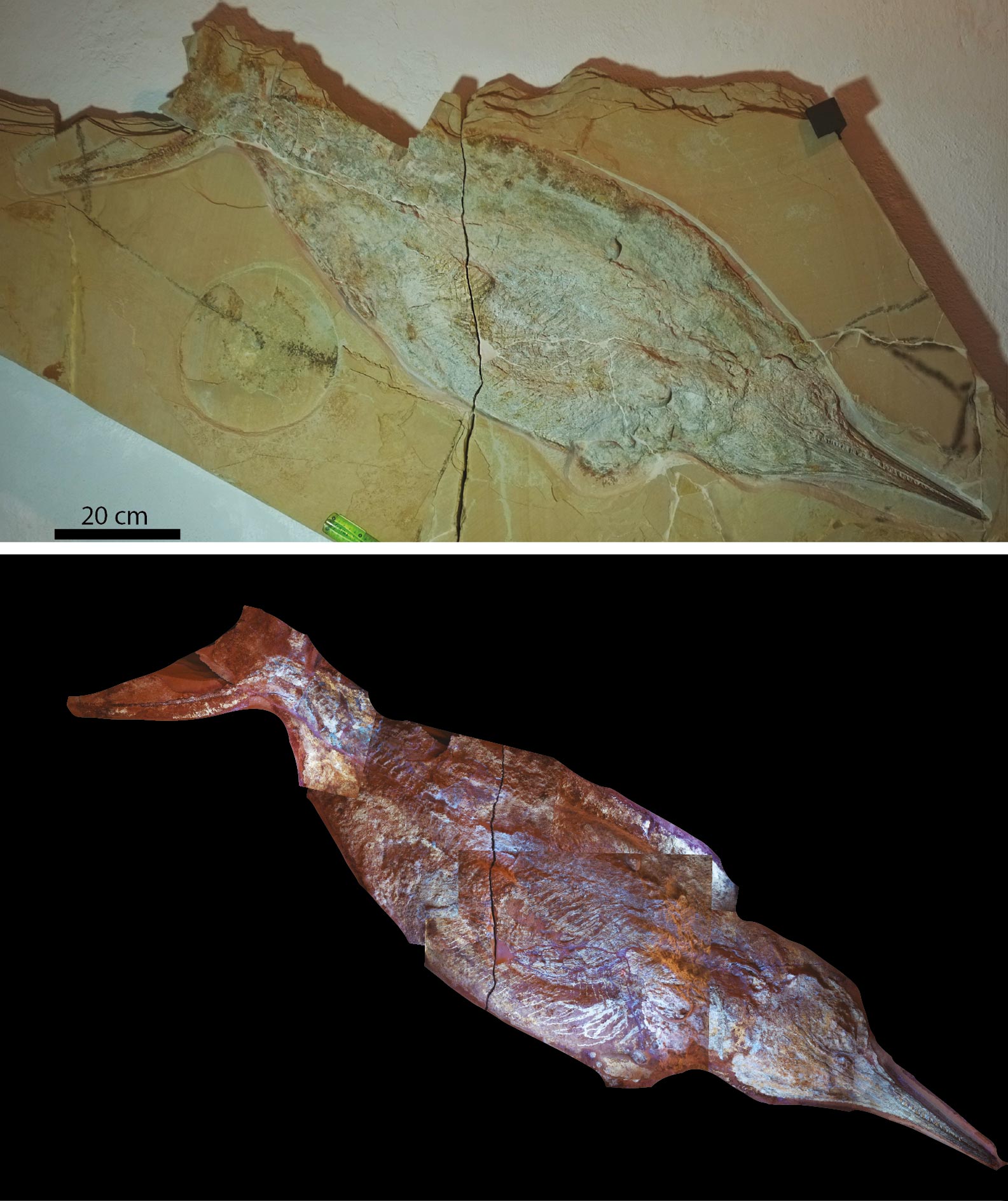
The complete specimen is really what makes this project unique because it tells a complete story. Ichthyosaurs are not common as fossils in Solnhofen, which at the time was a relatively shallow area with many islands, whereas ichthyosaurs were open ocean dwellers. We do not know why this one entered the lagoons, but it might be the reason why it died. Seeing the specimen makes an impact because it is so obviously a complete, dead animal body, where we can see its shape because of the unique preservation, Delsett says.
Phosphate’s Role in Preservation and Blubber Evidence
During or after death, the ichthyosaur landed on its back and side on the seafloor, and was covered in fine sediments. Little oxygen and quite a lot of luck preserved it until it was found and excavated in 2009. In the paper, the scientists do a first description of the specimen and start the process of understanding its soft tissue. In order to do so, they took small samples from the soft tissue in the tail and looked at it via X-ray crystallography and a scanning electron microscope. Because the skeletons and the rock they are preserved in, have almost the same color, UV light was used for studying the shape of the bones to understand which type of ichthyosaur these are. They found that phosphate found in the tissues of the ichthyosaurs likely contributed to the preservation. It is not yet possible to identify all of the fossilized tissue types in the ichthyosaur, but the new study confidently confirms the preservation of skin and possibly connective tissue. However, the major part of the matter that surrounds and covers the specimen is probably decomposed blubber.
We know from earlier research that ichthyosaurs likely had a blubber, like whales have today. Our research confirms this, for a group of ichthyosaurs where this has not been certain. The blubber is another strong similarity between whales and ichthyosaurs, in addition to their body shape. In the future, I hope that these two ichthyosaurs from Solnhofen can be used to enhance our understanding of swimming, as they preserve tail and body shape, Delsett says.
Reference: “The soft tissue and skeletal anatomy of two Late Jurassic ichthyosaur specimens from the Solnhofen archipelago” by Lene L. Delsett, Henrik Friis, Martina Kölbl-Ebert and Jørn H. Hurum, 7 April 2022, PeerJ.
DOI: 10.7717/peerj.13173
Never miss a breakthrough: Join the SciTechDaily newsletter.
Follow us on Google and Google News.
4 Comments
Something is drastically wrong with the age assignment here. Organic tissues naturally degrade quickly, even in the most controlled conditions. There is no way they could persist for 150 million years. It is reasonable that, if these were buried quickly by a global flood several thousand years ago, we might still find such organic tissues.
The samples are fossilized. Meaning turned to stone. With the tests run, they’re able to determine the samples used to be blubber vs bone, or other material. To see the full animal is present. Rather than just say an imprint of bones in soil.
Yep. Evolution is a religion for some folks. Not much objectivity here. Circular thinking abounds.
Uninteresting I’m sure, but has anyone else noticed the shape of the head and neck looks so similar to say, the penguin species?