
Scientists have uncovered new details explaining why iron oxide minerals are such effective long-term carbon traps in soils.
Scientists have known for years that iron oxide minerals play a major role in storing carbon by keeping it out of the atmosphere. A new study from Northwestern University now explains the underlying reasons these minerals are so effective at holding onto carbon.
Focusing on ferrihydrite, a widely found iron oxide mineral, engineers found that it relies on several distinct chemical processes to capture and retain carbon. Rather than using a single mechanism, the mineral applies multiple approaches that work together to secure organic material.
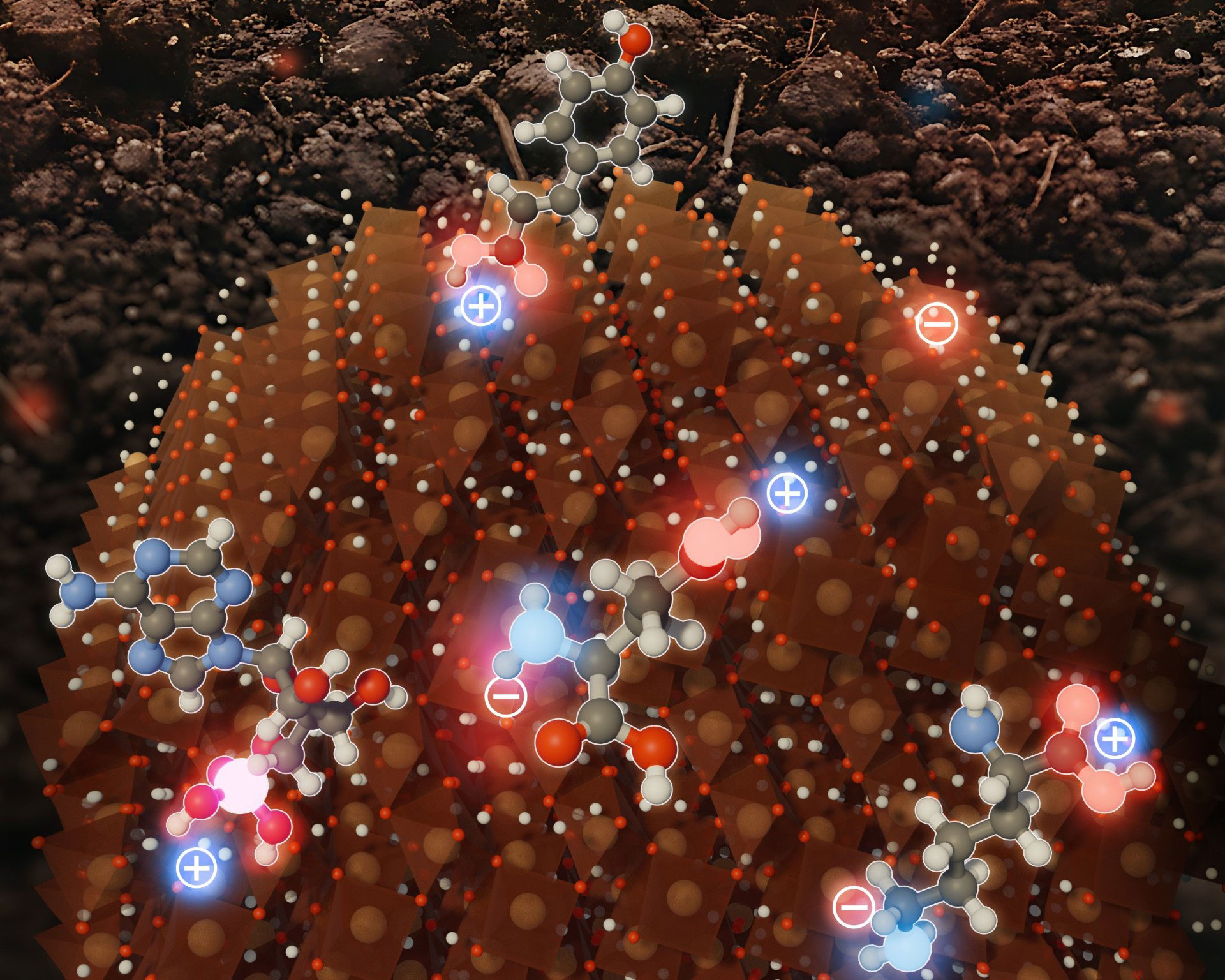
The researchers also discovered that ferrihydrite’s electrical properties are more complex than previously assumed. While the mineral carries an overall positive charge, its surface is made up of tiny regions with both positive and negative charges. In addition to electrical attraction, ferrihydrite binds carbon through stronger chemical bonds and hydrogen bonding, creating durable connections with organic compounds.
This combination of binding methods allows iron oxide minerals to interact with a wide range of organic molecules. As a result, they can preserve carbon in soils for decades or even centuries, reducing the amount that returns to the atmosphere as climate-warming greenhouse gases.
The study was published in the journal Environmental Science & Technology. It offers the most detailed examination so far of ferrihydrite’s surface chemistry and its role as a key type of iron oxide minerals.
“Iron oxide minerals are important for controlling the long-term preservation of organic carbon in soils and marine sediments,” said Northwestern’s Ludmilla Aristilde, who led the study. “The fate of organic carbon in the environment is tightly linked to the global carbon cycle, including the transformation of organic matter to greenhouse gases. Therefore, it’s important to understand how minerals trap organic matter, but the quantitative evaluation of how iron oxides trap different types of organic matter through different binding mechanisms has been missing.”
An expert in the dynamics of organics in environmental processes, Aristilde is a professor of civil and environmental engineering at Northwestern’s McCormick School of Engineering. She also is a member of the International Institute for Nanotechnology, the Paula M. Trienens Institute for Sustainability and Energy and Center for Synthetic Biology. Jiaxing Wang is the study’s first author, and Benjamin Barrios Cerda is the study’s second author. Both Wang and Barrios Cerda are currently postdoctoral associates in Aristilde’s laboratory.
Keeping carbon buried
Holding approximately 2,500 billion tons of sequestered carbon, soil is one of Earth’s largest carbon sinks — second only to the ocean. But even though soil is all around us, scientists are only just beginning to understand how it locks in carbon to remove it from the active carbon cycle.
By combining laboratory experiments with theoretical modeling, Aristilde and her team have spent years studying minerals and soil-dwelling microbes with the goal of determining the factors that cause soil to either trap or release carbon. In previous works, Aristilde and her team explored how clay minerals bind organic matter and how soil microbes preferentially turn non-sugar organics into carbon dioxide.
In the new study, Aristilde’s group turned its focus to iron oxide minerals, which are associated with more than one-third of the organic carbon stored in soils. Specifically, the team examined ferrihydrite, a type of iron oxide mineral commonly found in soils near plant roots or in soils and sediments with abundant organic matter. Although ferrihydrite appears to be positively charged under many environmental conditions, it manages to bind a wide variety of organic compounds — some negatively charged, some positively charged and some neutral.
Watching molecules stick
To understand how this occurs, Aristilde and her team first used high-resolution molecular modeling and atomic force microscopy to gain a detailed look at the mineral’s surface. While the mineral’s charge is positive overall, the researchers found its surface actually contains intermixed patches of positive and negative charges. The finding explains why ferrihydrite can attract negatively charged species like phosphate and positively charged species like metal ions.
“It is well documented that the overall charge of ferrihydrite is positive in relevant environmental conditions,” Aristilde said. “That has led to assumptions that only negatively charged compounds will bind to these minerals, but we know the minerals can bind compounds with both negative and positive charges. Our work illustrates that it is the sum of both negative and positive charges distributed across the surface that gives the mineral its overall positive charge.”
After mapping ferrihydrite’s surface charges, Aristilde and her team tested how molecules bind to it, allowing them to connect surface chemistry directly to carbon trapping. They introduced ferrihydrite to organic molecules commonly found in soils, including amino acids, plant acids, sugars, and ribonucleotides. Then, they measured how much of these molecules stuck to the ferrihydrite and used infrared spectroscopy to examine exactly how each molecule attached.
More than attraction
Ultimately, the team found that compounds bind to ferrihydrite using multiple strategies. While positively charged amino acids bonded to negative patches on ferrihydrite’s surface, negatively charged amino acids bonded to the positively charged patches. Other compounds, like ribonucleotides, are first drawn to ferrihydrite by electrostatic attraction and then go on to form much stronger chemical bonds with iron atoms. And sugars, which form the weakest bonds, are attached to the mineral through hydrogen bonding.
“Collectively, our findings provide a rationale, on a quantitative basis, for building a framework for the mechanisms that drive mineral-organic associations involving iron oxides in the long-term preservation of organic matter,” Aristilde said. “These associations may help explain why some organic molecules remain protected in soils while others are more vulnerable to being broken down and respired by microbes.”
Next, the team plans to investigate what happens after organic molecules are attached to mineral surfaces. Some compounds may undergo chemical transformations to products that are available for further degradation or to even more stable products that could be resistant to decomposition.
Reference: “Surface Charge Heterogeneity and Mechanisms of Organic Binding Modes on an Iron Oxyhydroxide” by Jiaxing Wang, Benjamin Barrios-Cerda and Ludmilla Aristilde, 15 December 2025, Environmental Science & Technology.
DOI: 10.1021/acs.est.5c10850
The study was supported by the U.S. Department of Energy and the International Institute for Nanotechnology.
Never miss a breakthrough: Join the SciTechDaily newsletter.
Follow us on Google and Google News.