
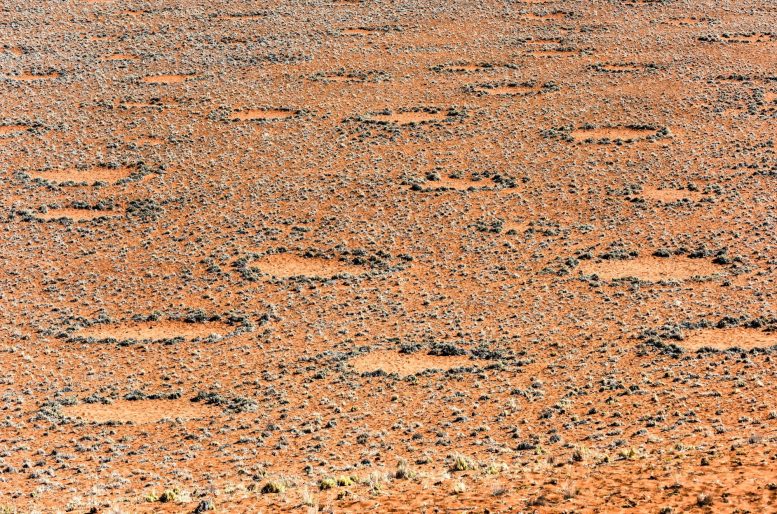
Research indicates that fairy circles, previously identified only in Namibia and Australia, have now been discovered in over 250 sites across 15 nations and three continents.
Among the most captivating and mysterious natural phenomena in the world’s arid regions are fairy circles.
These enigmatic circles appear as bare patches of soil encircled by rings of vegetation and, until recently, were documented only in Namibia and Australia.
Over the years, multiple hypotheses have been proposed to explain their formation, which has given rise to numerous discussions about the mechanisms that give rise to them. However, until now, we did not know the global dimension of this type of phenomena and the environmental factors that explain them.
Until now, the climatic, edaphic, and environmental factors that determine their distribution on a global scale have not been analyzed because they were only known in Namibia and part of Australia.
“Analyzing their effects on the functioning of ecosystems and discovering the environmental factors that determine their distribution is essential to better understand the causes of the formation of these vegetation patterns and their ecological importance,” says Emilio Guirado, principal investigator of the study, belonging to the Laboratory of Ecology of Arid Zones and Global Change at the University of Alicante (UA).
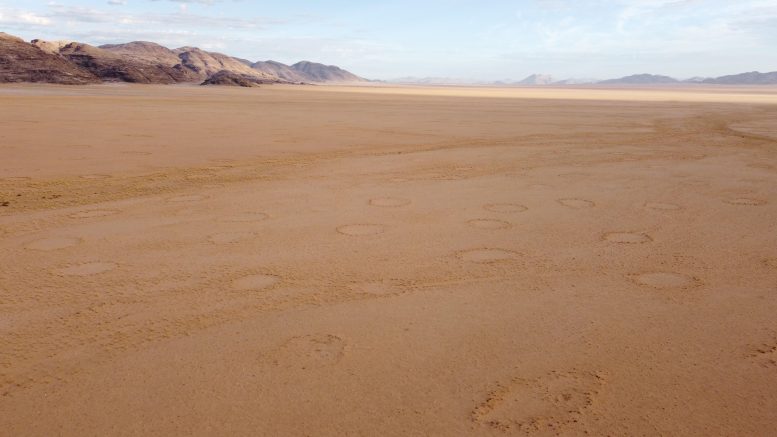
With the help of artificial intelligence-based models, the scientists classified satellite images and obtained 263 sites where patterns similar to the fairy circles described to date, those of Namibia and Western Australia, including the Sahel, Western Sahara, the Horn of Africa, Madagascar, Southwest Asia or Central Australia, can be observed.
“Our study provides evidence that fairy-circle are far more common than previously thought, which has allowed us, for the first time, to globally understand the factors affecting their distribution,” highlights Manuel Delgado Baquerizo, leader of the IRNAS-CSIC BioFunLab and co-author of this study.
Climate and Soil Conditions Influencing Fairy Circles
The researchers found that the combination of certain soil and climate characteristics, such as low nitrogen content and an average rainfall of less than 200 mm/year, were associated with the presence of fairy circles.
“This study has taken into account multiple variables hitherto not considered, such as albedo or the state of the aquifers. This is a particularly relevant factor, since the massive use of groundwater in arid areas around the world, including deserts, could disturb these formations,” says Jaime Martínez-Valderrama of the EEZA-CSIC.
Fairy Circles and Ecosystem Stability
The researchers also compared the stability of primary productivity of fairy circle vegetation with that of other ecosystems and found greater stability when fairy circles were present.
“These results provide the first empirical evidence of increased stability of fairy circle productivity, a key property of ecosystems that is related to the stable provision of ecosystem services such as the amount of forage,” indicates Fernando T. Maestre, UA professor and director of the Laboratory of Arid Zone Ecology and Global Change.
“These results also open the door to research on whether these spatial patterns can be indicators of ecosystem degradation with climate change, as is the case for other spatial patterns of vegetation in arid zones,” says Miguel Berdugo, co-author of the study.
This study makes available a global atlas of fairy circles and a database that could be useful in determining whether fairy circle vegetation patterns are more resilient to climate change and other disturbances.
“We hope that these unpublished data will be useful for those interested in comparing the dynamic behavior of these patterns with others present in arid areas around the world,” concludes Emilio Guirado.
Reference: “The global biogeography and environmental drivers of fairy circles” by Emilio Guirado, Manuel Delgado-Baquerizo, Blas M. Benito, José Luis Molina-Pardo, Miguel Berdugo, Jaime Martínez-Valderrama and Fernando T. Maestre, 25 September 2023, Proceedings of the National Academy of Sciences.
DOI: 10.1073/pnas.2304032120
Never miss a breakthrough: Join the SciTechDaily newsletter.
Follow us on Google and Google News.