
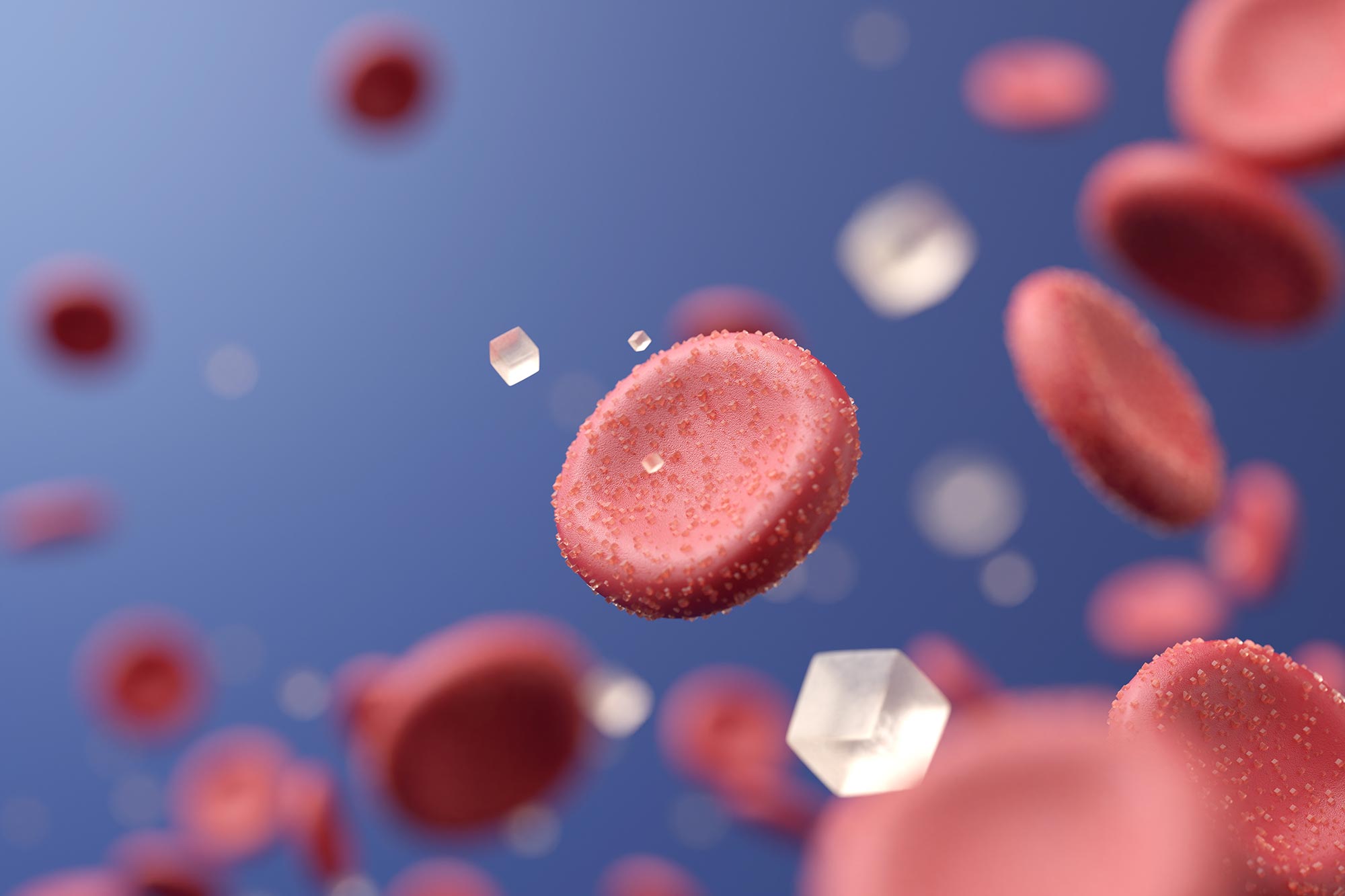
The drug candidate shows promise in filling existing treatment gaps.
A new experimental drug has been shown to lessen cell damage, inflammation, and organ injury linked to diabetes.
In research led by scientists at NYU Langone Health, tests in mice revealed that the potential treatment stops two proteins, RAGE and DIAPH1, from interacting. This specific connection contributes to heart and kidney damage in diabetes and can delay wound healing.
Featured as a cover story in Cell Chemical Biology, the study found that blocking DIAPH1 from binding to RAGE helped reduce tissue swelling and promote faster recovery. Experiments in both human cells and mice demonstrated that the compound, called RAGE406R, lowered both immediate and long-term complications associated with Type 1 and Type 2 diabetes. RAGE406R is a small molecule designed to target the RAGE protein.
“There are currently no treatments that address the root causes of diabetic complications, and our work shows that RAGE406R can – not by lowering the high blood sugar, but instead by blocking the intracellular action of RAGE,” said co-senior study author Ann Marie Schmidt, MD, the Dr. Iven Young Professor of Endocrinology at the NYU Grossman School of Medicine. “If confirmed by further testing in human trials, the compound could potentially fill gaps in treatment, including that most current drugs work only against Type 2 diabetes.”
Harmful Interaction
RAGE is a receptor, a protein type that interacts with signaling molecules called advanced glycation end products (AGEs). Created when proteins or fats attach to sugars in people with diabetes, AGEs build up in the blood of those with diabetes and obesity, and as part of normal aging.
Experiments showed that the RAGE406R compound competes for the site on RAGE that would otherwise be occupied by DIAPH1, which builds actin filaments that form part of the cell’s skeleton. The research team showed that DIAPH1 attaches inside cells to the tail end of RAGE. This DIAPH1-RAGE complex then increases the formation of actin structures that worsen diabetic complications.
Previously, Schmidt’s team screened a library of more than 58,000 molecules and found a subset that competitively inhibited RAGE-DIAPH1 signaling. Its prior lead drug candidate, RAGE229, failed a standard test that detects if a drug has structure that may possibly change DNA code to create cancer risk. RAGE406R effectively eliminates the risk-creating part of RAGE229’s structure.
The team tested RAGE406R in a lead model of chronic diabetes complications, which is impaired wound healing in obese mice with Type 2 diabetes. The data revealed that in both male and female diabetic mice, topical treatment with RAGE406R accelerated wound closure.
The results revolve around the body’s immune system, which recognizes and destroys invading bacteria and viruses. This system’s activation causes inflammation — responses such as swelling that result from immune cells homing in on sites of infection or injury. Many diseases, including diabetes, feature misplaced inflammation. RAGE406R lowered levels of a key proinflammatory immune signaling chemical, the chemokine CCL2, which damped down inflammation in immune cells called macrophages. This, in turn, increased tissue structural changes that occur as part of healing.
“Our findings point to a promising new pathway for treating diabetes in the future,” said co-senior study author Alexander Shekhtman, PhD, a professor in the Department of Chemistry at the State University of New York (SUNY) at Albany. “The current study results serve as a springboard for the development of therapies for both types of diabetes, and for designing markers that can measure how well the new treatment works in live animals.”
Reference: “RAGE-mediated activation of the formin DIAPH1 and human macrophage inflammation are inhibited by a small molecule antagonist” by Gregory G. Theophall, Michaele B. Manigrasso, Parastou Nazarian, Aaron Premo, Sergey Reverdatto, Gautham Yepuri, David S. Burz, Sally M. Vanegas, Kaamashri Mangar, Yanan Zhao, Huilin Li, Robert J. DeVita, Ravichandran Ramasamy, Ann Marie Schmidt and Alexander Shekhtman, 1 October 2025, Cell Chemical Biology.
DOI: 10.1016/j.chembiol.2025.09.004
This work was supported by U.S. Public Health Service grants 1R24DK103032, 1R01DK122456-01A1, P01HL146367, and 5R01GM085006. The NYU Histology Core is partly supported by Perlmutter Cancer Center support grant P30CA016087. Support was also provided by the Diabetes Research Program at the NYU Grossman School of Medicine.
Drs. Manigrasso, Ramasamy, and Schmidt are named on patent applications owned by NYU Langone Health that cover the work detailed in the current study manuscript. The study authors’ relationship to this intellectual property is being managed in accordance with the policies of NYU Langone Health. Dr. DeVita, a consultant for NYU Technology Opportunities & Ventures’ Therapeutics Alliances and for Intercept Therapeutics, was compensated for this project.
Never miss a breakthrough: Join the SciTechDaily newsletter.
Follow us on Google and Google News.
2 Comments
Sorry, big pharma, the root cause is diet.
Where can we get this