
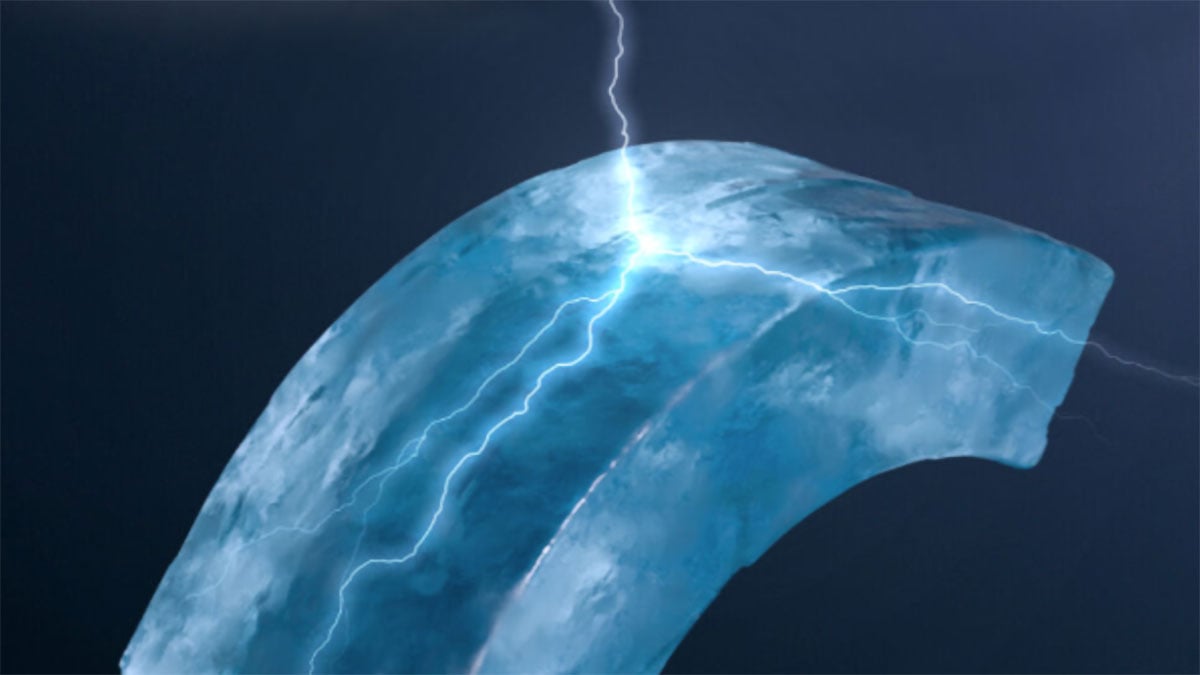
Ice can generate electricity when bent, a process called flexoelectricity. The discovery connects to lightning formation and future device applications.
Ice is among the most common materials on Earth, covering glaciers, mountain ranges, and the polar regions. Despite its familiarity, ongoing research continues to uncover surprising aspects of its behavior.
A team from ICN2 at the UAB campus, Xi’an Jiaotong University (Xi’an), and Stony Brook University (New York) has demonstrated for the first time that regular ice displays flexoelectricity. This means it can produce an electrical charge when mechanically bent or unevenly deformed. The finding has potential applications in future technologies and may also help clarify natural processes such as the formation of lightning during storms.
The work, published in Nature Physics, represents a major advance in understanding the electromechanical behavior of ice.
“We discovered that ice generates electric charge in response to mechanical stress at all temperatures. In addition, we identified a thin ‘ferroelectric’ layer at the surface at temperatures below -113ºC (160K). This means that the ice surface can develop a natural electric polarization, which can be reversed when an external electric field is applied—similar to how the poles of a magnet can be flipped. The surface ferroelectricity is a cool discovery in its own right, as it means that ice may have not just one way to generate electricity but two: ferroelectricity at very low temperatures, and flexoelectricity at higher temperatures all the way to 0 °C,” said Dr Xin Wen, a lead researcher from the ICN2 Oxide Nanophysics Group.
This dual ability places ice alongside electroceramic materials such as titanium dioxide, which are already employed in advanced technologies like sensors and capacitors.
Ice, flexoelectricity, and thunderstorms
One of the most striking outcomes of this research is its link to natural processes. The findings indicate that the flexoelectric behavior of ice may contribute to the buildup of electrical charge in storm clouds, potentially playing a part in how lightning is generated.
It is known that lightning forms when an electric potential builds up in clouds due to collisions between ice particles, which become electrically charged. This potential is then released as a lightning strike. However, the mechanism by which ice particles become electrically charged has remained unclear, since ice is not piezoelectric — it cannot generate charge simply by being compressed during a collision.
However, the study shows that ice can become electrically charged when it is subjected to inhomogeneous deformations, i.e. when it bends or deforms irregularly.
“During our research, the electric potential generated by bending a slab of ice was measured. Specifically, the block was placed between two metal plates and connected to a measuring device. The results match those previously observed in ice-particle collisions in thunderstorms,” explains ICREA Prof. Gustau Catalán, leader of the Oxide Nanophysics Group at ICN2.
Implications and future applications
Thus, the results suggest that flexoelectricity could be one possible explanation for the generation of the electric potential that leads to lightning during storms.
The researchers in the group are already exploring new lines of investigation aimed at exploiting these properties of ice for real-world applications. Although it is still a bit early to discuss potential solutions, this discovery could pave the way for the development of new electronic devices that use ice as an active material, which could be fabricated directly in cold environments.
Reference: “Flexoelectricity and surface ferroelectricity of water ice” by X. Wen, Q. Ma, A. Mannino, M. Fernandez-Serra, S. Shen and G. Catalan, 27 August 2025, Nature Physics.
DOI: 10.1038/s41567-025-02995-6
Never miss a breakthrough: Join the SciTechDaily newsletter.
Follow us on Google and Google News.
4 Comments
“Upper Entropy Congestion+Ion Exchange through Biomass=Insulation Inheritance”
this has given me an idea.. what about using a computer chip based on dry ice and nitrogen. I would study the electron I said dfry ice and work for number pattern and use it for AI as long as the dry ice could be replenished by the nitrogen
Also replying to the comment above…
alithoth chlorine to entripy as a replenishing mechinism
…or chloride wtth properties of sugar to stablize