
Researchers at the European XFEL and DESY are investigating unusual forms of ice that can exist at room temperature when subjected to extreme pressure.
Ice comes in many forms, even when made of nothing but water molecules. Scientists have now identified more than 20 unique solid structures, or “phases,” of ice, each with its own molecular arrangement. These variations are labeled with Roman numerals, such as ice I, ice II, and ice III.
In a recent breakthrough, an international team of researchers led by scientists from the Korea Research Institute of Standards and Science (KRISS) has discovered a completely new phase known as ice XXI. Using advanced X-ray facilities at the European XFEL and PETRA III, the team captured and analyzed this previously unknown structure. Their findings have been published in Nature Materials.
Ice XXI is unlike any other form of ice observed so far. It develops when liquid water is subjected to rapid compression, creating what scientists call “supercompressed water” at room temperature. This phase is metastable, meaning it can persist for a time even though another type of ice would normally be more stable under the same conditions. The discovery provides valuable new insights into how ice behaves and transforms under extreme pressure.
The Complexity of a Simple Molecule
Water or H2O, despite being composed of just two elements, exhibits remarkable complexity in its solid state. The majority of the phases are observed at high pressures and low temperatures. The team has learned more about how the different ice phases form and change with pressure.
“Rapid compression of water allows it to remain liquid up to higher pressures, where it should have already crystallized to ice VI,” KRISS scientist Geun Woo Lee explains. Ice VI is an especially intriguing phase, thought to be present in the interior of icy moons such as Titan and Ganymede. Its highly distorted structure may allow complex transition pathways that lead to metastable ice phases.
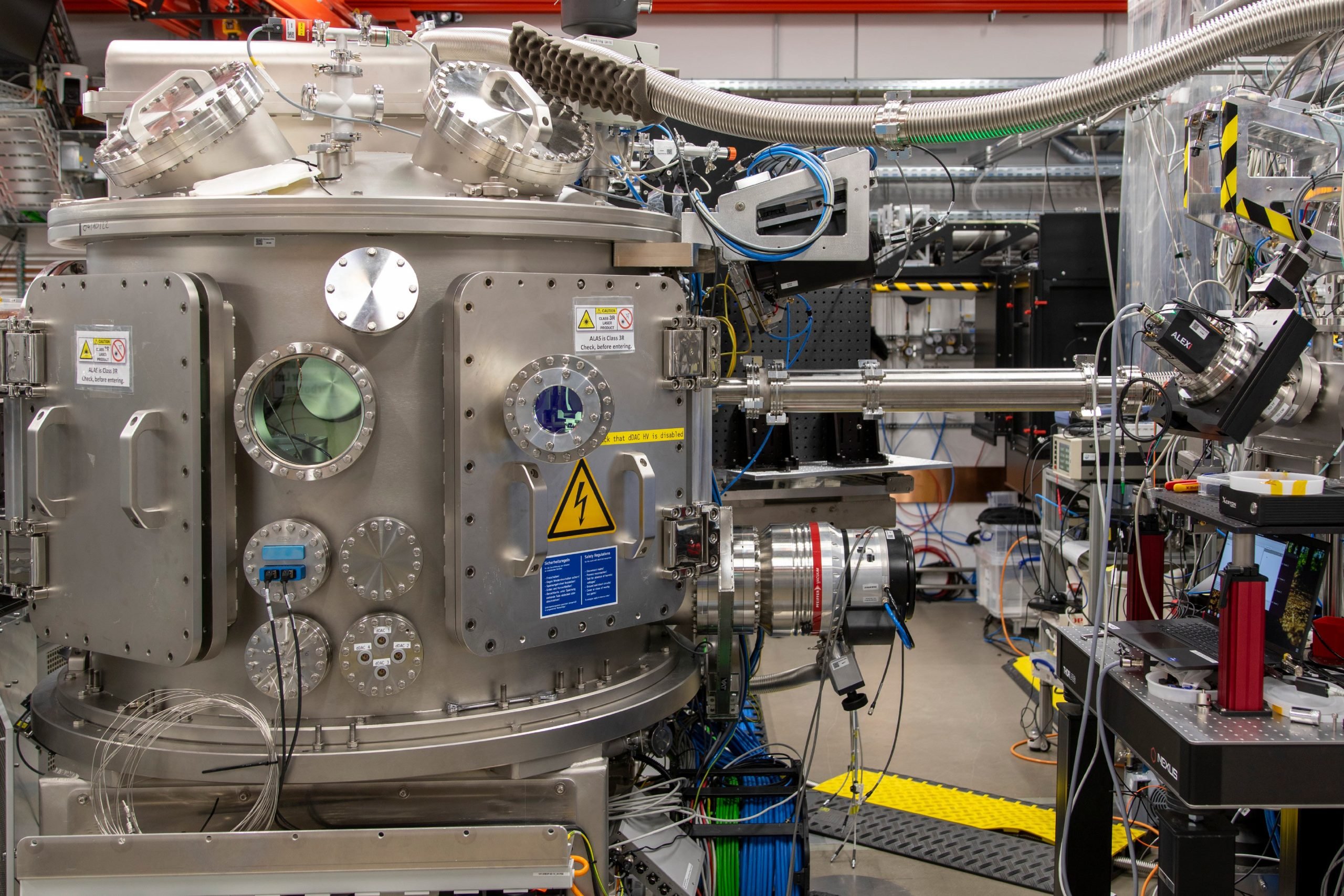
Because most ice variants exist only under extreme conditions, the researchers created high-pressure conditions using diamond anvil cells. The sample – in this case, water – is placed between two diamonds, which can be used to build up very high pressure due to their hardness. Water was examined under pressures of up to two gigapascals, which is about 20,000 times more than normal air pressure. This causes ice to form even at room temperature, but the molecules are much more tightly packed than in normal ice.
In order to observe ice formation under different pressure conditions, the researchers first generated a high pressure of two gigapascals within 10 milliseconds (a millisecond is one thousandth of a second). They then released the anvil cell over a period of 1 second, then repeated the process. During these cycles, the team used the X-ray flashes of the European XFEL to capture images of the sample every microsecond – one millionth of a second. With its extremely high rate of X-ray pulses – working like a high-speed camera – they could make movies of how the ice structure formed.
Crystallizing the Discovery
Then, using the P02.2 beamline at PETRA III, the researchers determined that ice XXI has a tetragonal crystal structure built of surprisingly large repetitive units, called unit cells.
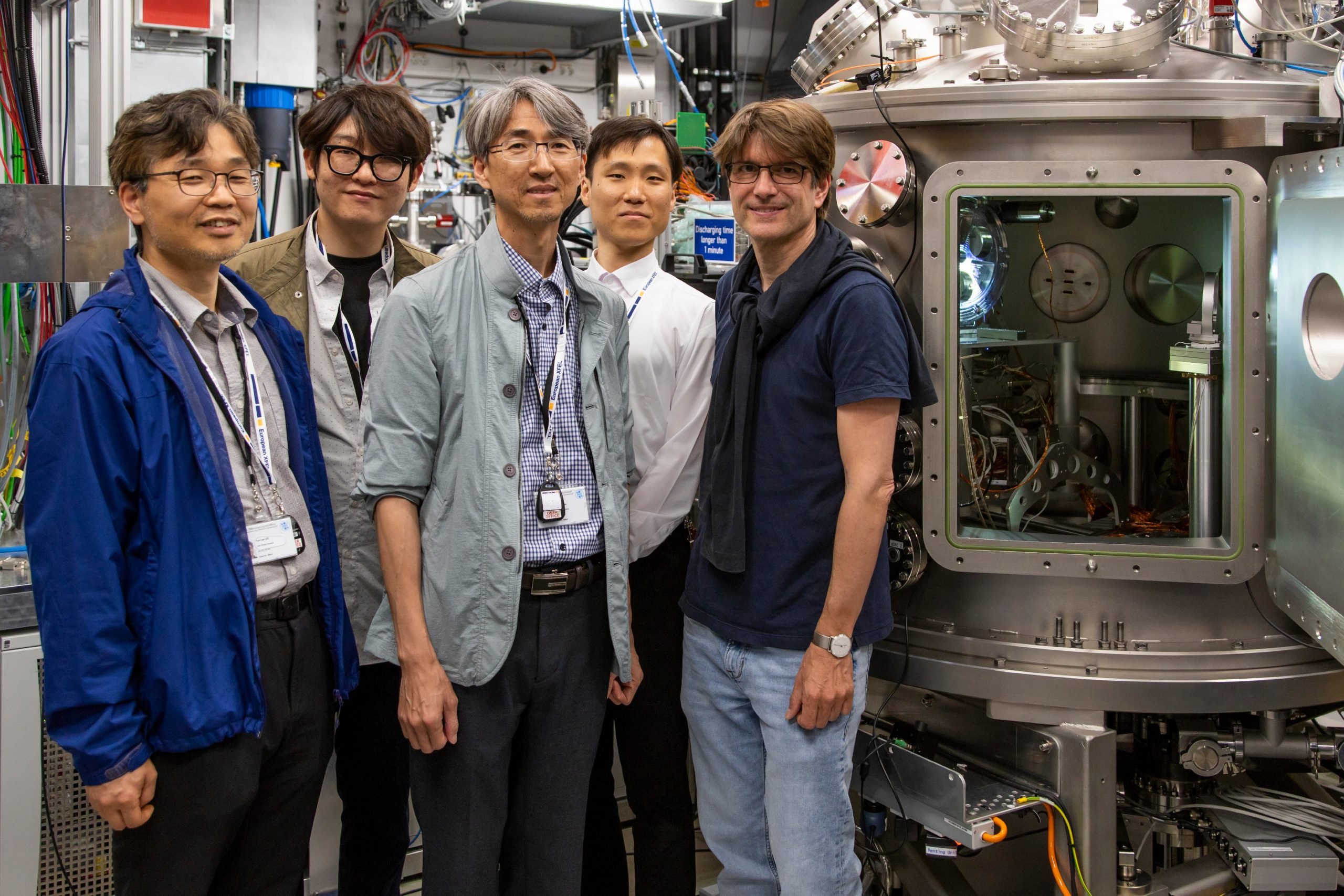
“With the unique X-ray pulses of the European XFEL, we have uncovered multiple crystallization pathways in H2O which was rapidly compressed and decompressed over 1000 times using a dynamic diamond anvil cell,” explains Lee. “In this special pressure cell, samples are squeezed between the tips of two opposing diamond anvils and can be compressed along a predefined pressure pathway,” states Cornelius Strohm from the DESY HIBEF team that implemented this set-up at the High Energy Density (HED) instrument of European XFEL.
“The structure in which liquid H2O crystallizes depends on the degree of supercompression of the liquid,” says Lee. “Our findings suggest that a greater number of high-temperature metastable ice phases and their associated transition pathways may exist, potentially offering new insights into the composition of icy moons,” Rachel Husband from the DESY HIBEF team adds.
Both DESY and European XFEL are making concerted efforts to better understand water: DESY through the joint effort Centre for Molecular Water Science, and European XFEL through its Water Call, from which this research was performed. Sakura Pascarelli, Scientific Director at European XFEL notes: “It is fantastic to see another great outcome from our Water Call, an initiative inviting scientists to propose innovative studies on water. We are looking forward to many more exciting discoveries ahead.”
Reference: “Multiple freezing–melting pathways of high-density ice through ice XXI phase at room temperature” by Yun-Hee Lee, Jin Kyun Kim, Yong-Jae Kim, Minju Kim, Yong Chan Cho, Rachel J. Husband, Cornelius Strohm, Emma Ehrenreich-Petersen, Konstantin Glazyrin, Torsten Laurus, Heinz Graafsma, Robert P. C. Bauer, Felix Lehmkühler, Karen Appel, Zuzana Konôpková, Minxue Tang, Anand Prashant Dwivedi, Jolanta Sztuck-Dambietz, Lisa Randolph, Khachiwan Buakor, Oliver Humphries, Carsten Baehtz, Tobias Eklund, Lisa Katharina Mohrbach, Anshuman Mondal, Hauke Marquardt, Earl Francis O’Bannon, Katrin Amann-Winkel, Choong-Shik Yoo, Ulf Zastrau, Hanns-Peter Liermann, Hiroki Nada and Geun Woo Lee, 10 October 2025, Nature Materials.
DOI: 10.1038/s41563-025-02364-x
Never miss a breakthrough: Join the SciTechDaily newsletter.
Follow us on Google and Google News.
5 Comments
thank you for this
If it shouldn’t exist then they shouldn’t have discovered it.
Scientists Discover a New Form of Ice That Shouldn’t Exist.
VERY GOOD!
Scientists, please think deeply:
1. Do you think the reasons that should not exist are scientific and correct?
2. Are the theories and dogmas you believe in scientific or pseudoscientific?
Using advanced X-ray facilities at the European XFEL and PETRA III, the team captured and analyzed this previously unknown structure. Unknown does not mean it Shouldn’t Exist.
As P. W. Anderson pointed out in his classic paper “More is Different”: “The ability to reduce everything to simple fundamental laws does not imply the ability to start from those laws and reconstruct the entire universe.” The richness and diversity of nature are not a negation of the fundamental laws but rather a rich expression thereof. “More” is not just a quantitative increase but also a qualitative transition. Differences are not merely oppositions but also diverse manifestations of unity.
Ah, the resident moron is back with a non-sequitur, as usual.
Thank you for browsing. It has nothing to do with intelligence.
Topological Vortex Theory (TVT) paints a brand new picture of the quantum world:
1. It puts an end to the metaphorical fallacy of the “dead-and-alive cat,” redefining the quantum as an objective entity with a topological structure.
2. It unifies spacetime structure and the energy unit into the topological vortex, providing a solid and intuitive geometric basis for quantization phenomena.
3. It perfectly interprets quantum spin through the spin dynamics of the vortex, reducing an abstract mathematical property to concrete geometric motion.
4. By introducing the philosophical distinction between the “noumenon” and “phenomenon,” it settles accounts with the residual subjectivism in traditional quantum theory, establishing a thoroughly objective and realist quantum ontology.
This theoretical framework not only holds the potential to mathematically unify general relativity and quantum mechanics (as both originate from the geometric properties of spacetime) but also philosophically heralds a fundamental paradigm shift. It suggests that the future of quantum theory will no longer be entangled in the epistemological labyrinth of “how to observe,” but will courageously explore the grand ontological landscape of the “thing-in-itself” universe composed of topological vortices, which exists independently of us.
——Excerpted from https://t.pineal.cn/blogs/4643/The-quantum-is-not-a-cat-that-is-both-dead.