
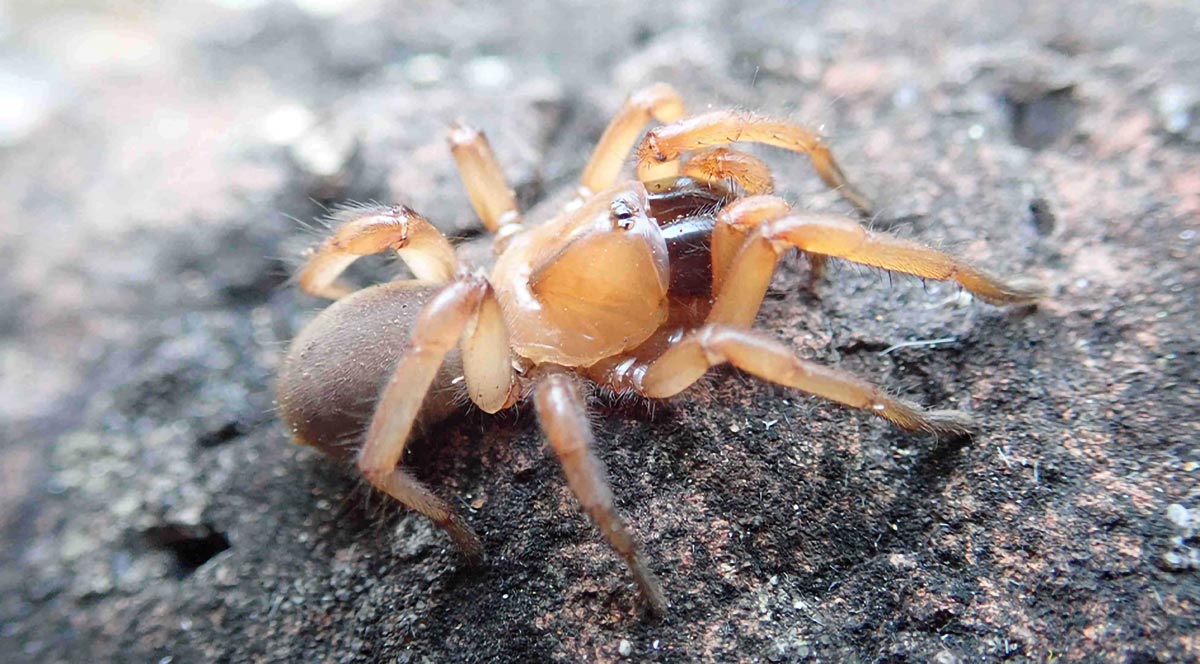
Researchers discovered two new species of trapdoor spiders in northern Australia with uniquely engineered burrows, enhancing understanding of biodiversity in the region.
A team of scientists, led by The University of Western Australia, has identified two new species of trapdoor spiders in the Kimberley region, marking the first recorded discovery of this spider group in northern Australia.
The newly described species, Kwonkan fluctellus and Kwonkan nemoralis, were detailed in a recent publication in the Australian Journal of Taxonomy. Their discovery contributes significantly to the scientific understanding of Australia’s diverse and often unique spider fauna.
The research was led by Dr. Jeremy Wilson, a postdoctoral fellow in UWA’s School of Biological Sciences and a research associate at the Western Australian Museum. The spiders were discovered during a 2022 Bush Blitz expedition to the remote northern Kimberley, supported by the Australian Government.

“We didn’t discover these spiders in the typical dry savannah landscapes the Kimberley is known for, but instead the specimens we found of Kwonkan nemoralis, which grows to around the size of a 20-cent coin, were located deep within a gorge that shelters patches of richer forest,” Dr Wilson said.
“These wetter forest patches are quite small and usually sheltered by the gorge so when you enter them, it’s a completely different environment – much more humid, with a different collection of plant species.”
Unique Microhabitats
According to Dr Wilson, what makes the spiders fascinating is their highly specialized burrow construction.
“Unlike most related species that build simple open entrances to their burrows, spiders of the Kwonkan genus create elaborate burrow entrances with unique features,” Dr Wilson said.
“We were exploring along a small creek when we noticed distinctive circular burrows in the sandy banks.
“The burrows constructed by the Kwonkan nemoralis had a little collapsible silken collar around the entrance, which had grains of sand embedded in it and were unlike anything we’d seen before – clever engineering that serves multiple functions.”

He continues, “When disturbed, the collar around the burrow’s entrance collapses and seals the entrance, while the sand blends perfectly with the surrounding landscape, making it virtually invisible to predators.
“One question we’re particularly interested in is why they build these unusual, modified entrances and whether they may be adaptions to specific hunting strategies, or for defending against predators such as scorpions, centipedes, and wasps, which we know hunt these spiders.”
Dr Wilson said the design may also protect the spiders during unexpected flooding events in arid areas.
The discovery of the two new species contributes to Taxonomy Australia, a national initiative under the Australian Academy of Science that aims to document Australia’s biodiversity within a generation.
Reference: “Two new species of the mygalomorph spider genus Kwonkan (Mygalomorphae: Anamidae) from the Kimberley region of Western Australia” by Jeremy D. Wilson, Michael G. Rix and Mark S. Harvey, 2025, Australian Journal of Taxonomy.
DOI: 10.54102/ajt
Never miss a breakthrough: Join the SciTechDaily newsletter.
Follow us on Google and Google News.
2 Comments
KiII them with fire!
A team of scientists great research !