
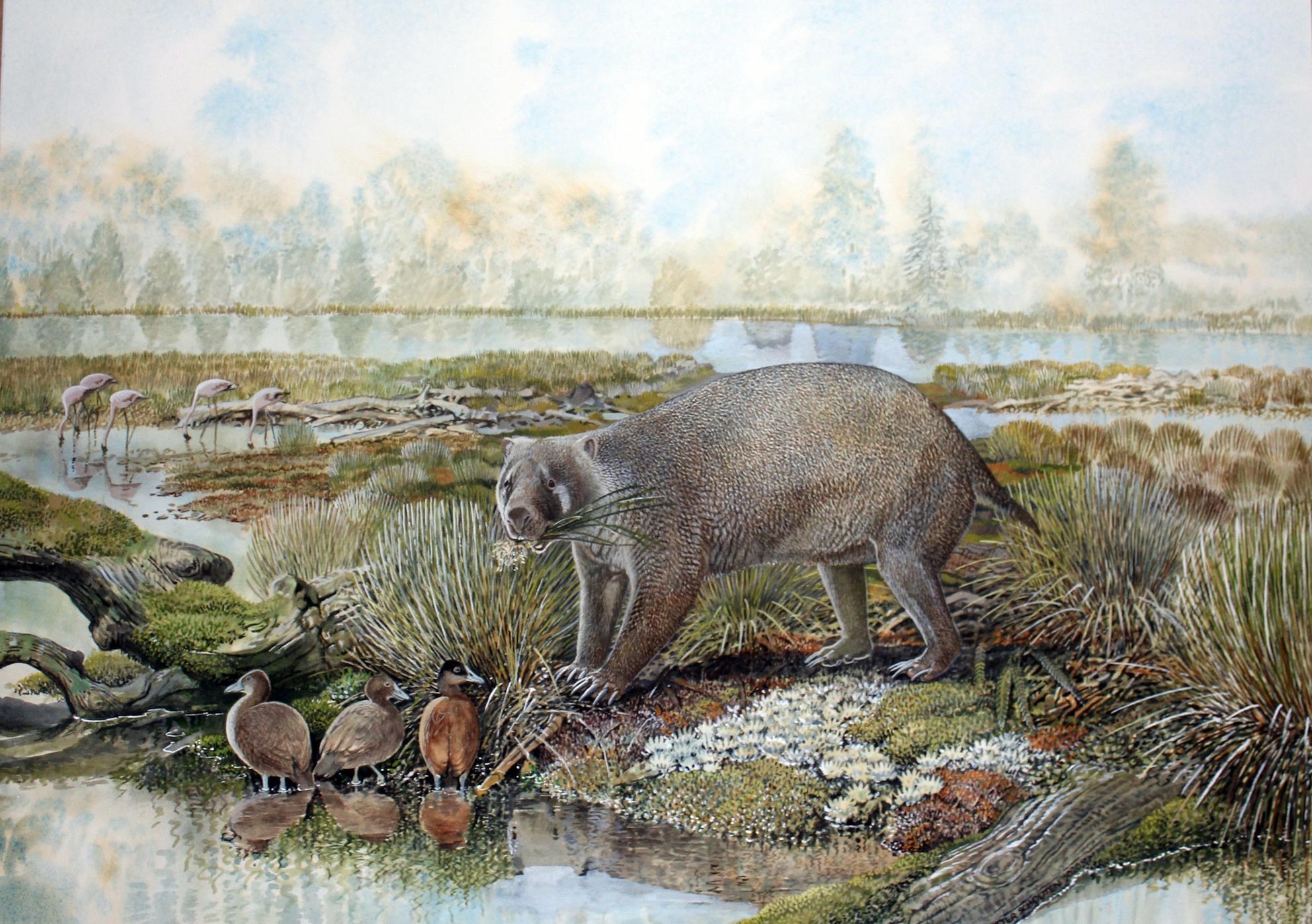
A giant marsupial that roamed prehistoric Australia 25 million years ago is so different from its wombat cousins that scientists have had to create a new family to accommodate it.
The unique remains of a prehistoric, giant wombat-like marsupial – Mukupirna nambensis – that was unearthed in central Australia are so different from all other previously known extinct animals that it has been placed in a whole new family of marsupials.
Mukupirna – meaning “big bones” in the Dieri and Malyangapa Aboriginal languages – is described in a paper published on June 25, 2020, in Scientific Reports by an international team of paleontologists including researchers from the UNSW Sydney, Salford University in the UK, Griffith University in Brisbane, the Natural History Museum in London, and the American Museum of Natural History in New York. The researchers reveal that the partial skull and most of the skeleton discovered originally in 1973 belonged to an animal more than four times the size of any living wombats today and may have weighed about 150kg.
An analysis of Mukupirna’s evolutionary relationships reveals that although it was most closely related to wombats, it is so different from all known wombats as well as other marsupials, that it had to be placed in its own unique family, Mukupirnidae.
Lucky break
UNSW Science’s Professor Mike Archer, a co-author on the paper, was part of the original international team of paleontologists along with Professor Dick Tedford, another co-author, that found the skeleton in 1973 in the clay floor of Lake Pinpa – a remote, dry salt lake east of the Flinders Ranges in South Australia. He says their discovery of Mukupirna was in part due to good luck after an unusual change in local conditions exposed the 25 million-year-old fossil deposit on the floor of the dry salt lake.
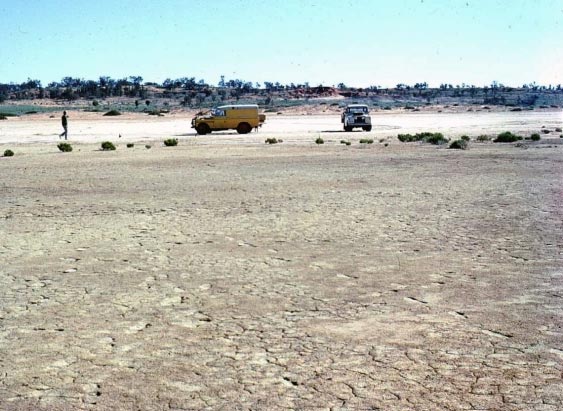
“It was an extremely serendipitous discovery because in most years the surface of this dry lake is covered by sands blown or washed in from the surrounding hills,” he says.
“But because of rare environmental conditions prior to our arrival that year, the fossil-rich clay deposits were fully exposed to view. And this unexpected view was breathtaking.
“On the surface, and just below we found skulls, teeth, bones, and in some cases, articulated skeletons of many new and exotic kinds of mammals. As well, there were the teeth of extinct lungfish, skeletons of bony fish, and the bones of many kinds of water birds including flamingos and ducks.
“These animals ranged from tiny carnivorous marsupials about the size of a mouse right up to Mukupirna which was similar in size to a living black bear. It was an amazingly rich fossil deposit full of extinct animals that we’d never seen before.”
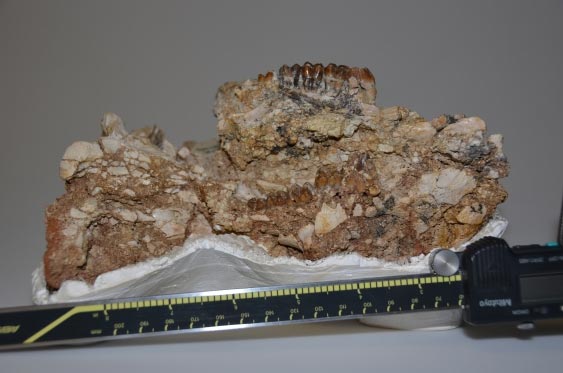
The skull of Mukupirna. Although badly fragmented it preserves the dentition and basic features of the head. The snout is to the right while the rounded occipital condyle at the back of the skull, which articulated with the backbone, is visible at the left. Credit: Julien Louys / UNSW
Gentle giant
Professor Archer says when Mukupirna’s skeleton was first discovered just below the surface, nobody had any idea what kind of animal it was because it was solidly encased in clay.
“We found it by probing the dry flat surface of the Lake with a thin metal pole, like acupuncturing the skin of Mother Earth. We only excavated downwards into the clay if the pole contacted something hard below the surface – and in this case it turned out to be the articulated skeleton of a most mysterious new creature.”
The researchers’ recent study of the partial skull and skeleton reveals that despite its bear-like size, Mukupirna was probably a gentle giant. Its teeth indicate that it subsisted only on plants, while its powerful limbs suggest it was probably a strong digger. However, a close examination of its features revealed the creature was more likely suited to scratch-digging, and unlikely to have been a true burrower like modern wombats, the authors say.
Lead author on the paper Dr Robin Beck from the University of Salford says Mukupirna is one of the best-preserved marsupials to have emerged from late Oligocene Australia (about 25 million years ago).
“Mukupirna clearly was an impressive, powerful beast, at least three times larger than modern wombats,” he says. “It probably lived in an open forest environment without grasses, and developed teeth that would have allowed it to feed on sedges, roots, and tubers that it could have dug up with its powerful front legs.”
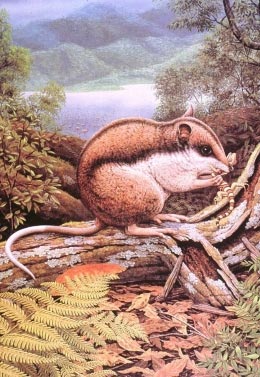
Central Australia was green 25 million years ago with vast freshwater lakes surrounded by forests, but no grasslands. An archaic, omnivorous kangaroo, a contemporary of Mukupirna nambensis, gobbles a gecko in the foreground. Credit: Rod Scott / UNSW
Seriously strange
Griffith University’s Associate Professor Julien Louys, who co-authored the study, said “the description of this new family adds a huge new piece to the puzzle about the diversity of ancient, and often seriously strange marsupials that preceded those that rule the continent today.”
The scientists examined how body size has evolved in vombatiform marsupials – the taxonomic group that includes Mukupirna, wombats, koalas, and their fossil relatives – and showed that body weights of 100 kg or more evolved at least six times over the last 25 million years. The largest known vombatiform marsupial was the relatively recent Diprotodon, which weighed over 2 tonnes and survived until at least 50,000 years ago.
“Koalas and wombats are amazing animals,” says Dr Beck, “but animals like Mukupirna show that their extinct relatives were even more extraordinary, and many of them were giants.”
Reference: “A new family of diprotodontian marsupials from the latest Oligocene of Australia and the evolution of wombats, koalas, and their relatives (Vombatiformes)” by Robin M. D. Beck, Julien Louys, Philippa Brewer, Michael Archer, Karen H. Black and Richard H. Tedford, 25 June 2020, Scientific Reports.
DOI: 10.1038/s41598-020-66425-8
The original party that discovered Mukupirna in 1973 was an international exploration team led by Professor Dick Tedford from the American Museum of Natural History along with paleontologists from the South Australian Museum (Neville Pledge), Queensland Museum (where Professor Archer was Curator of Fossil & Modern Mammals at the time), Flinders University (Professor Rod Wells) and the Australian Geological Survey Organisation (Mike Plane and Richard Brown).
Never miss a breakthrough: Join the SciTechDaily newsletter.
Follow us on Google and Google News.