
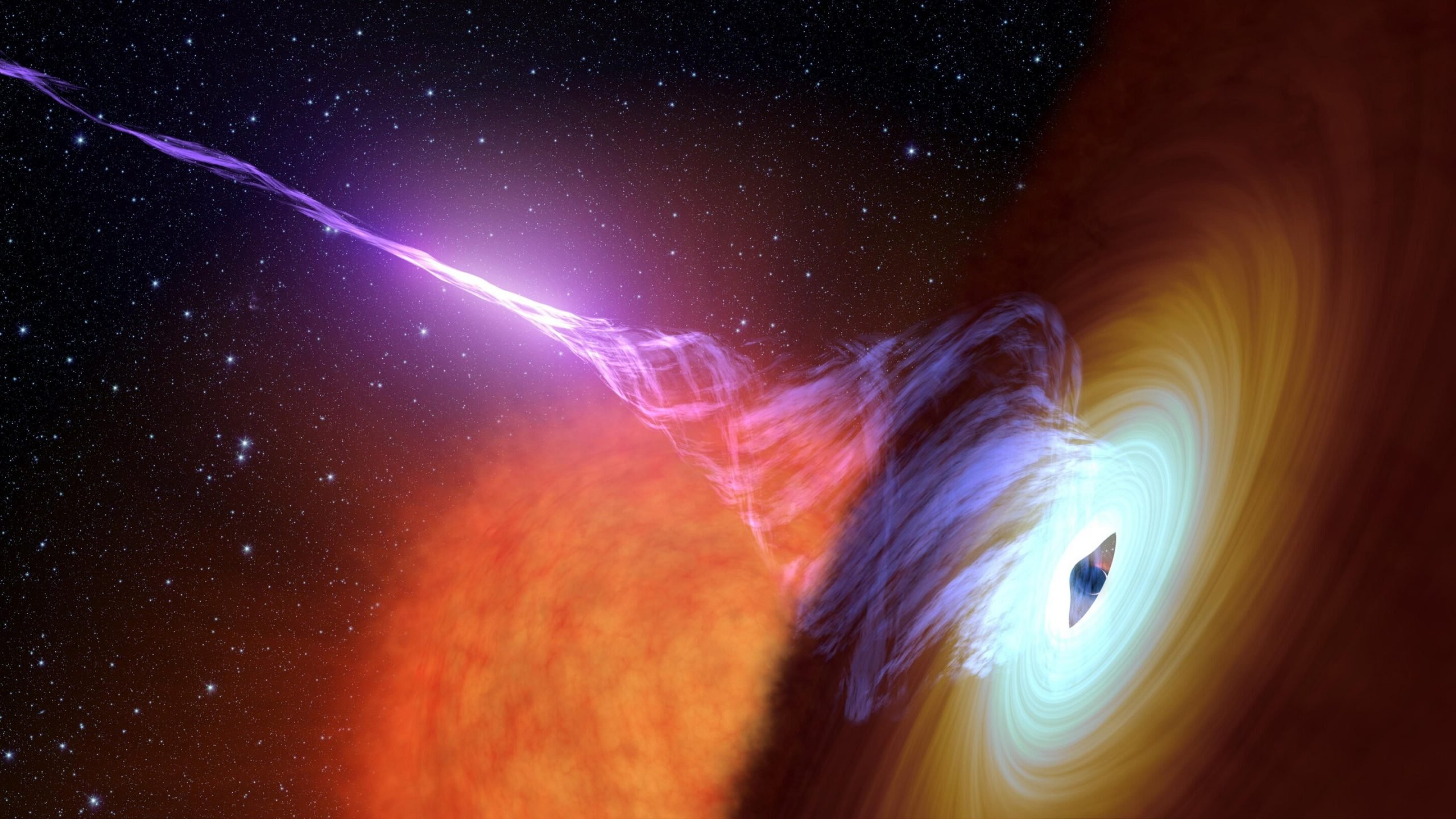
The black holes of Einstein’s theory of relativity can be completely described by just three parameters: their mass, spin angular momentum, and electric charge. Since two black holes that share these parameters cannot be distinguished, regardless of how they were made, black holes are said to “have no hair” — they have no additional attributes that can be used to tell them apart.
In the early 1970s, the late Jacob Bekenstein provided a proof for the nonexistence of hair made of scalar fields given a set of assumptions on the properties of the latter. Researcher Lior Burko of Theiss Research said, “Since Bekenstein’s proof, several papers found examples for scalar hair, and all these examples violate one or another of the assumptions made by Bekenstein. But in all cases, the hair was made of the scalar field itself.”
Recently, it was shown that black holes that are charged by the maximum possible electric charge (“extreme black holes”) can have an additional property, permanent hair that is made of a massless scalar field, and that this newly found hair can be observed from a great distance. “A massless scalar hair does not violate any of the assumptions underlying Bekenstein’s proof. It was a big surprise for me when this new hair was found by Angelopoulos, Aretakis, and Gajic, so I wanted to look at it in greater detail. It is hair in a different sense than the kinds of hair that were found before. It is not the scalar field itself, but a certain integral on a derivative of the scalar field that is to be calculated on the surface of the black hole, on its event horizon,” said Burko. The new hair can be observed at a great distance, by calculating a different quantity there. “The measurement at a great distance that Angelopoulos, Aretakis, and Gajic found is strictly speaking precise only at infinitely late time,” added Burko. “These would be observers who are very distant from the black hole, and who make the measurements in the infinite future. We wanted to see what happens at late but finite times, to see the time dependence of the measurement and how it approaches its asymptotic value. Another special thing about this new hair is that it is applies only for exactly extreme black holes, and we wanted to understand what happens when the black hole is nearly extreme, but not exactly extreme.”
“Nearly extreme black holes that attempt to regrow hair will lose it and become bald again.” — Lior Burko, Theiss Research
Burko and his colleagues Gaurav Khanna of the University of Massachusetts Dartmouth and his former student Subir Sabharwal, currently with the Eastamore Group, showed in a paper just published on November 15, 2019, in Physical Review Research that measurements from a great distance are approaching the hair value, with the difference between them decaying with inverse time. But then they went beyond the original model used by Angelopoulos, Aretakis, and Gajic, and generalized the hair to black holes that rotate at the maximum possible spin rate or just close to it. “In addition to a maximal value of charge, there is also a limit for how fast a black hole can spin. Black holes that spin at the maximal allowed rate are therefore also called extreme black holes. We describe both maximally charged and maximally spinning black holes by the name extreme black holes, as there are many similarities between the two. The new hair was originally found for a very useful toy model for black holes, specifically black holes that are spherically symmetric and electrically charged. But black holes in reality are neither. Instead, we wanted to find out if this hair can be found also for spinning black holes,” said Burko. “In the movie Interstellar the monster black hole is nearly extreme. We wanted to see if Gargantua has hair.”
The team used very intensive numerical simulations to generate their results. The simulations involved using dozens of the highest-end Nvidia graphics processing units (GPUs) with over 5,000 cores each, in parallel. “Each of these GPUs can perform as many as 7 trillion calculations per second; however, even with such computational capacity the simulations took many weeks to complete,” said Khanna.
The team showed that for the nearly extreme spinning black holes the hair is a transient behavior. At intermediate times nearly extreme black holes behave like extreme black holes would, but at late times they behave like regular, non-extreme black holes. “Nearly extreme black holes can pretend that they are extreme for only so long. But eventually their non-extremality becomes manifest,” Burko summarized. “Nearly extreme black holes that attempt to regrow hair will lose it and become bald again.” The team also discusses the observational features, e.g., with gravitational waves observatories such as LIGO/VIRGO or LISA, of the smoking-gun detection of nearly extreme black holes.
Reference: “Transient scalar hair for nearly extreme black holes” by Lior M. Burko, Gaurav Khanna and Subir Sabharwal, 15 November 2019, Physical Review Research.
DOI:10.1103/PhysRevResearch.1.033106
The research was partially funded by the National Science Foundation and the Office of Naval Research. Computational resources of UMass Dartmouth’s Center for Scientific Computing & Visualization Research (CSCVR) were utilized for the research work. The CSCVR promotes the mission of UMass Dartmouth by providing undergraduate and graduate students with high quality discovery-based educational experiences that transcend the traditional boundaries of academic field or department, and foster collaborative research in the computational sciences within the University and with researchers at other universities, National Labs, and industry. Khanna serves as the Director of the Center.
Never miss a breakthrough: Join the SciTechDaily newsletter.
Follow us on Google and Google News.
2 Comments
Shorter article title: Scientist Discover Another Red Hairing
Wonderful information. Thanks for sharing such a great article about Black Holes.