
Deep beneath Antarctica’s ice, scientists have uncovered a geological archive that could reshape predictions of future sea-level rise.
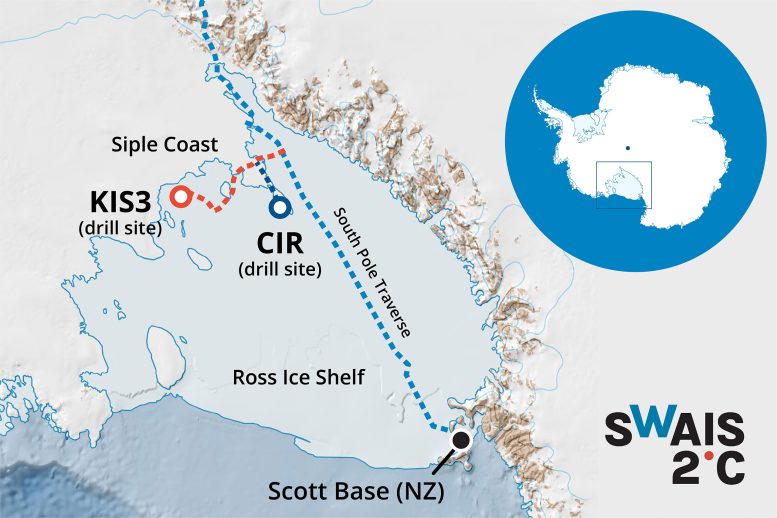
Working roughly 700 kilometers from the closest Antarctic research stations, the team drilled through 523 meters of solid ice at Crary Ice Rise, located along the edge of the West Antarctic Ice Sheet. Beneath the ice, they recovered a 228-meter-long core made up of layered mud and rock. These sediments preserve a long record of environmental change during earlier warm phases in Earth’s history, offering crucial evidence for estimating how quickly ice in the region could melt as the planet warms.
If the West Antarctic Ice Sheet were to collapse entirely, scientists estimate that global sea levels would climb by four to five meters. Until now, predictions about how the ice sheet might react to additional warming have relied largely on satellite data and sediment records gathered near the ice margin, beneath floating ice shelves, within sea ice, and across the Ross Sea and Southern Ocean.
The newly recovered core was drilled as part of the international SWAIS2C project (Sensitivity of the West Antarctic Ice Sheet to 2°C). It was collected at Crary Ice Rise, an ice dome anchored at the inner edge of the Ross Ice Shelf. Unlike previous records, this core provides direct and detailed evidence of how the ice sheet’s margin behaved during earlier warm intervals.
23 Million Years of Climate History Above 2°C
“This record will give us critical insights about how the West Antarctic Ice Sheet and Ross Ice Shelf is likely to respond to temperatures above 2°C. Initial indications are that the layers of sediment in the core span the past 23 million years, including time periods when Earth’s global average temperatures were significantly higher than 2°C above pre-industrial,” says SWAIS2C Co-Chief Scientist Huw Horgan of Te Herenga Waka – Victoria University of Wellington, ETH Zurich, and WSL.
Initial age estimates were made at the drilling site by identifying microscopic fossils from marine organisms preserved in several sediment layers. Researchers from 10 countries involved in the SWAIS2C project will now carry out more detailed analyses to confirm and refine the timeline.
As drilling progressed deeper below the ice sheet, the team extracted sections of core measuring up to three meters at a time. The sediments showed remarkable diversity, ranging from fine mud to compact gravel containing larger embedded rocks.
“We saw a lot of variability. Some of the sediment was typical of deposits that occur under an ice sheet like we have at Crary Ice Rise today. But we also saw material that’s more typical of an open ocean, an ice shelf floating over ocean, or an ice-shelf margin with icebergs calving off,” says Co-Chief Scientist Molly Patterson, Professor of Geology at Binghamton University, USA.
Evidence of Past Ice Retreat and Open Ocean Conditions
Fragments of shells and the remains of light-dependent marine organisms indicate that the area was once covered by open ocean rather than ice. Scientists have long suspected that this region experienced earlier periods of open water, suggesting partial or even complete retreat of the Ross Ice Shelf and the possible collapse of parts of the West Antarctic Ice Sheet.
Pinpointing exactly when these retreats occurred, and identifying the environmental conditions that triggered them, is now a primary goal for the SWAIS2C research team, according to Patterson.
Antarctic Frontier Science: Deep Drilling Breakthrough
Recovering the sediment core represents both a scientific milestone and a major engineering accomplishment. The 29-member team of scientists, drillers, engineers, and polar specialists faced significant uncertainty from the outset. Two previous drilling attempts had failed due to technical difficulties. The challenge was considerable, as no project had previously extracted such a deep geological record from beneath an ice sheet at such a remote location.
“To our knowledge, the longest sediment cores previously drilled under an ice sheet are less than ten meters. We exceeded our target of 200 meters. This is Antarctic frontier science,” says Patterson.
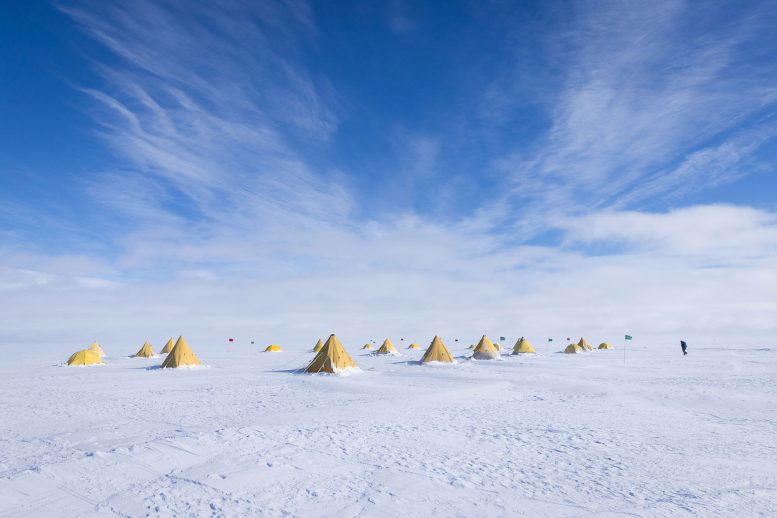
The team operated continuously in rotating shifts, using a specially built drilling system. They first melted a 523 m deep hole through the ice with a hot water drill. More than 1300 m of ‘riser’ and ‘drill string’ pipe was then lowered to reach the sediment below. Each recovered section of core was carefully logged, photographed, x-rayed, and sampled for further study.
From Breakthrough Core Recovery to Future Antarctic Drilling Missions
“It was a great feeling when that first core came up, but then you start worrying about the next core and the next core after that. So, it’s stressful right up until the end. We’re thrilled to have learned from our previous challenges and to have successfully retrieved this geological record that will help the world prepare for the impacts of climate change,” says Horgan.
Looking ahead, the team plans to build on this success. “Our multi-disciplinary international team is already collaborating to unravel the climate secrets hidden in the core. With our drilling system having been put to the test under these tough Antarctic conditions and passing with flying colors, we’re looking ahead to plan future drilling to continue our mission to learn more about the sensitivity of the West Antarctic Ice Sheet to global warming,” says Horgan.
Reference: “Sensitivity of the West Antarctic Ice Sheet to +2 °C (SWAIS 2C)” by Molly O. Patterson, Richard H. Levy, Denise K. Kulhanek, Tina van de Flierdt, Huw Horgan, Gavin B. Dunbar, Timothy R. Naish, Jeanine Ash, Alex Pyne, Darcy Mandeno, Paul Winberry, David M. Harwood, Fabio Florindo, Francisco J. Jimenez-Espejo, Andreas Läufer, Kyu-Cheul Yoo, Osamu Seki, Paolo Stocchi, Johann P. Klages, Jae Il Lee, Florence Colleoni, Yusuke Suganuma, Edward Gasson, Christian Ohneiser, José-Abel Flores, David Try, Rachel Kirkman, Daleen Koch and the SWAIS 2C Science Team, 25 February 2022, Scientific Drilling.
DOI: 10.5194/sd-30-101-2022
Never miss a breakthrough: Join the SciTechDaily newsletter.
Follow us on Google and Google News.
17 Comments
We must do more to more
To do what’s needed to
Slow this down and learn new ways of living one with our “mother EARTH”
A.BARBOUR
You either can’t understand what your reading or just want the fear monger.
Worry??. Its out of your control. Mother nature just laughs at your idiotic claims that we can control the planets
Worry about that bright fireball in the sky that controls everything happening on earth. If it goes out it will be plenty cold
It will go out, I’m about 5 billion years, it’s half way through it’s lifecycle. However planet earth will have drifted out of the Goldilocks zone in about a billion years so we’ll be long gone before the sun.
That’s why we need to drop politics, religion and wokeness. We’re all in the same toilet.
Stop drilling
Absolutely agree! I explained why.
Correct
40% of earth’s fresh water is frozen in Antarctica, my theory is that a very large ice meteor collided with the what’s now the bottom of the earth as we see it , Without it ,life would not exist. Explaining the depression and gravitational anomaly in the southern cap.Before even the earliest forms of life that came with it, had developed on earth. Followed 5 ,6,or7 hundred million years later and chixulub the impactor made impact .But I’m just a nut not a scientist or geologist or palentologist .
“If the West Antarctic Ice Sheet were to collapse entirely, scientists estimate that global sea levels would climb by four to five meters.”
What is missing from that somewhat alarming claim is how fast it might happen. Keeping in mind that civilization is only about 10,000-years-old, and the Industrial Revolution is less than 300 years old, the speed of melting is important. The ability to cope with a change over a future period of hundreds or thousands of years is bound to improve significantly. Consider what the Dutch have done over hundreds of years. From Wikipedia, “By 1250 most dikes had been connected into a continuous sea defense.” Today, with massive machines, humans are much better prepared to deal with a future encroachment of the sea.
Also, what seems to be ignored in the debate is that significant changes in sea level have taken place before the release of anthropogenic carbon dioxide began. There is no reason to believe that such changes have stopped just because humans are adding carbon dioxide. That is, the changes are natural and the human influence may well be much less than is commonly claimed.
10000 years old? More like 2million
Are you saying that civilization has existed for 2 million years? If so, can you provide a reliable citation to support that belief?
To break limestone you drill holes in it. Pour water in the holes and allow to freeze. This breaks the limestone rock. Scientists drill holes in ice for research. Then likely refilling the hole with new water allowing it to freeze. Any idea what happens? Yep they cracked the ice with new water expansion at a different rate than when the glacial sheet originally froze. Crack and we will blame it on global warming.
“… with new water expansion at a different rate than when the glacial sheet originally froze.”
Why would that be the case? Ice is ice! Besides that, ice only behaves in a brittle manner for about the first 60m from the surface. Below that, fractures (and drill holes) close and the ice generally deforms plastically, albeit it it can shear over barriers such as ridges. The exact depth of the transition varies with the temperature of the ice and the rate of change of stress. Have you ever hit Silly Putty with a hammer?
Why care at all? Agreement or not whatever is going to happen WILL HAPPEN REGARDLESS OF A piece of stupid documentation stating we give up whatever “for our lives”? If We are “done for” in the 1 billion years, we need to all realize, that’s 1 B years, everyone on earth currently will be gone in a tiny fraction of that. Stop tripping on your emotions, and have some fun, screw all these so called “expert” billionaire class “climate” hysteriatic “preachers”…lol if we have 20y, yall should ask yourselves, in today’s technology and paired with corruption and wickedness worldwide, I’d hedge my bets on <15y tbh. But I'm. Still living my life. Live miserable, or have fun riding the miserable train and adapt to the best outcome for the worst of times. Treat everyday as a blessing and prepare for the next day.
Cheers,
Agree with you if all of you read the article. They explained as well how they managed to drill so deep down. And they use hot water drilling.two-stage drilling system. This custom-built technology combined ice-melting and mechanical sediment-coring.
Agree with you if all of you read the article. They explained as well how they managed to drill so deep down. And they use hot water drilling.two-stage drilling system. This custom-built technology combined ice-melting and mechanical sediment-coring.