
Scientists have built atom-sized pores that act like living ion channels, opening the door to next-generation nanotech.
Ion channels are extremely narrow pathways that are essential for many processes in living systems. To understand how ions move through these confined spaces, scientists need to build artificial pores at incredibly small scales. The tightest parts of these channels can be only a few angstroms wide, roughly the size of single atoms, which makes precise and repeatable fabrication very difficult with current nanotechnology.
Researchers at the University of Osaka have now tackled this problem. In a study published in Nature Communications, they describe a new approach that uses a miniature electrochemical reactor to form pores that approach subnanometer size.
How Ion Channels Generate Electrical Signals
In living cells, ions pass through protein channels embedded in the cell membrane. This flow of ions creates electrical signals, including nerve impulses that control muscle movement. These protein channels contain extremely narrow regions and can switch between open and closed states. External signals trigger changes in the protein structure, which in turn regulate the flow of ions.
A Solid-State System That Mimics Biology
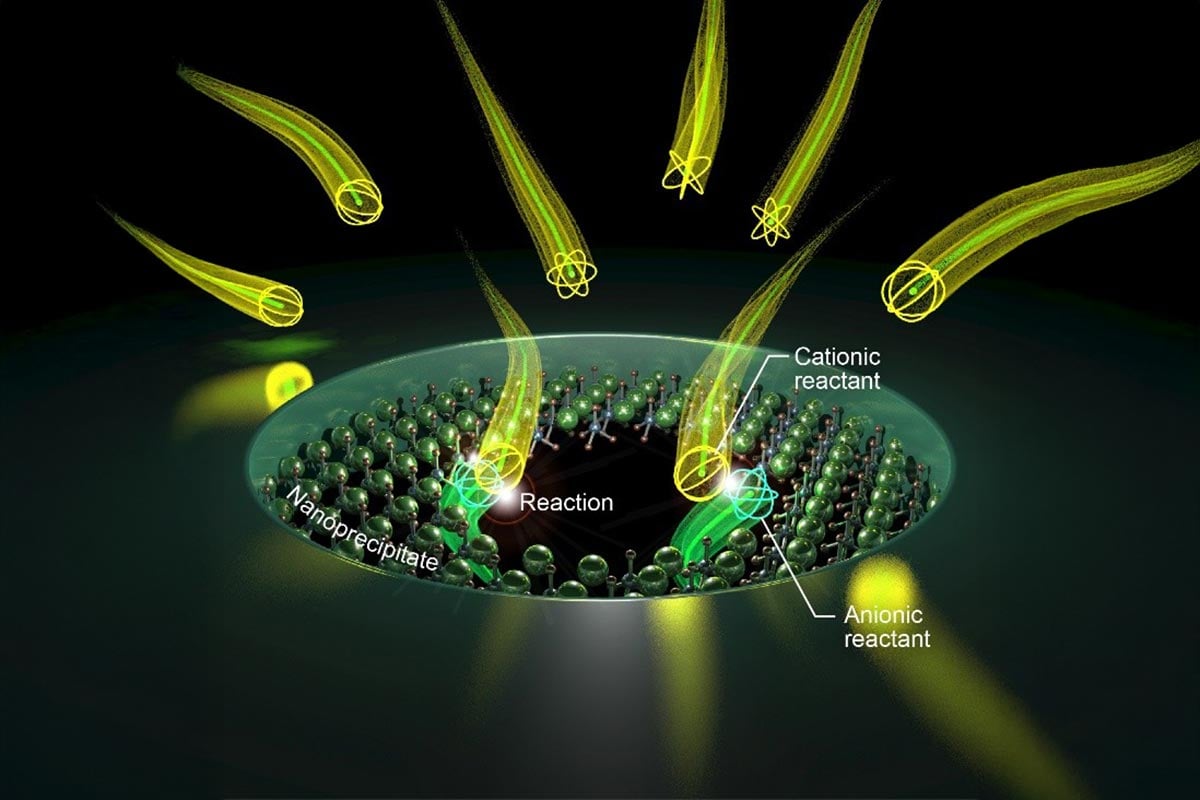
Inspired by these natural mechanisms, the research team created a solid-state system capable of forming pores close in size to biological ion channels. They started by forming a nanopore in a silicon nitride membrane. This nanopore then acted as a tiny reaction chamber where even smaller pores could be generated.
When a negative voltage was applied across the membrane, it triggered a chemical reaction inside the nanopore that produced a solid precipitate. As this material accumulated, it gradually filled and blocked the pore. Reversing the voltage caused the precipitate to dissolve, restoring pathways for ions to pass through.
“We were able to repeat this opening and closing process hundreds of times over several hours,” explains lead author Makusu Tsutsui. “This demonstrates that the reaction scheme is robust and controllable.”
Electrical Spikes and Tunable Ion Transport
The researchers tracked the flow of ions through the membrane and observed sudden spikes in current. Similar patterns are seen in natural ion channels. Their analysis indicates that these signals likely arise from the formation of many subnanometer pores within the original nanopore.
They also found that the system could be adjusted to change how the pores behave. By modifying the composition and pH of the reactant solutions, they were able to control the size and properties of the ultrasmall pores.
“We were able to vary the behavior and effective size of the ultrasmall pores by changing the composition and pH of the reactant solutions,” reports Tomoji Kawai, senior author. “This enabled selective transport of ions of different effective sizes through the membrane by tuning the ultrasmall pore sizes.”
Potential Uses in Sensing and Brain-Inspired Computing
This new reaction method allows multiple ultrasmall pores to form within a single nanopore. It offers a powerful way to study how ions and fluids move in extremely confined environments similar to those found in biology.
The chemically driven membrane system could also support emerging technologies such as single-molecule sensing (e.g., using nanopores to sequence DNA), neuromorphic computing (using electrical spikes to mimic the behavior of biological neurons), and nanoreactors (creating unique reaction conditions through confinement).
Reference: “Chemistry-driven autonomous nanopore membranes” by Makusu Tsutsui, Wei-Lun Hsu, Denis Garoli, Ali Douaki, Yuki Komoto, Hirofumi Daiguji and Tomoji Kawai, 18 February 2026, Nature Communications.
DOI: 10.1038/s41467-026-68800-x
Never miss a breakthrough: Join the SciTechDaily newsletter.
Follow us on Google and Google News.
1 Comment
The biological ion channels may be quantum in nature, and as such, reactant to wave nature impulse not readily interrogated. Investigation of sub-nanometer size and behavior is suggested.