
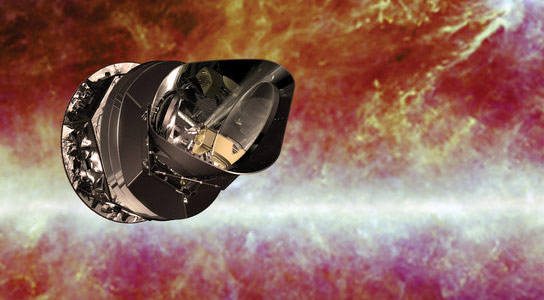
After four plus years of service, scientists prepare the Planck satellite for its final shutdown and for permanent safe disposal.
In preparation for its final switch-off on October 23, mission controllers today fired Planck’s thrusters to empty its fuel tanks. The burn is one of the final steps to ensure that Planck ends its hugely successful mission in a permanently safe configuration.
The satellite, which mapped the relic radiation from the Big Bang – the Cosmic Microwave Background, or CMB – in unprecedented detail, will be switched off in two days.
One of Planck’s two instruments, the HFI high-frequency instrument, exhausted its liquid helium supply in January 2012. Planck had by then completed five full-sky surveys using both HFI and its partner detector, the LFI low-frequency instrument.
Since January 2012, the spacecraft has conducted three more sky surveys with LFI, enabling scientists to refine their CMB data. All science operations finally came to an end on October 3, and the payload was switched off on October 19.
“In the past weeks, we’ve been working to prepare Planck for permanent safe disposal,” says ESA’s Steve Foley, Spacecraft Operations Manager at the European Space Operations Center in Darmstadt, Germany.
“This includes ‘passivating’ the spacecraft and placing it onto a disposal trajectory that will keep it in a parking orbit around the sun well away from the Earth–Moon system for hundreds of years.”
This is very similar to the procedure for Planck’s ‘sister’ mission, Herschel, which was deactivated in June.
“These are the first two missions ESA has flown at the scientifically valuable L2 Lagrange point, so it’s important that we set a positive precedent as to how we dispose of missions there,” says Andreas Rudolph, responsible for astronomy mission operations at ESOC.
Animation of the spin-stabilized Planck spacecraft during the cruise toward its final destination: an operational orbit around the second Lagrange point L2.
On October 9, controllers commanded Planck to perform a lengthy, two-day maneuver to move away from the Sun-Earth Lagrange point and start a slow drift away from Earth.
Today, around 12:00 GMT (14:00 CEST), the thrusters will again be switched on to burn the remaining fuel to depletion, an important aspect of rendering the spacecraft inert, as required by ESA’s space debris mitigation guidelines.
“We’ve already programmed the onboard software so that it will no longer try to automatically reactivate the transmitters, and next we will disconnect the batteries and disable the onboard protection mechanisms,” says Steve.
“The final step will be the simple act of switching off the transmitters: we will witness the silencing of Planck and we will never receive a signal from her again. This is important because we cannot cause radio interference for any future mission.”
This will happen on October 23 during a small ceremony, when the final command will be sent by ESA’s Jan Tauber, the Project Scientist, who has personally invested more than a decade and a half in Planck.
“At ESOC, our business is keeping missions alive and productive, so sending a ‘shut-down’ command is very difficult,” says Paolo Ferri, Head of Mission Operations.
“While the end of this outstanding scientific mission was always foreseen with the exhaustion of the helium coolant, it seems fitting that we have a colleague from the science team to send the final command that once and for all silences the Planck spacecraft.”
Never miss a breakthrough: Join the SciTechDaily newsletter.
Follow us on Google and Google News.