

A popular heart scan may be unnecessary for many patients but valuable for those whose risk is difficult to judge.
Coronary artery calcium scanning has become an increasingly accessible way to refine estimates of heart attack and stroke risk. Yet a Northwestern Medicine study involving more than 6,000 adults suggests the quick, relatively inexpensive test adds little for most people when used alongside PREVENT, the American Heart Association’s leading cardiovascular risk calculator.
The findings, published in JAMA, indicate that calcium scanning is most informative for adults whom PREVENT places in borderline or intermediate risk categories. In these cases, the scan can help reveal whether a person’s actual risk is higher or lower than routine health measurements suggest.
What a Calcium Score Reveals
PREVENT uses commonly collected information (such as blood pressure, cholesterol, age, and sex) to estimate the likelihood of cardiovascular disease over the next 10 or 30 years. Because it relies on information already available during many medical visits, the calculator can assess risk without imaging.
A coronary artery calcium test takes a different approach. The CT scan detects calcium-containing plaque in the arteries that supply the heart and converts the findings into a numerical score. A higher score generally signals a greater burden of coronary atherosclerosis and a higher risk of future cardiovascular events.
Calcium scoring can uncover disease before symptoms appear, but additional information is not automatically useful for every patient. If someone is already clearly at low or high risk, the result may be unlikely to change the recommended treatment.
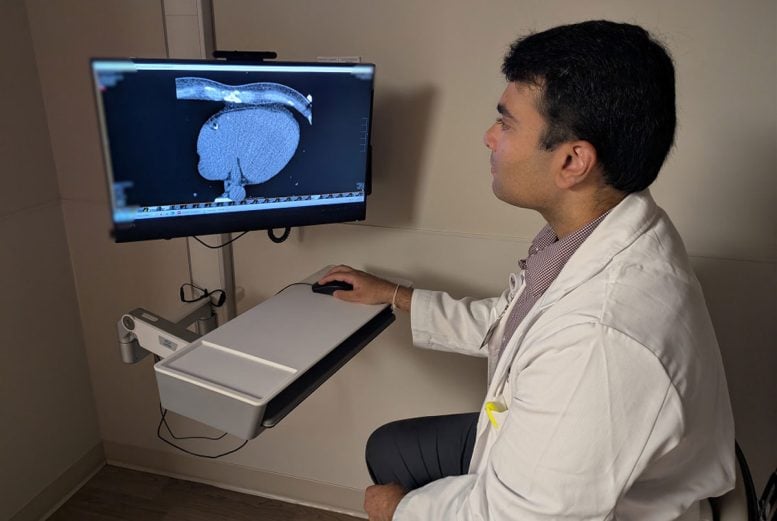
“Coronary artery calcium scans are becoming more widely available and less expensive,” said senior study author Dr. Nilay Shah, assistant professor of medicine in the division of cardiology at Northwestern University Feinberg School of Medicine. “Our findings suggest that not everyone necessarily needs or would benefit from a coronary artery calcium scan for the purpose of predicting risk of heart attack and stroke.”
“Routinely using a calcium scan in people who are at low risk may result in unnecessary radiation exposure, testing, and costs with unclear clinical benefits,” Shah added. “Using calcium scans in people who are at high risk is likely to result in unnecessary testing because these individuals are recommended to start a statin regardless of what the calcium scan shows.”
Calcium Scans Add Little for Most Adults
Statins lower cholesterol and are commonly prescribed to reduce cardiovascular risk. For people who already qualify for treatment based on conventional risk factors, a calcium scan may confirm what clinicians know without changing the decision. At the other end of the spectrum, scanning people with very low estimated risk could expose them to radiation and lead to further testing without a clear benefit.
To examine where the test might be most useful, researchers analyzed data from more than 6,000 adults ages 45 to 79 enrolled in the Multi-Ethnic Study of Atherosclerosis. At the beginning of the study, participants underwent calcium scanning and received a PREVENT estimate representing their risk of a cardiovascular event during the next decade.
Over 10 years of follow-up, 6% of participants experienced a heart attack or stroke. Adding calcium scores produced only a modest improvement across the full study population. The model’s discrimination (a measure of how well it forecasted who would go on to have a heart event) increased from 0.73 to 0.75.
Greater Value in the Uncertain Middle
The results changed when researchers focused on adults in the borderline and intermediate groups (those initially deemed to have a 3% to 9% risk of heart disease within 10 years). Among these participants, calcium scores produced a more meaningful improvement in identifying who would later experience a cardiovascular event.
“For patients at borderline risk, knowing their calcium score can help determine whether their risk is actually lower or higher than initially estimated, which can help guide treatment decisions,” Shah explained.
A score showing little or no coronary calcium could support a less aggressive approach for some patients, while a substantial plaque burden could strengthen the case for preventive treatment. The scan, therefore, appears most useful when its result has a realistic chance of changing what happens next.
About 10% of U.S. adults ages 30 to 79 have cardiovascular disease, the nation’s leading cause of death. Many heart attacks and strokes are preventable, making accurate risk assessment important for directing treatment toward the people most likely to benefit.
Refining Preventive Heart Care
“The findings help us understand how best to use the available tools to estimate someone’s risk of a heart attack or stroke. That provides more precise guidance for who is most likely to benefit from using a statin to help prevent heart disease,” Shah said.
The results also reinforce the clinical value of PREVENT. Although the calculator is relatively new, it performed well on its own, suggesting that routine health information can provide a strong initial assessment before clinicians consider additional imaging.
Researchers have not yet determined how much calcium scores improve PREVENT estimates in certain high-risk populations, including South Asian and Filipino adults. The findings also may not apply to younger adults because every participant was between ages 45 and 79 when the study began.
Reference: “Predictive Utility of Coronary Artery Calcium Score Added to the PREVENT Atherosclerotic Cardiovascular Disease Equations” by Xiaoning Huang, Lucia C. Petito, Norrina B. Allen, Ron Blankstein, Roger S. Blumenthal, Josef Coresh, Philip Greenland, Jennifer E. Ho, Amit Khera, Donald M. Lloyd-Jones, Janani Rangaswami, James H. Stein, Chiadi E. Ndumele, Sadiya S. Khan and Nilay S. Shah, 26 August 2026, JAMA.
DOI: 10.1001/jama.2026.13233
The study was supported by the American Heart Association and the National Heart, Lung, and Blood Institute.
Never miss a breakthrough: Join the SciTechDaily newsletter.
Follow us on Google and Google News.