
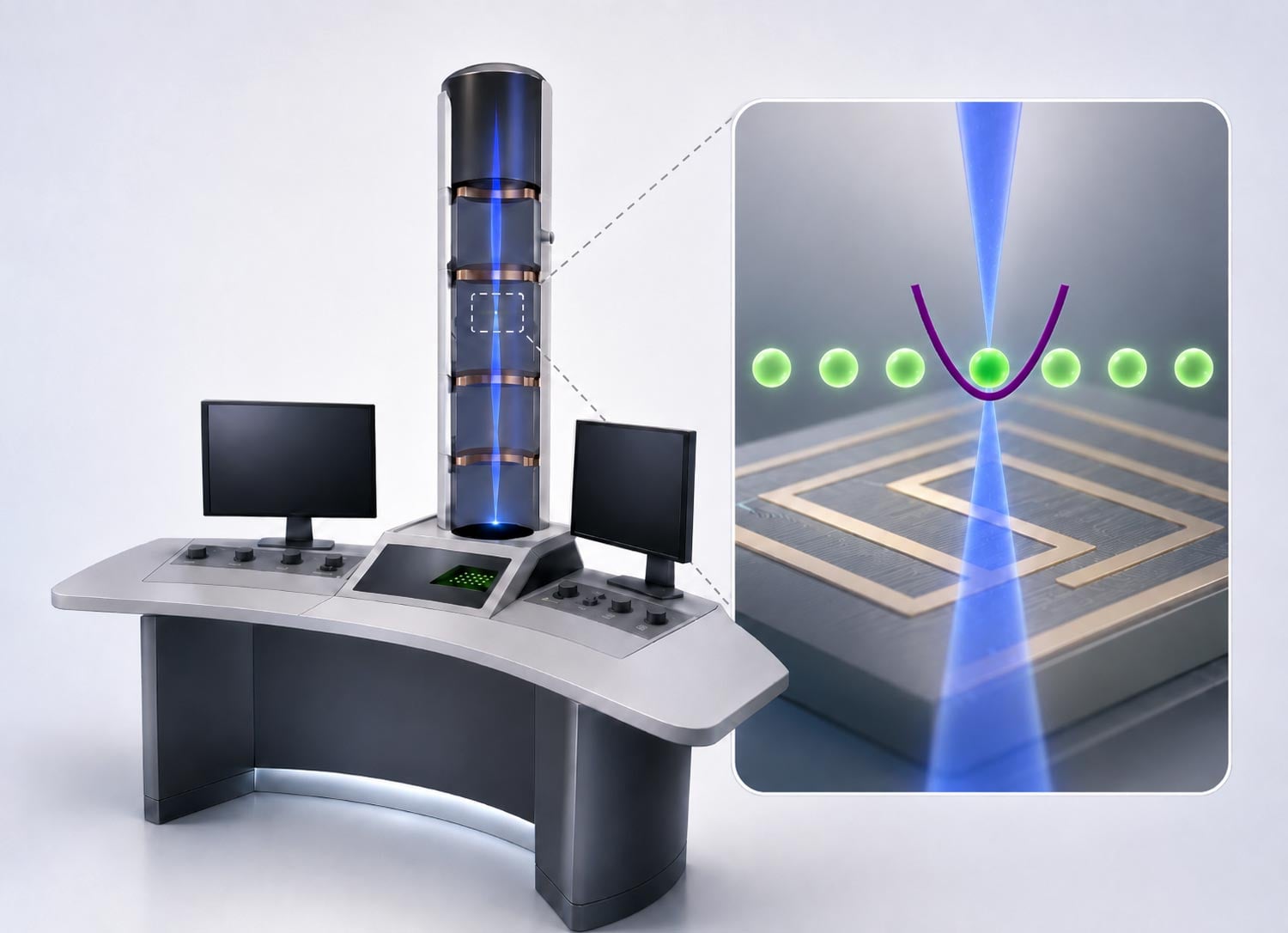
A new invention could significantly improve electron microscopy by integrating a small quantum computer directly into the microscope.
For delicate samples such as individual proteins, electron microscopy faces a fundamental tradeoff. Producing a clearer image generally requires sending more electrons through the specimen, but increasing the dose also raises the risk of damaging the very material researchers are trying to observe.
Researchers in Austria have proposed a way around that limitation by coupling an electron microscope to a quantum computer. Rather than using electrons only to form an image and discarding the additional quantum information they carry, the system would preserve and process that information. In principle, this could strengthen signals without requiring as many electrons to pass through a fragile sample.
“Today, we can image tiny details on the atomic scale,” says Philipp Haslinger from the Institute of Atomic and Subatomic Physics at TU Wien. “However, this requires a large number of electrons. And not every sample can be exposed to so many electrons without being damaged. This is often a problem, particularly when imaging biological samples such as individual proteins.”
Trapped ions preserve information from passing electrons
The researchers’ approach is designed to extract more information from each electron before that opportunity is lost.
Teams from TU Wien, the University of Vienna, JKU Linz, and the University of Innsbruck developed a scheme in which electrons traveling through the microscope interact with ions held in place along the path of the beam. Those ions form part of a quantum computer and can become entangled with the passing electrons.
“Our idea is to combine the electrons with a quantum computer. We let them interact with ions that are held in place along the path of the electron beam,” explains Elias Pescoller, first author of the publication and a doctoral student at the Institute for Theoretical Physics and the Institute of Atomic and Subatomic Physics at TU Wien. “This can, for example, create quantum entanglement between the electron and the quantum computer. The electron and the ion then share a joint quantum state.”
That interaction allows the ion to retain quantum information associated with one electron even after the electron has continued through the microscope. When another electron arrives, it can interact with the quantum computer in the same way. Information from successive electrons can therefore be accumulated rather than treated as a series of completely separate measurements.
“If we perform very specific quantum-computing operations each time, we can optimally combine the information from several electrons so that we obtain a signal of maximum strength even though we use only a relatively small number of electrons,” says Dennis Rätzel from the Institute of Atomic and Subatomic Physics at TU Wien.
The quantum algorithms needed to combine that information were developed in collaboration with Johannes Kofler’s team at JKU Linz.
Quantum processing could reveal signals hidden as noise
The microscope would still rely on electrons to probe and image a sample. What changes is how much information researchers attempt to recover from those electrons.
In a conventional electron microscope, measurements are largely based on detecting and counting electrons. The proposed system would add another layer by processing the quantum information carried by the particles after they interact with the trapped ions.
“The electrons themselves are used to image small objects, just as in any other electron microscope. But by processing the quantum information carried by these electrons in a quantum computer, we can extract significantly more information from the process,” says Iva Březinová from the Institute for Theoretical Physics at TU Wien. “What would previously have been indistinguishable from random noise can thus become a clear signal.”
This matters because ordinary electron counting is subject to statistical limits. When only a small number of electrons can safely be used, weak features in an image can become difficult to distinguish from random fluctuations. By exploiting quantum effects such as entanglement, the researchers say their approach could retrieve information that conventional measurements leave unused.
“Quantum physics allows us to overcome the statistical limits that constrain conventional electron microscopes,” says Elias Pescoller.
The quantum microscope now faces an experimental test
For now, the advantages of the approach have been demonstrated mathematically rather than in a working microscope. The researchers are now preparing to test whether those theoretical gains can be reproduced experimentally.
At TU Wien’s University Service Centre for Transmission Electron Microscopy, or USTEM, the team plans to integrate an ion-based quantum computer developed by Philipp Schindler’s group at the University of Innsbruck with an electron microscope.
Doing so requires bringing together expertise that normally sits in separate areas of research, including quantum information, quantum computing, and electron microscopy. The collaboration is being carried out through Austria’s quantA Cluster of Excellence.
“It is really exciting that, within the quantA Cluster of Excellence, we can combine the expertise in quantum information, quantum computing and electron microscopy available at the different universities in Austria. This allows us to launch a unique project,” says Thomas Juffmann from the University of Vienna.
If the experimental system works as predicted, its main advantage would be the ability to recover more useful information from a smaller number of electrons. That could make electron microscopy better suited to fragile specimens, including individual proteins, that may be damaged before conventional imaging can collect enough electrons to produce a clear picture.
Reference: “Coupling free electrons to a trapped-ion quantum computer” by Elias Pescoller, Santiago Beltrán-Romero, Sebastian Egginger, Nicolas Jungwirth, Martino Zanetti, Dominik Hornof, Michael S. Seifner, Iva Březinová, Philipp Haslinger, Thomas Juffmann, Johannes Kofler, Philipp Schindler and Dennis Rätzel, January 15, 2026, arXiv.
DOI: 2601.11446
Major funding for the consortium (https://qcem.info), which is coordinated by the University of Vienna, comes from the Austrian Science Fund (FWF) through the Cluster of Excellence quantA and from the Gordon and Betty Moore Foundation.
Never miss a breakthrough: Join the SciTechDaily newsletter.
Follow us on Google and Google News.
3 Comments
A new invention could significantly improve electron microscopy by integrating a small quantum computer directly into the microscope.
VERY GOOD.
Ask the researchers:
1. How do you define quantum computer and electronic computer?
2. How do you understand the physical reality of the quantum and the electronic?
I applaud the extraordinary work coming out of the Austrian research consortium (TU Wien, University of Innsbruck, and the University of Vienna). Coupling a transmission electron microscope (TEM) to a trapped-ion quantum logic register is a monumental leap forward in observational physics.
For decades, structural biology and quantum materials science have been constrained by a fundamental dilemma: to see smaller, we had to blast samples with higher-energy electron beams, often destroying delicate biological scaffolds or disrupting fragile quantum spin textures before a clean image could be captured.
By entangling passing probe electrons with trapped ions via Coulomb-mode interactions, this team has effectively bypassed classical radiation damage limits. Utilizing Quantum Phase Estimation (QPE) to extract sub-angstrom structural data at the Heisenberg limit of measurement precision is nothing short of brilliant. It shifts the paradigm of microscopy from destructive particle bombardment to coherent, non-destructive phase extraction.
To appreciate why this hybrid system works so well across all scientific disciplines, consider the difference between traditional observation and phase detection:
Traditional Electron Microscopy (Brute-Force Impact): Works like flash photography using a cannon. Firing high-intensity electron streams at a specimen deposits thermal energy, causing bond breakage, specimen charging, and structural deformation.
MRI & Quantum Phase Microscopy (Non-Destructive Echoes): Works like precise radar phase detection. An MRI scanner doesn’t burn human tissue with radiation; it senses the subtle timing delays and phase shifts of precessing nuclear spins across tissue gradients.
The Austrian team’s trapped-ion microscope applies that exact same MRI phase-encoding principle to single subatomic particles. As a single electron glides past a specimen, its wave front experiences a subtle phase shift from the sample’s electrostatic field. Instead of letting the electron crash destructively into a detector screen, a trapped-ion qubit “catches” that phase shift in quantum memory. Reading accumulated phase echoes replaces thermal destruction with uncorrupted structural clarity.
The Austrian team has delivered a masterclass in quantum engineering. By replacing destructive energy transfer with non-destructive phase accumulation, if they were to consider using the mechanics of the MRI & Quantum Phase Microscopy (Non-Destructive Echoes) they are even enhancing a cleaner, uncorrupted view of the physical world.
The Updated Link , https://docs.google.com/document/d/1QxfeaGKnt4efbAuA_WR1RHeVJ8HAmrSIq-HMiLwt5aM/edit?usp=drive_link