

Researchers have successfully demonstrated negative entanglement entropy using classical electrical circuits as stand-ins for complex quantum systems, providing a practical model for exploring exotic quantum phenomena and advancing quantum information technology.
Entanglement entropy quantifies the degree of interconnectedness between different parts of a quantum system. It indicates how much information about one part reveals about another, uncovering hidden correlations between particles. This concept is essential for advancing quantum computing and quantum communication technologies.
To understand what negative entanglement entropy means, we will first need to know what entanglement and entropy are.
Entanglement and Entropy in a nutshell
Imagine you have two coins. Normally, if you flip one coin, it doesn’t affect the outcomes of flipping the other. But in the quantum world, particles can become “entangled,” meaning their states are linked. If two coins are entangled, the entanglement rule can be such that when one coin is flipped into a head, the other coin must show a tail. In essence, knowing the result of one restricts the possible outcomes for the other.
Entanglement Entropy
When putting together, “entanglement entropy” measures how much information you lose about one part of a system if another part of the system suddenly becomes inaccessible i.e. is truncated by a so-called “entanglement cut”. Intuitively, the more highly entangled the two parts are, the more information will be lost.
One simple analogy to understand entanglement entropy is to imagine a pair of socks. You put one sock in one drawer and the other sock in another drawer. If the socks are “entangled”, then knowing the color of the sock in one drawer immediately tells you the color of the sock in the other drawer. Here, two situations can arise:
- High Entanglement: If the colors of the two socks are almost perfectly correlated, then knowing the color of one sock gives you almost perfect information about the other. In particular, if one sock suddenly becomes inaccessible, one would also lose knowledge of the color of the other sock.
- Low Entanglement: If the socks’ colors are essentially uncorrelated, then knowing the color of one sock does not make one more certain about the color of the other. In particular, if one sock suddenly becomes inaccessible, there will not be any more uncertainty i.e. entropy regarding the color of the other sock.
Negative Entanglement Entropy
Conventional quantum mechanics have only been concerned with conservative systems where particles and energy do not get destroyed or made. However, intriguing new physics arises when this restriction is lifted – in the sock analogy, where socks can be removed or added to the system. Such systems as known as “Non-Hermitian” systems.
In non-Hermitian systems, the concept of entanglement needs to be modified, because information can also be lost when the number of particles changes. In particular, gaining new socks and their information can be construed as giving out a negative amount of sock information to others. This leads to the new concept of negative entanglement entropy.
While the theoretical recipe for achieving negative entanglement entropy in a non-Hermitian quantum system has been thought of since a few years ago, actually observing negative entanglement in quantum experiments cannot be easily done. This is due to significant challenges in manipulating intricate quantum states in a way that they gain or lose energy, while at the same time also measuring how entangled they are.
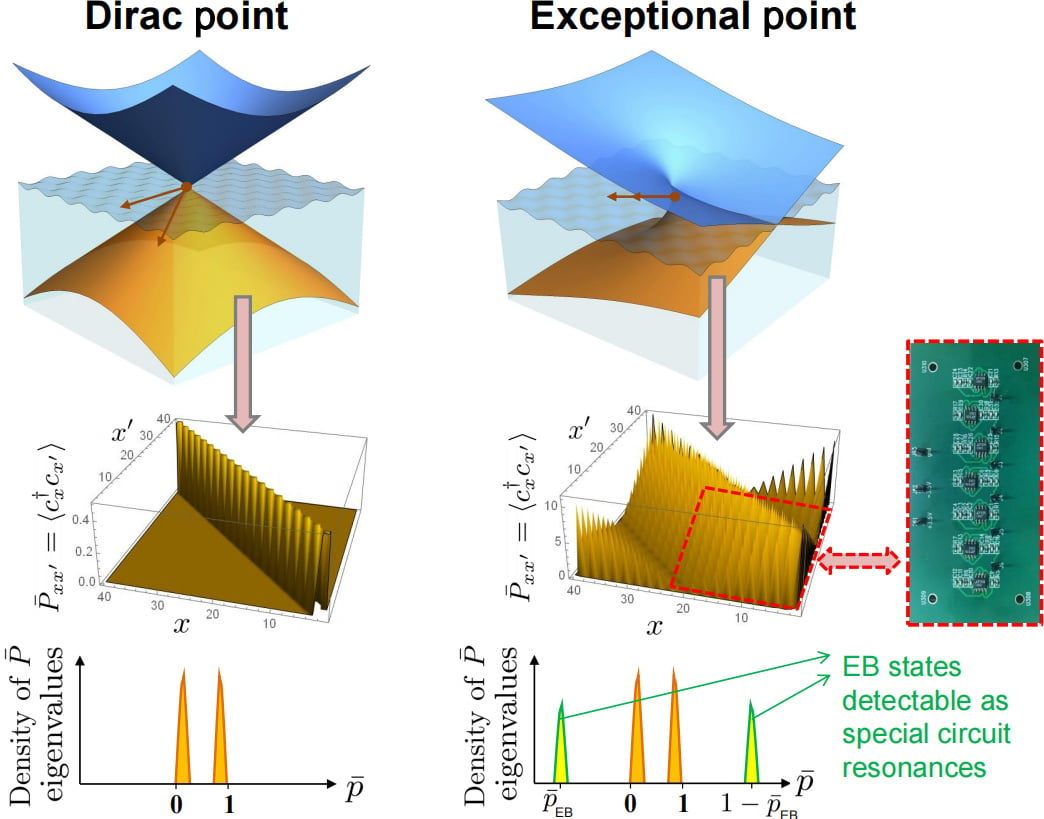
Exceptional bound states and negative entanglement entropy in electrical circuits
Reporting in Science Bulletin, physicists from Singapore and China have experimentally observed elusive states that mathematically possess negative entanglement entropy. Instead of using a quantum system, the research team employed a non-quantum (or classical) electrical circuit to generate a ‘sandbox’ system that is mathematically identical to a system with negative entanglement, but without the challenges accompanying true quantum systems. Such classical electrical circuits are built with easily available electronic components such as resistors, capacitors, and operational amplifiers, without the need for ultralow cryogenic cooling and high-precision lasers using needed in a quantum system.
“EB states are highly robust and exhibit prominent measurable signatures, thus greatly facilitating their physical realization in relatively simple classical networks such as electrical circuits without the need for fine-tuning,” said Professor Xiangdong Zhang from the Beijing Institute of Technology whose research team provided the experimental measurements of EB states using electrical circuits.
“A very pertinent question that we have always wanted to answer is: can the esoteric negative entanglement behavior manifest in realistic experiments? In this work, we provide an affirmative “yes” through the novel concept of exceptional bound (EB) states,” said the project leader Assistant Professor Ching Hua Lee from the National University of Singapore.
“EB states are special states that provide the key fingerprints for negative entanglement,” said Professor Haiyu Meng from Xiangtan University, co-author of this work. Whenever the host system becomes very sensitive due to the non-Hermiticity, EB states may emerge as a direct consequence of negative entanglement.
“This work suggests classical electrical circuits as a new hunting ground for the search of exotic quantum phenomena which are otherwise challenging to realize using atoms and material crystals. Due to their ease of fabrication, electrical circuits may offer a low-cost sandbox for designing and prototyping devices useful for future quantum technology”, said Assistant Professor Yee Sin Ang from the Singapore University of Technology and Design, co-author of this work.
The demonstration of negative entanglement entropy can have a profound impact in many areas of physics and engineering, particularly quantum information technology. Going forward, EB states and electrical circuits can be used to probe exotic physics in higher dimensions, thereby ushering a new fertile arena for the triple interplay of topological, non-Hermitian, and EB physics.
Reference: “Experimental observation of exceptional bound states in a classical circuit network” by Deyuan Zou, Tian Chen, Haiyu Meng, Yee Sin Ang, Xiangdong Zhang and Ching Hua Lee, 29 May 2024, Science Bulletin.
DOI: 10.1016/j.scib.2024.05.036
Never miss a breakthrough: Join the SciTechDaily newsletter.
Follow us on Google and Google News.
7 Comments
When physics no longer believes in mathematics, such as no longer believes the scientific validity of low dimensional spacetime topological fractal structure. It can only believe in God, angels, and even a strange cat (exotic quantum phenomena).
Scientific research guided by correct theories can help humanity avoid detours, failures, and pomposity. Please witness the exemplary collaboration between theoretical physicists and experimentalists (https://scitechdaily.com/microscope-spacecrafts-most-precise-test-of-key-component-of-the-theory-of-general-relativity/#comment-854286). Some people in contemporary physics has always lived in a self righteous children’s story world. Whose values have been overturned by such a comical and ridiculous reality? CP violation opened the dirtiest and ugliest era in the history of physics.
Space has physical properties of zero viscosity and absolute incompressibility. Zero viscosity and absolute incompressibility are physical characteristics of ideal fluids. The space with ideal fluid physical characteristics forms vortices via topological phase transitions, which is not difficult to understand mathematically. Once the topological vortex is formed, it occupies space and maintains its presence in time. This is the transition from chaos to order via two bidirectional coupled continuous chaotic systems.
Symmetry of topological vortex can be used to explore particle behavior under spatial, temporal, and quantum number reversals, involving quantum gravity, discrete and continuous changes. It underpins the consistency of natural laws and experiment reproducibility. The perpetually swirling topological vortices defy traditional physics’ expectations, heavily influencing traditional physics theories and potentially unveiling new particles and forces.
The perpetually swirling topological vortices defy traditional physics’ expectations potentially unveiling new particles and forces, and have an impact on modern physics theories.
Topological vortex fractal structures are ubiquitous. Topological spin creates all things. Topological spin creates the world.
Topological vortex fractal structures are ubiquitous. Topological spin creates all things. Topological spin creates the world. Topological vortices exhibit parity conservation, charge conjugation, and time reversal symmetry. CP violation opened the dirtiest and ugliest era in the history of physics.
The ugliest aspect of some so-called scholars in contemporary physics is that they would rather use two coins, God, or even an ugly cat to explain the interactions and changes of low dimensional spacetime matter than topological vortex fractal structures.
Ask the so-called scholars to reply:
1. From cosmic accretion disks to particle spin, is the spin related to topological vortex fractal structure?
2. Is spin a physical reality?
3. Is spin related to the topological spin?
In a pivotal discovery, researchers have identified a fundamental link between quantum entanglement and topology (https://scitechdaily.com/quantum-entanglements-new-dimension-a-topological-breakthrough/).
Please ask researchers to think deeply:
1. Is quantum gravity related to the spin of topological vortices?
2.Is quantum entanglement related to the spacetime entanglement of topological vortices?