
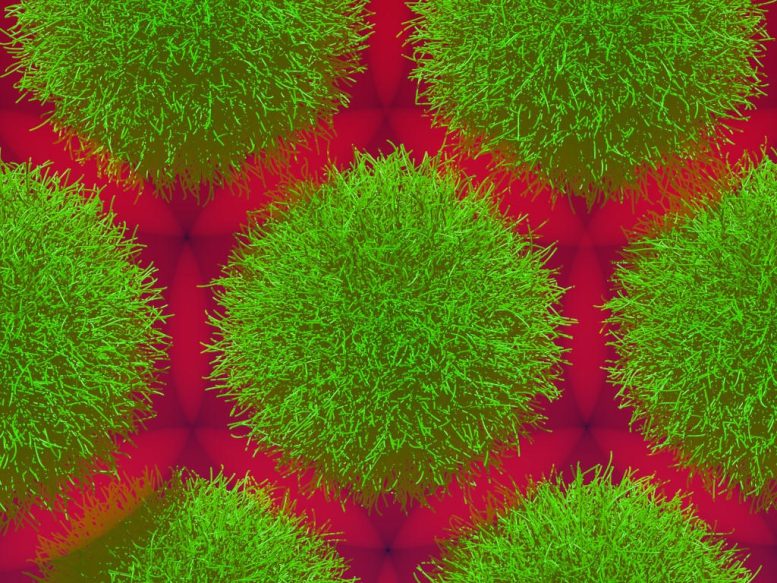
Microgels shrink due to overlapping ion clouds, a phenomenon now confirmed by neutron scattering. This breakthrough has exciting applications in pharmaceuticals and industrial materials.
Scientists from PSI and the University of Barcelona have managed to explain the strange behavior of microgels. Their experiments with neutron beams have stretched the capabilities of this measurement technique to its limits. This breakthrough holds promising potential for new applications in the fields of materials science and pharmaceutical research.
They flow through our arteries, add color to our walls, or make milk tasty: tiny particles or droplets that are very finely distributed in a solvent. Together they form a colloid. Whereas the physics of colloids involving hard particles – such as color pigments in emulsion paint – is understood well, colloids involving soft particles – such as hemoglobin, the red pigment in blood, or droplets of fat in milk – hold some startling surprises.
An experiment carried out 15 years ago showed that soft particles made of polymers – so-called microgels –shrink abruptly when their concentration in a solvent is increased above a certain threshold. When this happens, large particles contract until they are the size of their smaller neighbors. Amazingly, this happens even when the particles are not actually in contact with each other.
The researchers were puzzled: How does a gel particle know how big its neighbor is without touching it? Is there some sort of “telepathy” going on between microgels?
Hypothesis of 2016 Confirmed
“Of course not,” smiles Urs Gasser. The physicist has been studying the miraculous shrinking of microgels in colloids for the past ten years.
Together with a team of researchers, he published a paper in 2016 explaining the phenomenon. Briefly, in this situation, the polymer particles consist of long carbon chains. These carry a weak negative charge at one end. These chains form a ball, the microgel. This can be thought of as resembling a ball of wool, with the properties of a sponge.
This three-dimensional tangle therefore contains negative point charges that attract positively charged ions in the liquid. These so-called counterions arrange themselves around the negative charges in the ball, forming a positively charged cloud on the surface of the microgel. When the microgels come close together, their charge clouds overlap (see image). This in turn increases the pressure inside the liquid, which compresses the microgel particles until a new equilibrium is reached.
At the time, however, the research team was unable to provide experimental proof of the cloud of counterions. Together with his Ph.D. students Boyang Zhou and Alberto Fernandez-Nieves of the University of Barcelona, Gasser has now furnished that evidence – and it impressively supports the 2016 hypothesis. The results have been published in the journal Nature Communications.
SINQ Neutron Source Crucial to Solving the Puzzle
This was possible thanks to the neutrons from PSI’s spallation source SINQ – along with an experimental trick. Because the cloud of counterions in the colloid is so rarefied that it is not actually visible in the image of the scattered neutrons. The counterions account for no more than one percent of the mass of a microgel.
So Gasser, Zhou, and Fernandez-Nieves examined two samples: one colloid in which all the counterions were sodium ions and another in which they were ammonium ions (NH4). Both these ions also occur naturally in microgels – and they scatter neutrons differently. Subtracting one image from the other leaves the signals of the counterions. Boyang Zhou: “This seemingly simple solution requires the utmost care in preparing the colloids so as to make the ion clouds visible. No one has ever measured such a rarefied ion cloud before.”
Applications in Cosmetics and Pharmaceuticals
Knowing how soft microgels behave in colloids means that they can be tailored to fit many different applications. In the oil industry, they are pumped into underground reservoirs to adjust the viscosity of the oil in the well and facilitate its extraction. In cosmetics, they give creams the desired consistency.
Smart microgels are also conceivable, which could be loaded with medicines. The particles could react to gastric acid, for example, and release the drug by shrinking. Or else a microgel could shrink into a small, densely packed polymer ball when the temperature increases, one that reflects light differently than in its swollen state. This could be used as a temperature sensor in narrow fluid channels. Other sensors could be designed to respond to changes in pressure or contamination. “There are no limits to the imagination,” says Urs Gasser.
Reference: “Measuring the counterion cloud of soft microgels using SANS with contrast variation” by Boyang Zhou, Urs Gasser and Alberto Fernandez-Nieves, 7 July 2023, Nature Communications.
DOI: 10.1038/s41467-023-39378-5
Never miss a breakthrough: Join the SciTechDaily newsletter.
Follow us on Google and Google News.