
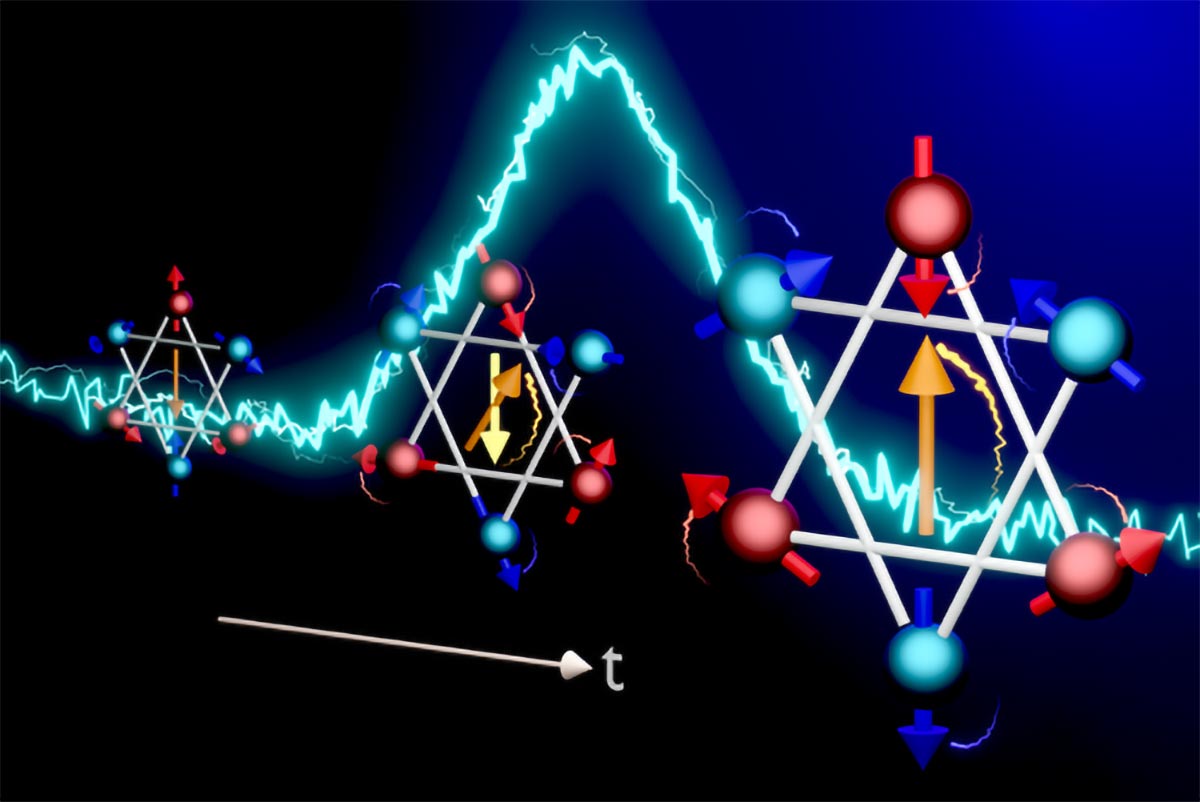
Researchers have managed to visualize two distinct mechanisms in which magnetism can switch within antiferromagnetic materials.
Scientists have now produced the first clear visualization of two separate processes that cause the up and down spins of electrons to switch inside an antiferromagnet, a type of material in which opposing spin directions neutralize one another. One of these switching pathways offers a potential foundation for developing ultrafast, non-volatile memory and logic technologies that could operate far faster than the systems in use today. The study was recently published in the journal Nature Materials.
Throughout the history of computing, information has been represented as 0s and 1s through many different tools, including punched paper, metal rods, vacuum tubes, and eventually transistors. As the demand for processing power continues to rise, researchers are exploring alternative ways to encode data.
Antiferromagnets have become a promising candidate for this search because their unusual magnetic behavior, or practical lack of magnetic response, may allow digital information to be written in entirely new ways.
The work was carried out by a team led by Ryo Shimano at the University of Tokyo.
“For many years,” says Shimano, “scientists believed that antiferromagnets like Mn₃Sn (manganese three tin) could switch their magnetization extremely quickly. However, it was unclear whether this non-volatile switching could complete within a few to several tens of picoseconds or how the magnetization really changed during the switching process.”
Unraveling a Long-Standing Mystery
The biggest question about the mechanism was whether it was driven by the heat generated by the electric current or by the current itself. The researchers thus set out to find the answer to this question by visualizing the mechanism. They prepared a thin layer of Mn3Sn and sent short electric pulses through it. Then, using precisely controlled ultrafast flashes of light with varying delays compared to the electric pulse, they tried to create a “time-lapse image” of the change in magnetization.
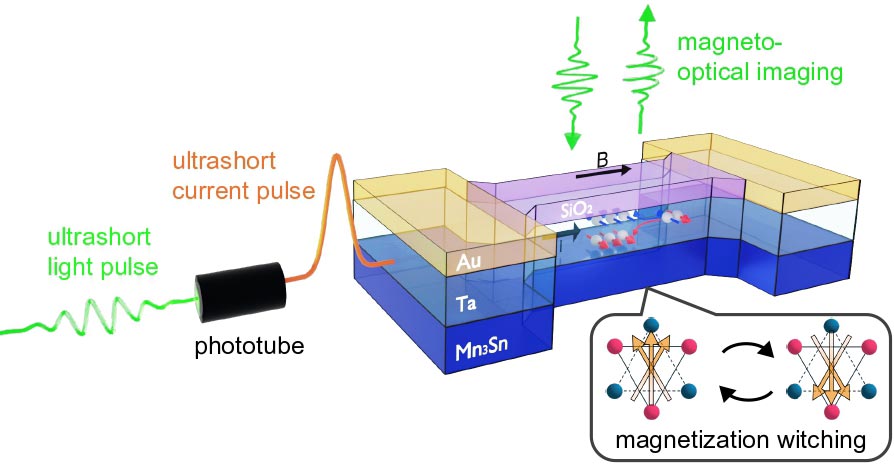
“The most challenging part of the project,” Shimano remembers, “was measuring the infinitesimal changes in the magneto-optical signal. However, we were surprised how clearly we could finally observe the switching process once we established the right method.”
Two Mechanisms Revealed
Their result was something that had never been seen before: a frame-by-frame visualization of the change in the magnetic pattern. The frames revealed that switching occurs in two distinct processes depending on the current amplitude: one driven by a thermal process under a large current and another driven without substantial heating under a weak current. The latter process could provide the base for applications in developing reliable next-generation spintronic devices for computing, communications, and advanced electronics. To Shimano, this means one thing: boundaries of knowledge waiting to be expanded.
“Our present fastest time-resolved observation of electrical switching in Mn₃Sn is 140 picoseconds, mainly limited by how short the current pulses can be generated in our device setup. However, our findings suggest that the material itself could switch even faster under appropriate conditions. In the future, we aim to explore these ultimate limits by creating even shorter current pulses and by optimizing the device structure.”
Reference: “Ultrafast time-resolved observation of non-thermal current-induced switching in an antiferromagnetic Weyl semimetal” by Kazuma Ogawa, Hanshen Tsai, Naotaka Yoshikawa, Takumi Matsuo, Yutaro Tsushima, Mihiro Asakura, Hanyi Peng, Takuya Matsuda, Tomoya Higo, Satoru Nakatsuji and Ryo Shimano, 4 December 2025, Nature Materials.
DOI: 10.1038/s41563-025-02402-8
Never miss a breakthrough: Join the SciTechDaily newsletter.
Follow us on Google and Google News.
2 Comments
Scientists Watch Spins Switch in 140 Trillionths of a Second.
VERY GOOD.
Please ask scientists to think deeply:
Is the spin you observed related to topological spin? Topological materials are reshaping the scientific paradigm and the future of human society.
NOTHING SPINS, in the universe!
Rotation is a।different thing and is slow!
so, may be you saw ghost of Don! ✔️😎
BETTET KEEP PEACE (SHUT UP!)