
Close Menu
    Facebook X (Twitter) Instagram
    SciTechDaily
    • Biology
    • Chemistry
    • Earth
    • Health
    • Physics
    • Science
    • Space
    • Technology
    Facebook X (Twitter) Pinterest YouTube RSS
    SciTechDaily
    Home»Science»Sea Snakes See in Technicolor: A Reversal of Ancestral Vision Loss
    Science

    Sea Snakes See in Technicolor: A Reversal of Ancestral Vision Loss

    By Oxford University Press USAJuly 18, 2023No Comments3 Mins Read
    Facebook Twitter Pinterest Telegram LinkedIn WhatsApp Email Reddit
    Share
    Facebook Twitter LinkedIn Pinterest Telegram Email Reddit
    Underwater Sea Snake Concept Art
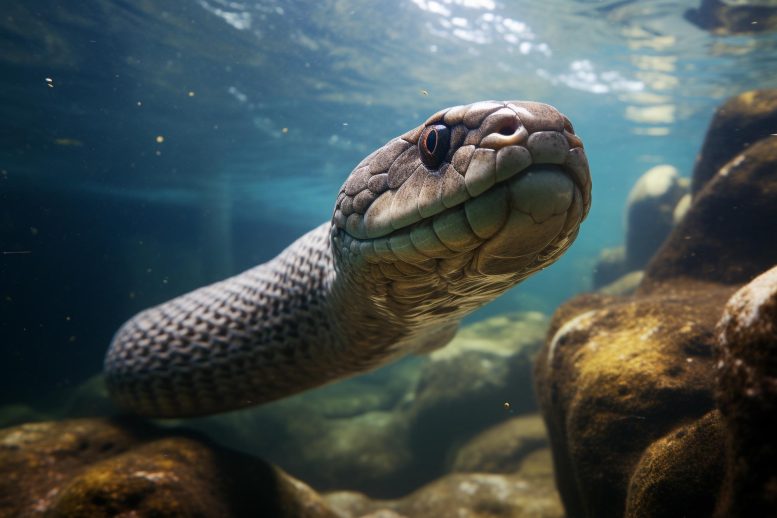
    The annulated sea snake has evolved to see a wider range of colors, a notable reversal from its ancestors who lost color vision due to adaptations to low-light environments. This evolution includes four copies of the opsin gene SWS1, providing sensitivity to longer wavelengths found in their ocean habitats. This expanded vision helps these sea snakes better distinguish predators, prey, and potential mates.

    A new study reveals that the annulated sea snake, a venomous snake species indigenous to the oceans of Australia and Asia, has evolved to perceive an extended color range.

    A new paper in Genome Biology and Evolution, published by Oxford University Press, finds that the annulated sea snake, a species of venomous snake found in ocean waters around Australia and Asia, appears to have evolved to see an extended palette of colors after its ancestors lost that ability in response to changing environments.

    Color vision in animals is primarily determined by genes called visual opsins. While there have been multiple losses of opsin genes during the evolution of tetrapods (the group including amphibians, reptiles, and mammals), the emergence of new opsin genes is extremely rare. Before this study, the only evolution  of new opsin genes within reptiles appeared to have occurred in species of  Helicops, a genus of snake from South America.
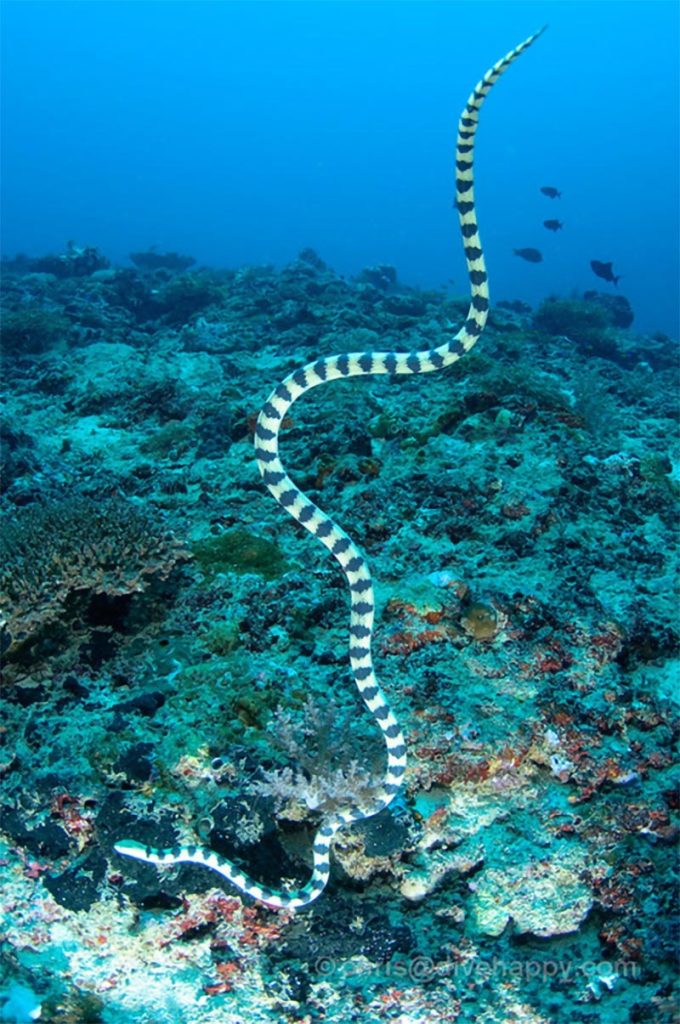
    Hydrophis cyanocinctus (Annulated Sea Snake)
    Hydrophis cyanocinctus (annulated sea snake). Credit: Chris Mitchell/ Genome Biology and Evolution

    This study used published reference genomes to examine visual opsin genes across five ecologically distinct species of elapid snakes. The history of elapids, a family of snakes that includes cobras and mambas in addition to the annulated sea snake, presents an opportunity to investigate the molecular evolution of vision genes. Early snakes had lost two visual opsin genes during their dim-light burrowing phase and could only perceive a very limited range of colors. However, some of their descendants now occupy brighter environments; two elapid lineages have even moved from terrestrial to marine environments within the last 25 million years.

    Annulated Sea Snakes Regain Opsin Genes

    Researchers here found that the annulated sea snake possesses four intact copies of the opsin gene SWS1. Two of these genes have the ancestral ultraviolet sensitivity, and two have evolved a new sensitivity to the longer wavelengths that dominate ocean habitats. The study’s authors believe that this sensitivity may provide the snakes with better color discrimination to distinguish predators, prey and/or potential mates against colorful marine backgrounds. This is dramatically different from the evolution of opsins in mammals like bats, dolphins, and whales during ecological transitions; they experienced further opsin losses as they adapted to dim light and aquatic environments.

     “The earliest snakes lost much of their ability to see color due to their dim-light burrowing lifestyle,” said the paper’s lead author Isaac Rossetto. “However, their sea snake descendants now occupy brighter and more spectrally complex marine environments. We believe that recent gene duplications have dramatically expanded the range of colors sea snakes can see. For reference, us humans have a similarly expanded sensitivity to colors, while cats and dogs are partially color-blind much like those early snakes.”

    For more on this discovery, see The Remarkable Vision Evolution of Sea Snakes.

    Reference: “Functional Duplication of the Short-Wavelength-Sensitive Opsin in Sea Snakes: Evidence for Reexpanded Color Sensitivity Following Ancestral Regression” by Isaac H Rossetto, Kate L Sanders, Bruno F Simões, Nguyen Van Cao and Alastair J Ludington, 12 July 2023, Genome Biology and Evolution.
    DOI: 10.1093/gbe/evad107

    Funding: Australian Research Council Discovery Project

    Never miss a breakthrough: Join the SciTechDaily newsletter.
    Follow us on Google and Google News.

    Evolution Genetics Marine Biology Snake
    Share. Facebook Twitter Pinterest LinkedIn Email Reddit

    Related Articles

    Sss-eeing in Color: The Remarkable Vision Evolution of Sea Snakes

    Sea Snakes Have Been Modifying Genetically to See Underwater for 15 Million Years

    Sturgeon “Methuselah Fish” Genome Sequenced – Important Piece of Evolutionary Puzzle

    Unraveling the Mystery of Neanderthal Death Rites – Discovery at ‘Flower Burial’ Site Offers “Unparalleled Opportunity”

    Fascinating Shark and Ray Vision Evolution Research Reveals Sharks Can’t See Colors

    New Fossils of Ancient Snake With Hind Legs Reveals Tantalizing Details of Evolution

    Scientists Reveal the Complex Story Behind the Beaker Phenomenon

    Examining the Genes of Stone Age Farmers

    Stickleback Fish Used Pre-Existing Genes to Go from Saltwater to Freshwater Environments

    Leave A Reply Cancel Reply

    • Facebook
    • Twitter
    • Pinterest
    • YouTube

    Don't Miss a Discovery

    Subscribe for the Latest in Science & Tech!

    Trending News

    Millions Take These IBS Drugs, But a New Study Finds Serious Risks

    Scientists Unlock Hidden Secrets of 2,300-Year-Old Mummies Using Cutting-Edge CT Scanner

    Bread Might Be Making You Gain Weight Even Without Eating More Calories

    Scientists Discover Massive Magma Reservoir Beneath Tuscany

    Europe’s Most Active Volcano Just Got Stranger – Here’s Why Scientists Are Rethinking It

    Alzheimer’s Symptoms May Start Outside the Brain, Study Finds

    Millions Take This Popular Supplement – Scientists Discover a Concerning Link to Heart Failure

    The Universe Is Expanding Too Fast and Scientists Can’t Explain Why

    Follow SciTechDaily
    • Facebook
    • Twitter
    • YouTube
    • Pinterest
    • Newsletter
    • RSS
    SciTech News
    • Biology News
    • Chemistry News
    • Earth News
    • Health News
    • Physics News
    • Science News
    • Space News
    • Technology News
    Recent Posts
    • U.S. Waste Holds $5.7 Billion Worth of Crop Nutrients
    • Scientists Say a Hidden Structure May Exist Inside Earth’s Core
    • Doctors Surprised by the Power of a Simple Drug Against Colon Cancer
    • Why Popular Diabetes Drugs Like Ozempic Don’t Work for Everyone: The “Genetic Glitch”
    • Scientists Create Improved Insulin Cells That Reverse Diabetes in Mice
    Copyright © 1998 - 2026 SciTechDaily. All Rights Reserved.
    • Science News
    • About
    • Contact
    • Editorial Board
    • Privacy Policy
    • Terms of Use

    Type above and press Enter to search. Press Esc to cancel.