
Using Neutron Stars To Detect Dark Matter
The search for dark matter may need a detector larger than we can build on Earth, but it could be that a neutron star can do the job.
The quest to uncover the nature of dark matter is one of the greatest challenges in science today, but the key to finally understanding this mysterious substance may well lie in the stars.
Or to be precise, one particular type of star – the neutron star.
So far, scientists have been able to infer the existence of dark matter, but not directly observe it. Actually detecting dark matter particles in experiments on Earth is a formidable task, because the interactions of dark matter particles with regular matter are exceedingly rare.
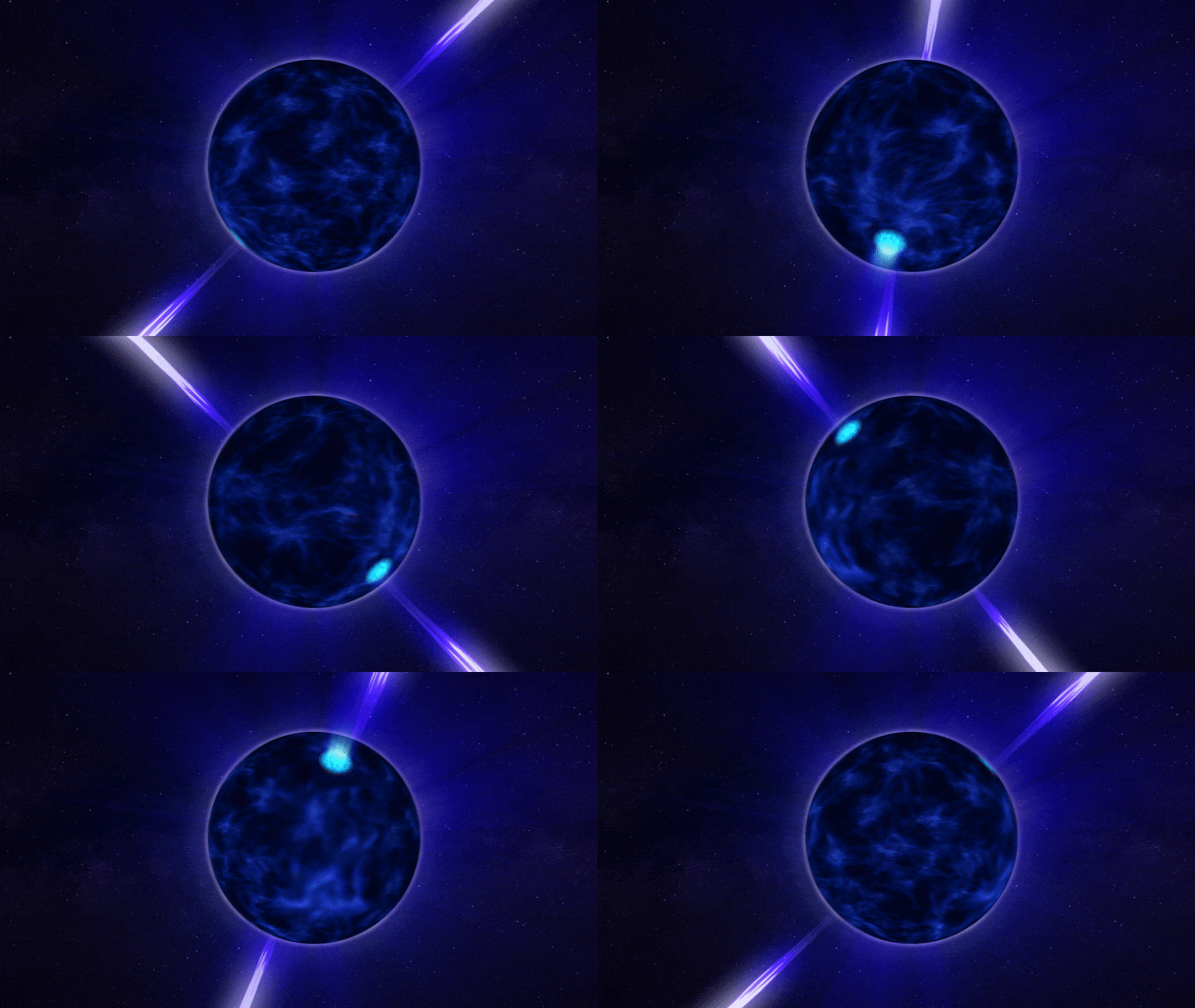
To search for these incredibly rare signals, we need a very large detector – perhaps so big that it is impracticable to build a detector large enough on Earth. However, Nature provides an alternative option in the form of neutron stars – an entire neutron star can act as the ultimate dark matter detector.
In research published in Physical Review Letters, we have determined how to much more accurately use information gained from these unique natural dark matter detectors.
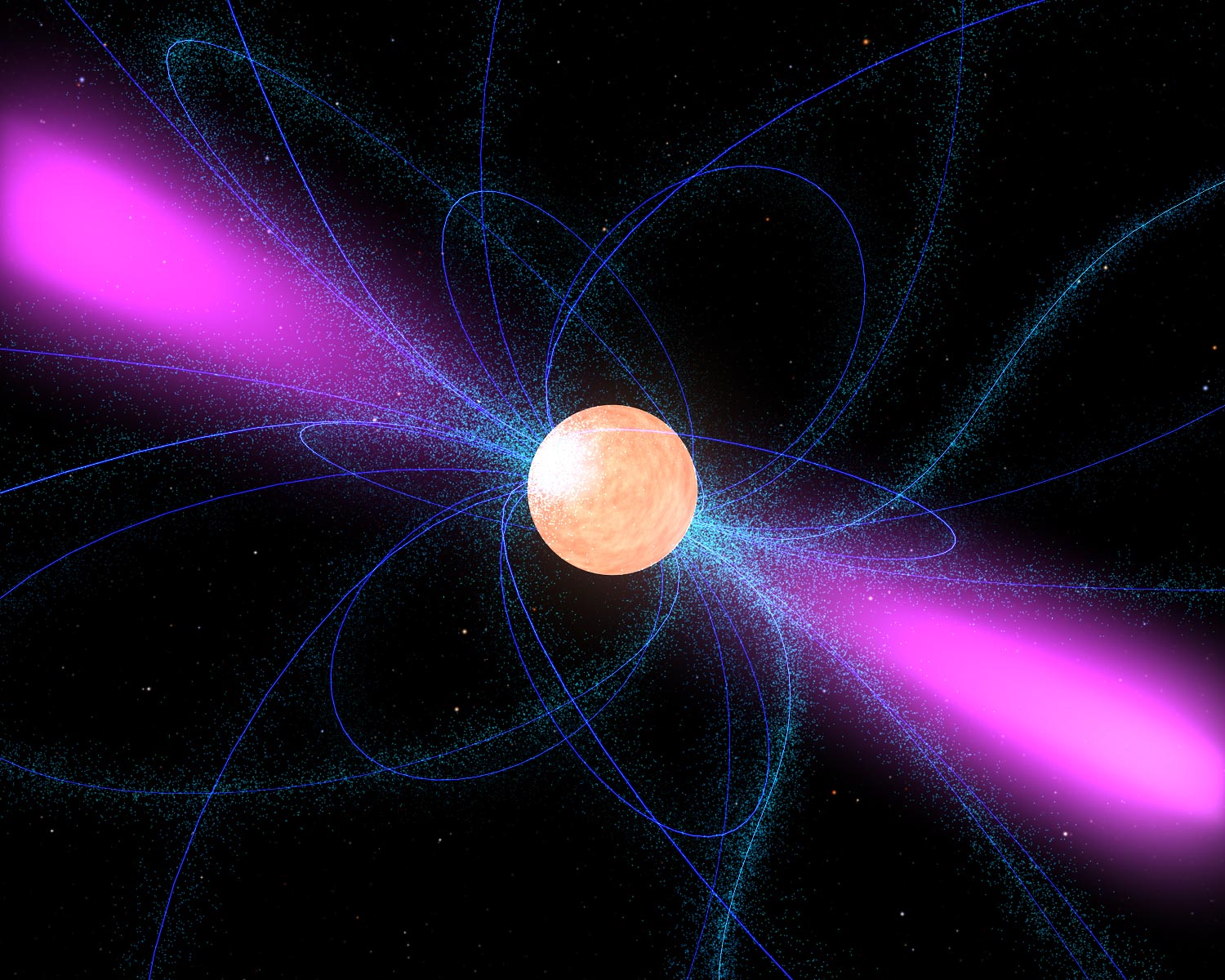
Neutron stars are the densest stars known to exist and form when giant stars die in supernovae explosions. Left behind is a collapsed core, in which gravity presses matter together so tightly that protons and electrons combine to make neutrons. With a mass comparable to that of the Sun – compressed into a 10km radius – one teaspoon of neutron star material has a mass of about a billion tons!
These stars are ‘cosmic laboratories’, enabling us to study how dark matter behaves under extreme conditions that cannot be replicated on Earth.
Trapping Elusive Particles
Dark matter interacts only very weakly with ordinary matter. For example, it can pass through a light-year of lead (about 10 trillion kilometers) without being stopped. Incredibly, however, neutron stars are so dense that they may be able to trap all dark matter particles that pass through them.

Heating, Collapse, and Black Hole Formation
Theoretically, the dark matter particles would collide with neutrons in the star, lose energy, and become gravitationally trapped. Over time, dark matter particles would accumulate in the core of the star. This is expected to heat up old, cold, neutron stars to a level that may be within reach of future observations. In extreme cases, the accumulation of dark matter may trigger the collapse of the star into a black hole.
This means that neutron stars may allow us to probe certain types of dark matter that would be difficult or impossible to observe in experiments on Earth.
On Earth, dark matter experiments look for tiny nuclear-recoil signals, caused by incredibly rare collisions of slow-moving dark matter particles. In comparison, the strong gravitational field of a neutron star accelerates dark matter to quasi-relativistic speeds, resulting in much higher energy collisions.
Another problem for Earth-based detection is that nuclear-recoil experiments are most sensitive to dark matter particles that have a similar mass to atomic nuclei, making it harder to detect dark matter that might be much lighter or heavier.
However, dark matter particles can theoretically be trapped in stars and planets in considerable amounts, regardless of how light or heavy they are.
Improving the Math Behind the Stars
A critical challenge in using neutron stars to detect dark matter is ensuring that the calculations scientists use, fully account for the unique environment of the star. Although the capture of dark matter in neutron stars had been studied for decades, existing calculations have missed important physical effects.
So, our team set about making key improvements to the calculation of the dark matter capture rate – i.e., how fast the dark matter accumulates in neutron stars – which changed the answers considerably.
Sharper Tools, Better Answers
Our research correctly accounts for nucleon structure, rather than treating the neutrons as point particles, and includes the effects of strong forces between nucleons, rather than modeling the neutrons as a free gas of particles. This built upon our earlier work in which we incorporated the composition of the star, relativistic effects, quantum statistics, and gravitational focusing.
Put simply, we showed how to correctly think about dark matter collisions in the extreme neutron star environment, which is so very different from dark matter detectors on Earth.
This new research greatly increases the accuracy and robustness of our estimates of the dark matter capture rate. This paves the way for us to better determine the strength of dark matter interactions with ordinary matter.
Ultimately, evidence (or lack of evidence) of dark matter accumulation in stars would provide valuable clues about where to target experimental efforts on Earth, helping to unlock the mystery of dark matter.
Reference: “Nucleon Structure and Strong Interactions in Dark Matter Capture in Neutron Stars” by Nicole F. Bell, Giorgio Busoni, Theo F. Motta, Sandra Robles, Anthony W. Thomas and Michael Virgato, 10 September 2021, Physical Review Letters.
DOI: 10.1103/PhysRevLett.127.111803
The research team involved scientists from the ARC Centre of Excellence for Dark Matter Particle Physics, including Dr. Sandra Robles, Michael Virgato and Professor Nicole Bell from the University of Melbourne, Dr. Giorgio Busoni from the Max Planck Institute for Nuclear Physics in Germany, and Theo Motta and Professor Anthony Thomas AC from the University of Adelaide.
Never miss a breakthrough: Join the SciTechDaily newsletter.
Follow us on Google and Google News.
5 Comments
These astro”physicists” just dont get it. Thete is no dark matter or dark energy. Plasma-electromagnetism is everything they need and this has already been shown in the NASA/JPL and Los Alamos labs. Low energy plasma labs fail but yhe ones with government power have enough current to show already the Dark Universe is a waste of time.
Fail.
The basis for the speculations in this article is that Dark Matter consists of particles.
Another possibility, from a view of String Theory, is that Dark Matter appears to us as an effect of string/anti-string annihilations. As you may know, quantum mechanics requires that strings must be formed as pairs in the quantum foam – a string and an anti-string – that immediately annihilate each other. Quantum mechanics also requires both the string and anti-string to be surrounded by “jitters” that reduce their monstrous vibrating energies. What if this jitter remains for a fraction of an instant after their string/anti-string annihilations? This temporary jitter would be seen by us as matter, via E=mc2, for that instant before it too returns to the foam. That’s why we never see it – the “mass” lasts only for that instant but is repeated over and over and over, all over. Specifics on this can be found in my YouTube, Dark Matter – A String Theory Way at https://www.youtube.com/watch?v=N84yISQvGCk
What if Dark Mater is repelled by Normal Mater? Then there would be no accumulation.
How can this substance ” dark matter” nearly interact with regular matter and yet has this powerful gravitational force as to coral galaxies? How can this dark matter that flies through real matter and yet form regional clumps in the void? The argument for Dark matter is Irrational Exuberance and astronomical who believe in this holy grail need to go back around the theoretical drawing table.
I suggest that Dark Matter (a kind of pseudo-matter described in my YouTube above) is everywhere but we only notice it when normal matter is around, too. Gas clouds form stars and may gravitationally attract nearby stars, but there’s just not enough normal matter for the galaxy shapes we see to exist. BTW, if you’re interested in a String Theory explanation of how galaxies form in the first place, see my YouTube, Creating Universes – A String Theory Way at https://www.youtube.com/watch?v=IaxfuKXdhkg&t=6s