
FAU College of Engineering and Computer Science researchers use flow visualization to qualitatively test facemasks and social distancing.
Currently, there are no specific guidelines on the most effective materials and designs for facemasks to minimize the spread of droplets from coughs or sneezes to mitigate the transmission of COVID-19. While there have been prior studies on how medical-grade masks perform, data on cloth-based coverings used by the vast majority of the general public are sparse.
Research from Florida Atlantic University’s College of Engineering and Computer Science, just published in the journal Physics of Fluids, demonstrates through visualization of emulated coughs and sneezes, a method to assess the effectiveness of facemasks in obstructing droplets. The rationale behind the recommendation for using masks or other face coverings is to reduce the risk of cross-infection via the transmission of respiratory droplets from infected to healthy individuals.
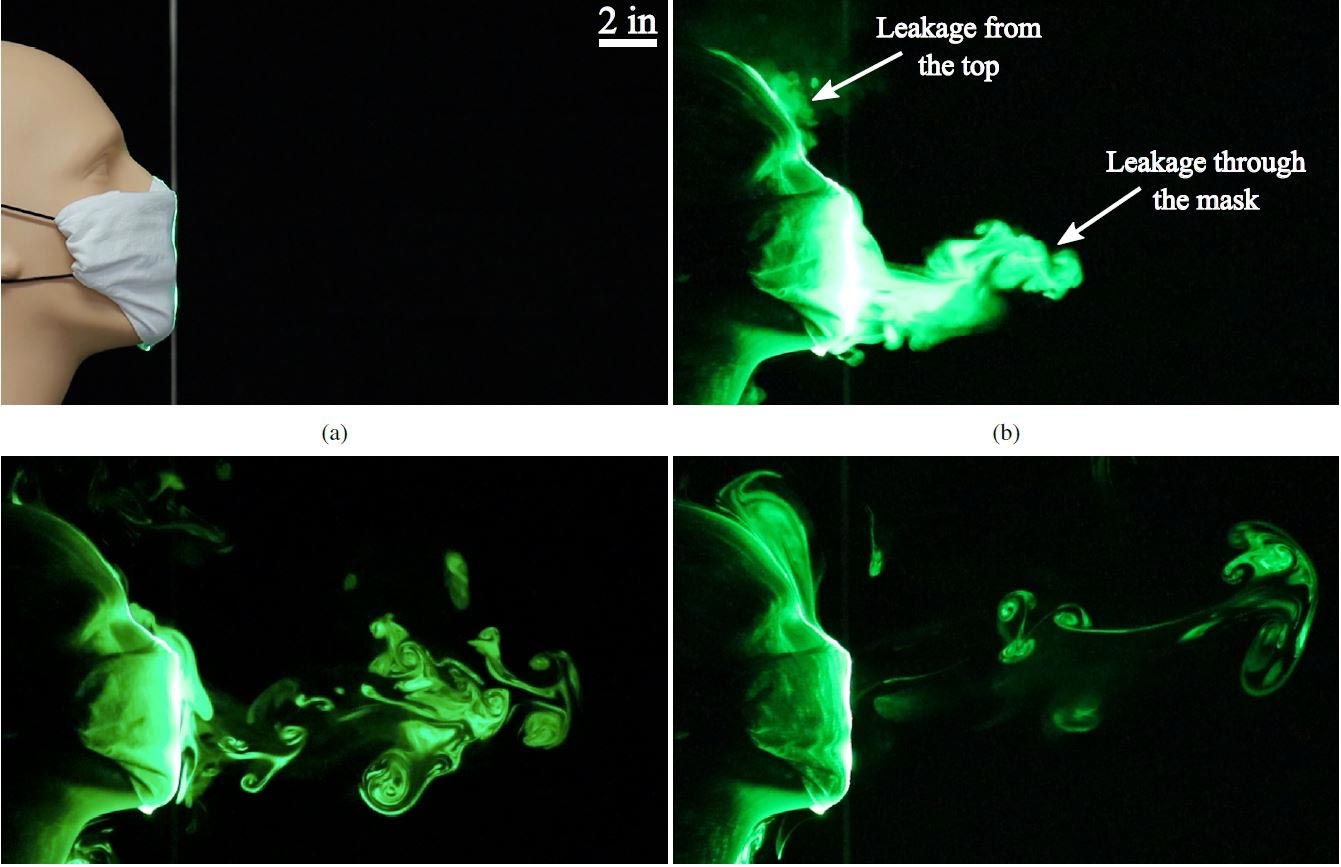
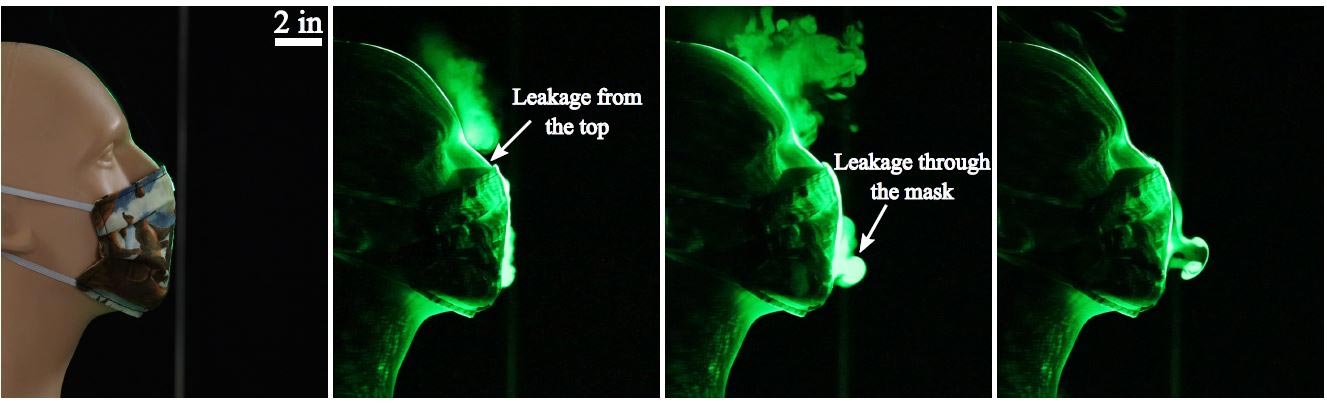
Researchers employed flow visualization in a laboratory setting using a laser light sheet and a mixture of distilled water and glycerin to generate the synthetic fog that made up the content of a cough-jet. They visualized droplets expelled from a mannequin’s mouth while simulating coughing and sneezing. They tested masks that are readily available to the general public, which do not draw away from the supply of medical-grade masks and respirators for healthcare workers. They tested a single-layer bandana-style covering, a homemade mask that was stitched using two layers of cotton quilting fabric consisting of 70 threads per inch, and a non-sterile cone-style mask that is available in most pharmacies. By placing these various masks on the mannequin, they were able to map out the paths of droplets and demonstrate how differently they perform.
Results showed that loosely folded facemasks and bandana-style coverings provide minimal stopping-capability for the smallest aerosolized respiratory droplets. Well-fitted homemade masks with multiple layers of quilting fabric, and off-the-shelf cone-style masks, proved to be the most effective in reducing droplet dispersal. These masks were able to curtail the speed and range of the respiratory jets significantly, albeit with some leakage through the mask material and from small gaps along the edges.
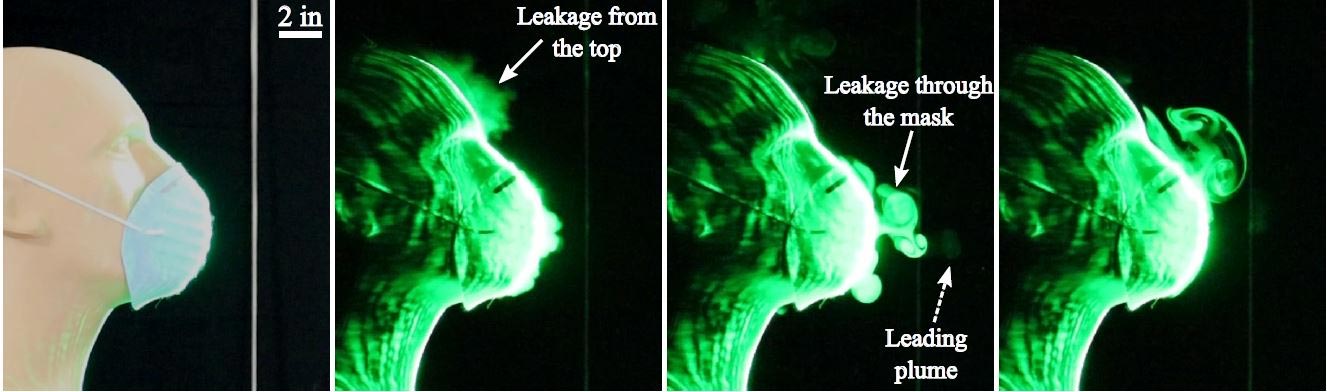
Importantly, uncovered emulated coughs were able to travel noticeably farther than the currently recommended 6-foot (1.8-meter) distancing guideline. Without a mask, droplets traveled more than 8 feet (2.4 meters); with a bandana, they traveled 3 feet, 7 inches (1.1 meters); with a folded cotton handkerchief, they traveled 1 foot, 3 inches (0.4 meters); with the stitched quilted cotton mask, they traveled 2.5 inches (6 centimeters); and with the cone-style mask, droplets traveled about 8 inches (20 centimeters).
“In addition to providing an initial indication of the effectiveness of protective equipment, the visuals used in our study can help convey to the general public the rationale behind social-distancing guidelines and recommendations for using facemasks,” said Siddhartha Verma, Ph.D., lead author and an assistant professor who co-authored the paper with Manhar Dhanak, Ph.D., department chair, professor, and director of SeaTech; and John Frakenfeld, technical paraprofessional, all within FAU’s Department of Ocean and Mechanical Engineering. “Promoting widespread awareness of effective preventive measures is crucial at this time as we are observing significant spikes in cases of COVID-19 infections in many states, especially Florida.”
When the mannequin was not fitted with a mask, they projected droplets much farther than the 6-foot distancing guidelines currently recommended by the United States Centers for Disease Control and Prevention. The researchers observed droplets traveling up to 12 feet within approximately 50 seconds. Moreover, the tracer droplets remained suspended in midair for up to three minutes in the quiescent environment. These observations, in combination with other recent studies, suggest that current social-distancing guidelines may need to be updated to account for aerosol-based transmission of pathogens.
“We found that although the unobstructed turbulent jets were observed to travel up to 12 feet, a large majority of the ejected droplets fell to the ground by this point,” said Dhanak. “Importantly, both the number and concentration of the droplets will decrease with increasing distance, which is the fundamental rationale behind social distancing.”
The pathogen responsible for COVID-19 is found primarily in respiratory droplets that are expelled by infected individuals during coughing, sneezing, or even talking and breathing. Apart from COVID-19, respiratory droplets also are the primary means of transmission for various other viral and bacterial illnesses, such as the common cold, influenza, tuberculosis, SARS (Severe Acute Respiratory Syndrome), and MERS (Middle East Respiratory Syndrome), to name a few. These pathogens are enveloped within respiratory droplets, which may land on healthy individuals and result in direct transmission, or on inanimate objects, which can lead to infection when a healthy individual comes in contact with them.
“Our researchers have demonstrated how masks are able to significantly curtail the speed and range of the respiratory droplets and jets. Moreover, they have uncovered how emulated coughs can travel noticeably farther than the currently recommended six-foot distancing guideline,” said Stella Batalama, Ph.D., dean of FAU’s College of Engineering and Computer Science. “Their research outlines the procedure for setting up simple visualization experiments using easily available materials, which may help healthcare professionals, medical researchers, and manufacturers in assessing the effectiveness of face masks and other personal protective equipment qualitatively.”
Reference: “Visualizing the effectiveness of face masks in obstructing respiratory jets featured” by Siddhartha Verma, Manhar Dhanak and John Frankenfield, 30 June 2020, Physics of Fluids.
DOI: 10.1063/5.0016018
Never miss a breakthrough: Join the SciTechDaily newsletter.
Follow us on Google and Google News.