
Close Menu
    Facebook X (Twitter) Instagram
    SciTechDaily
    • Biology
    • Chemistry
    • Earth
    • Health
    • Physics
    • Science
    • Space
    • Technology
    Facebook X (Twitter) Pinterest YouTube RSS
    SciTechDaily
    Home»Physics»Advanced Simulations Reveal How Air Conditioning Spreads COVID-19 Aerosols Through Restaurants
    Physics

    Advanced Simulations Reveal How Air Conditioning Spreads COVID-19 Aerosols Through Restaurants

    By SciTechDailyFebruary 9, 20211 Comment3 Mins Read
    Facebook Twitter Pinterest Telegram LinkedIn WhatsApp Email Reddit
    Share
    Facebook Twitter LinkedIn Pinterest Telegram Email Reddit
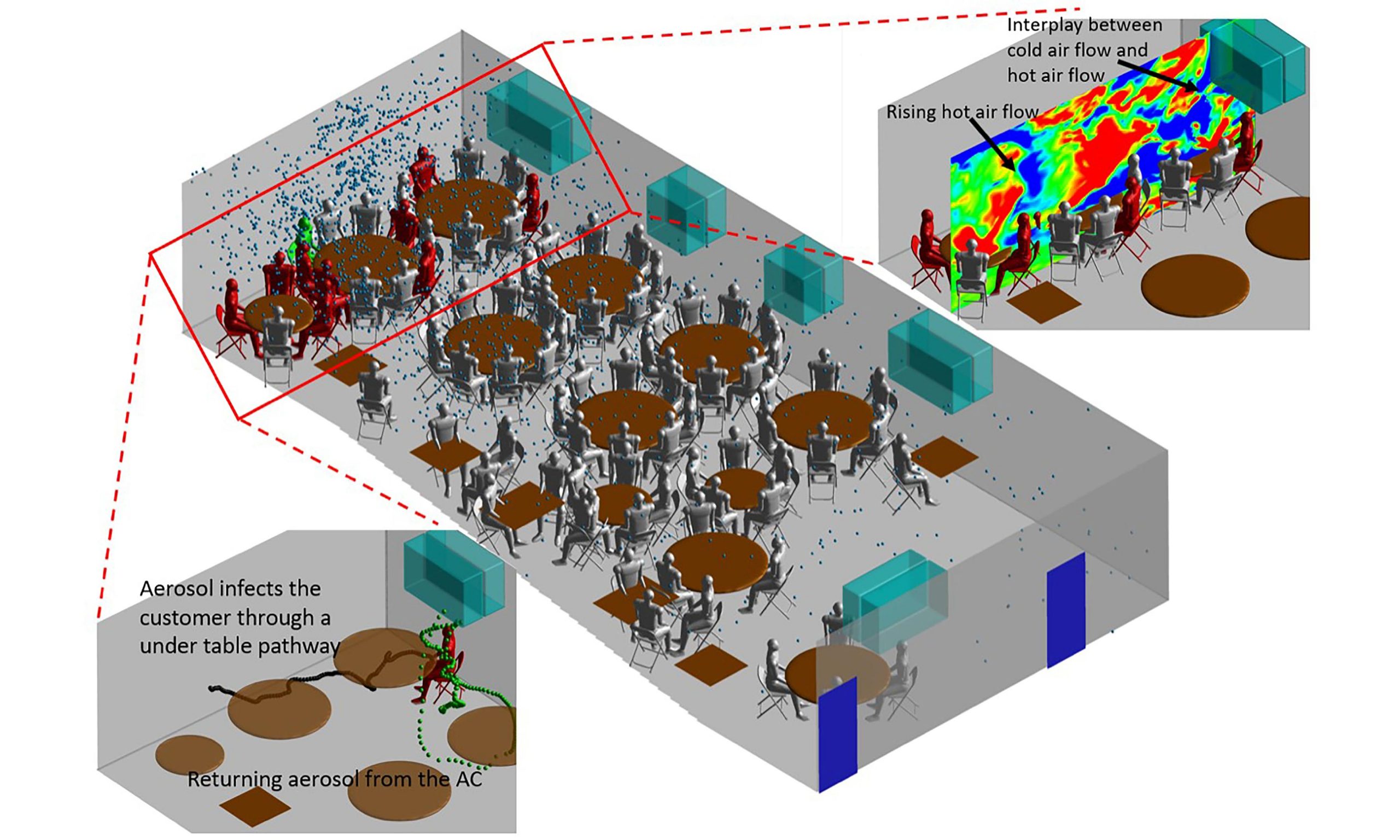
    Schematic of Flow and Particle Transport
    In Physics of Fluids, researchers report using advanced simulation methods to capture the complex flows that occur when the cold airflow from air conditioners interacts with the hot plume from a dining table and the transport of virus-loading particles within such flows. Schematic of the flow and particle transport, highlighting the two transport pathways, within the entire restaurant. Mannequins show where customers were seated. Credit: Han Liu

    Computer models showed that virus-laden aerosols can rise from under tables and recirculate through air conditioners.

    More preventive measures, such as shielding underneath tables and improving air conditioner filtration efficiency, could reduce exposure to COVID-19 within air-conditioned restaurants.

    The detailed physical processes and pathways involved in the transmission of COVID-19 are still not well understood. Researchers decided to use advanced computational fluid dynamics tools on supercomputers to deepen understanding of transmission and provide a quantitative assessment of how different environmental factors influence transmission pathways and airborne infection risk.

    A restaurant outbreak in China was widely reported as strong evidence of airflow-induced transmission of COVID-19. But it lacked a detailed investigation about exactly how transmission occurred.

    Why did some people get infected while others within the same area did not? What specific role did ventilation and air conditioning play in disease transmission? Exploring these questions can help develop more pinpointed preventative measures to improve our safety.

    Modeling Complex Airflow and Aerosol Transport

    In Physics of Fluids, from AIP Publishing, Jiarong Hong and colleagues at the University of Minnesota report using advanced simulation methods to capture the complex flows that occur when the cold airflow from air conditioners interacts with the hot plume from a dining table and the transport of virus-loading particles within such flows.

    “Our simulation captures various physical factors, including turbulent air flow, thermal effect, aerosol transport in turbulence, limited filtration efficiency of air conditioners, as well as the complex geometry of the space, all of which play a role in airborne transmission,” said Hong.

    Although many computer simulation studies of airborne transmission of COVID-19 have been conducted recently, few directly link the prediction of high-fidelity computational fluid dynamics simulation with the actual infection outbreaks reported through contact tracing.

    This work is the first realistic case simulated and linked directly with the prediction of simulation.

    “It was enabled by advanced computational tools used in our simulation, which can capture the complex flows and aerosol transport and other multiphysics factors involved in a realistic setting,” Hong said.

    The results show a remarkable direct linkage between regions of high aerosol exposure index and the reported infection patterns within the restaurant, which provides strong support to airborne transmission in this widely reported outbreak.

    Pinpointing Hidden Transmission Pathways

    By using flow structure analysis and reverse-time tracing of aerosol trajectories, the researchers further pinpointed two potential transmission pathways that are currently being overlooked: the transmission caused by aerosols rising from beneath a table and transmission due to reentry aerosols associated with limited filtration efficiency of air conditioners.

    “Our work highlights the need for more preventive measures, such as shielding more properly underneath the table and improving the filtration efficiency of air conditioners,” Hong said. “More importantly, our research demonstrates the capability and value of high-fidelity computer simulation tools for airborne infection risk assessment and the development of effective preventive measures.”

    Reference: “Simulation-based study of COVID-19 outbreaks associated with air-conditioning in a restaurant” by Han Liu, Sida He, Lian Shen and Jiarong Hong, 9 February 2021, Physics of Fluids.
    DOI: 10.1063/5.0040188

    Never miss a breakthrough: Join the SciTechDaily newsletter.
    Follow us on Google and Google News.

    COVID-19 Fluid Dynamics Fluid Mechanics Infectious Diseases Popular
    Share. Facebook Twitter Pinterest LinkedIn Email Reddit

    Related Articles

    Fluid Dynamics Shows Why You Should Wear Masks Outdoors To Prevent Coronavirus Exposure

    Droplets Loaded With Coronaviruses Last Far Longer Than Previously Thought

    Fluid Dynamics Expert Explains How to Reduce the Risk of COVID-19 Airborne Transmission Inside a Car

    New Testing Shows Masks Not Enough to Stop COVID-19’s Spread Without Social Distancing

    Safe Social Distancing Alert: Long Streams of Virus-Laden Droplets Can Trail Behind Infected Individuals

    COVID-19 Transmission: Tracking Flight Trajectory of Evaporating Cough Droplets

    Seeing Is Believing: Comparing Facemask Effectiveness in Mitigating Transmission of COVID-19

    Yikes! Flushing Toilets Create Long-Lasting Clouds of Virus-Containing Particles

    Laser Doppler Velocimetry Delivers New Insights Into Mysterious Fluid Motions

    1 Comment

    1. Edward Bullister, Ph.D. on February 10, 2021 5:49 am

      Good article.

      I believe there are ways to apply such CFD to segregate exhalants and lessen the exchange of COVID-containing aerosols; see:

      https://www.tdcommons.org/dpubs_series/4064

      Edward Bullister, Ph.D.

      Reply
    Leave A Reply Cancel Reply

    • Facebook
    • Twitter
    • Pinterest
    • YouTube

    Don't Miss a Discovery

    Subscribe for the Latest in Science & Tech!

    Trending News

    New “Nanozyme Hypothesis” Could Rewrite the Story of Life’s Origins

    Anatomy Isn’t Finished: The Human Body Still Holds Secrets

    “Pretty Close to Home”: The Hidden Earthquake Threat Beneath Seattle

    The Surprising Reason You Might Want To Sleep Without a Pillow

    Scientists Say This Natural Hormone Reverses Obesity by Targeting the Brain

    35-Million-Year-Old Mystery: Strange Arachnid Discovered Preserved in Amber

    Is AI Really Just a Tool? It Could Be Altering How You See Reality

    JWST Reveals a “Forbidden” Planet With a Baffling Composition

    Follow SciTechDaily
    • Facebook
    • Twitter
    • YouTube
    • Pinterest
    • Newsletter
    • RSS
    SciTech News
    • Biology News
    • Chemistry News
    • Earth News
    • Health News
    • Physics News
    • Science News
    • Space News
    • Technology News
    Recent Posts
    • Hidden Oceans of Magma Could Be Protecting Alien Life
    • After Decades of Searching, Astronomers Finally Track Down the Universe’s Missing Hydrogen
    • Scientists Capture Hidden Electron Patterns Inside Quantum Materials
    • New Study Challenges Alzheimer’s Theories: It’s Not Just About Plaques
    • Scientists Discover Way To Treat Lung Cancer and Its Deadly Side Effect Together
    Copyright © 1998 - 2026 SciTechDaily. All Rights Reserved.
    • Science News
    • About
    • Contact
    • Editorial Board
    • Privacy Policy
    • Terms of Use

    Type above and press Enter to search. Press Esc to cancel.