
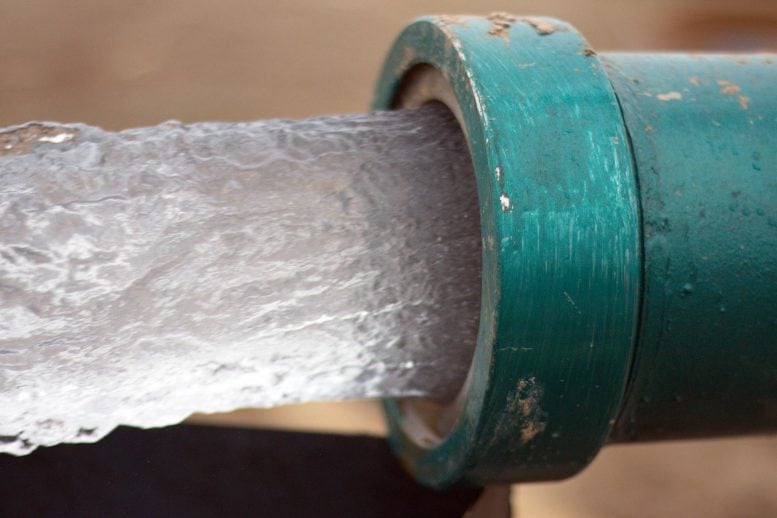
Scientists gain a deeper understanding of turbulent and transitional pipe flows.
Water issuing from an ordinary faucet tells a complex tale of its journey through a pipe. At high velocities, the faucet’s gushing stream is turbulent: chaotic, disorderly — like the crash of ocean waves.
Compared to orderly laminar flows, like the faucet’s steady stream at low velocities, scientists know little about turbulence. Even less is known about how laminar flows become turbulent. A mix of orderly and disorderly flows, transitional flows occur when fluids move at intermediate velocities.
Now, Dr. Rory Cerbus, Dr. Chien-chia Liu, Dr. Gustavo Gioia, and Dr. Pinaki Chakraborty, researchers in the Fluid Mechanics Unit and the Continuum Physics Unit at the Okinawa Institute of Science and Technology Graduate University (OIST), have drawn from a decades-old conceptual theory of turbulence to develop a new approach for studying transitional flows. The scientists’ findings, published today (January 24, 2020) in Science Advances, may help furnish a more comprehensive, conceptual understanding of transitional and turbulent flows, with practical applications in engineering.
“Turbulence is often touted as the last unsolved problem in classical physics — it has a certain mystique about it,” said Cerbus. “And yet, under idealized conditions, we have a conceptual theory that helps explain turbulent flows. In our research, we’re striving to understand if this conceptual theory might also shed light on transitional flows.”
Finding order in disorder
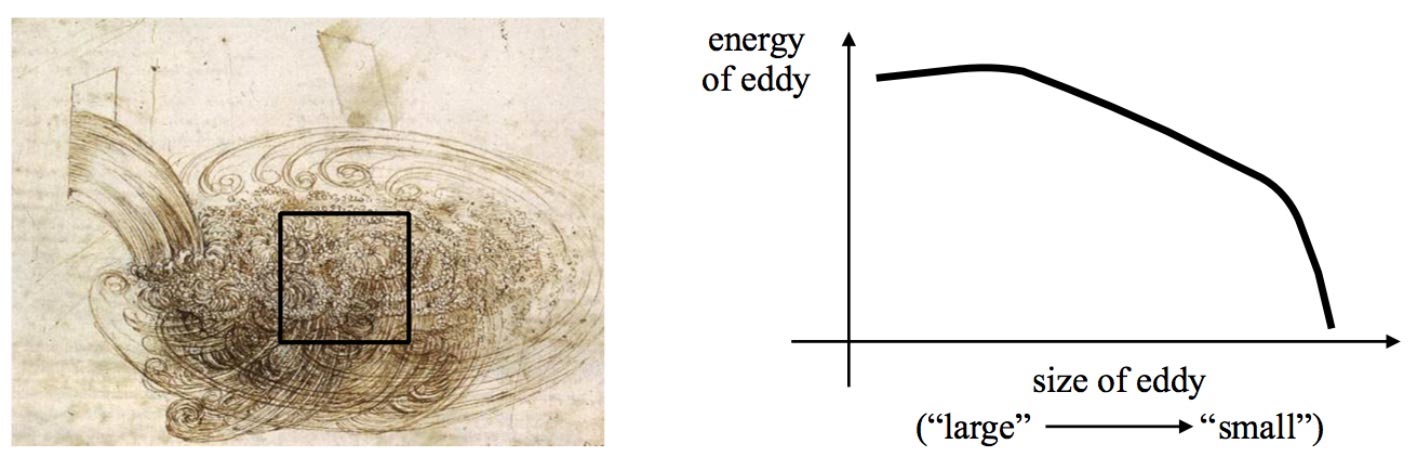
Scientists have long been captivated by turbulent flows. In the fifteenth century, Leonardo da Vinci illustrated turbulent flows as collections of swirling eddies, or circular currents, of varying sizes.
Centuries later in 1941, mathematician Andrey Kolmogorov developed a conceptual theory that revealed order underlying the energetics of seemingly disordered eddies.
As depicted in DaVinci’s sketch, a stream plunging into a pool of water initially forms a large, swirling eddy, which quickly becomes unstable and breaks apart into progressively smaller eddies. Energy is transferred from the large to ever-smaller eddies, until the smallest eddies dissipate the energy via the water’s viscosity.
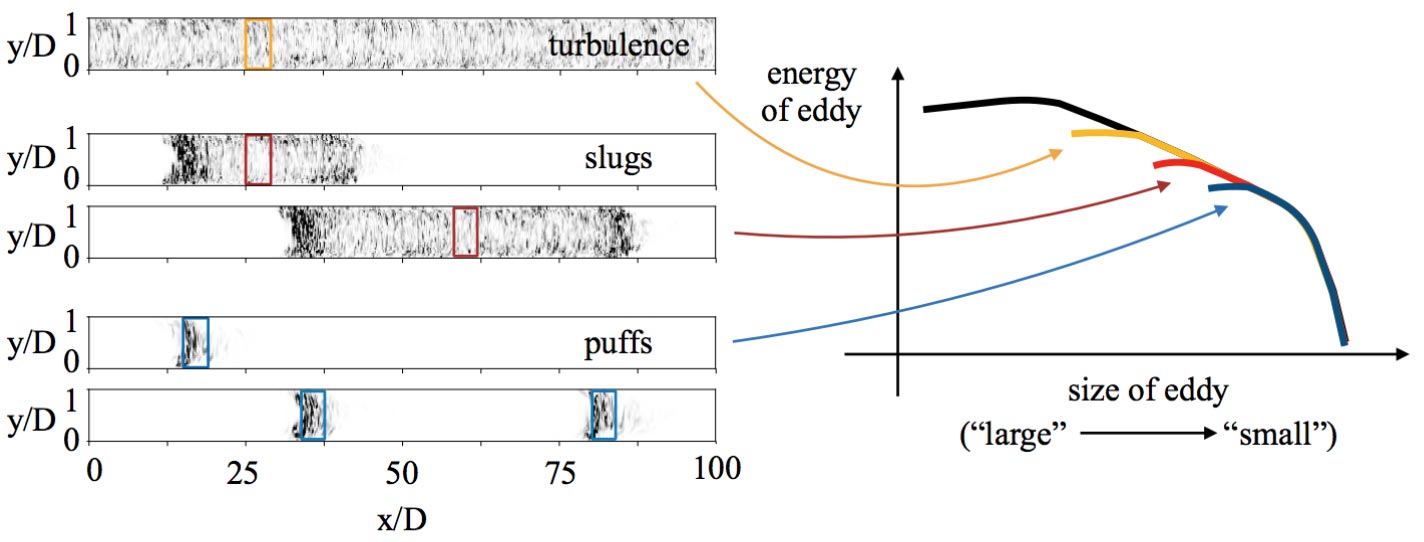
Capturing this imagery in the language of mathematics, Kolmogorov’s theory predicts the energy spectrum, a function which describes how the kinetic energy — the energy from motion — is apportioned across eddies of different sizes.
Importantly, the theory says that the energetics of the small eddies is universal, meaning that although turbulent flows may look different, the smallest eddies in all turbulent flows have the same energy spectrum.
“That such simple concepts can elegantly elucidate a seemingly intractable problem, I find it truly extraordinary,” said Chakraborty.
But there is a catch. Kolmogorov’s theory is widely thought to apply only to a small set of idealized flows, and not the flows of everyday life, including the transitional flows.
To study these transitional flows, Cerbus and his collaborators conducted experiments on water flowing through a 20-meter-long, 2.5-centimeter-diameter glass cylindrical pipe. The researchers added small, hollow particles with approximately the same density as water, allowing them to visualize the flow. They used a technique called laser doppler velocimetry to measure the velocities of the eddies in the transitional pipe flows. With these measured velocities, they computed the energy spectrum.
Surprisingly, the researchers found that, despite seeming distinct from turbulent flows, the energy spectrum corresponding to the small eddies in the transitional flows conformed to the universal energy spectrum from Kolmogorov’s theory.
Beyond furnishing a new conceptual understanding of transitional flows, this finding has applications in engineering. Over the past two decades, Gioia and Chakraborty’s research has shown that energy spectra can help predict friction between the flow and the pipe — a major concern for engineers. The more friction in a pipe, the more difficult it is to pump and transport fluids like oil.
“Our study combines esoteric mathematical ideas with factors that engineers care about,” said Chakraborty. “And, we’ve found that Kolmogorov’s theories have wider applicability than anyone thought. This is an exciting new insight into turbulence as well as into the transition to turbulence.”
Reference: “Small-scale universality in the spectral structure of transitional pipe flows” by Rory T. Cerbus, Chien-chia Liu, Gustavo Gioia and Pinaki Chakraborty, 24 January 2020, Science Advances.
DOI: 10.1126/sciadv.aaw6256
Never miss a breakthrough: Join the SciTechDaily newsletter.
Follow us on Google and Google News.