
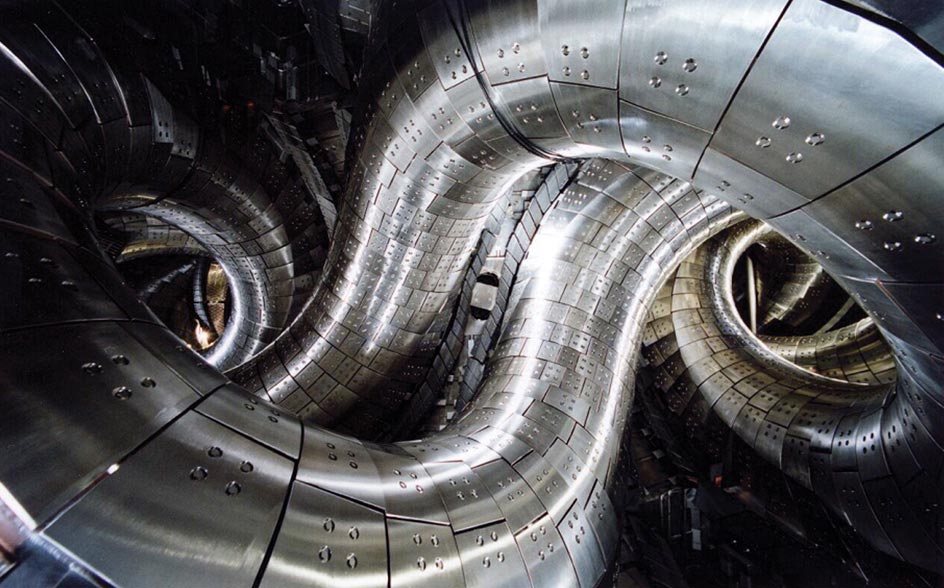
New insights into understanding turbulence in fusion plasmas.
In order to achieve fusion in a power plant, it is necessary to stably confine a plasma of more than 100 million degrees Celsius in a magnetic field and maintain it for a long time.
A research group led by Assistant Professor Naoki Kenmochi, Professor Katsumi Ida, and Associate Professor Tokihiko Tokuzawa of the National Institute for Fusion Science (NIFS), National Institutes of Natural Sciences (NINS), Japan, using measuring instruments developed independently and with the cooperation of Professor Daniel J. den Hartog of the University of Wisconsin, USA, discovered for the first time in the world that turbulence moves faster than heat when heat escapes in plasmas in the Large Helical Device (LHD). One characteristic of this turbulence makes it possible to predict changes in plasma temperature, and it is expected that observation of turbulence will lead to the development of a method for real-time control of plasma temperature in the future.

In high-temperature plasma confined by the magnetic field, “turbulence,” which is a flow with vortexes of various sizes, is generated. This turbulence causes the plasma to be disturbed, and the heat from the confined plasma flows outward, resulting in a drop in plasma temperature. To solve this problem, it is necessary to understand the characteristics of heat and turbulence in plasma. However, the turbulence in plasmas is so complex that we have not yet achieved a full understanding of it. In particular, how the generated turbulence moves in the plasma is not well understood, because it requires instruments that can measure the time evolution of minute turbulence with high sensitivity and extremely high spatiotemporal resolution.
Barriers and Magnetic Fields in Plasma Behavior
A “barrier” can form in the plasma, which acts to block the transport of heat from the center outward. The barrier makes a strong pressure gradient in the plasma and generates turbulence. Assistant Professor Kenmochi and his research group have developed a method to break this barrier by devising a magnetic field structure. This method allows us to focus on the heat and turbulence that flow vigorously as the barriers break, and to study their relationship in detail. Then, using electromagnetic waves of various wavelengths, we measured the changing temperature and heat flow of electrons and millimeter-sized fine turbulence with the world’s highest level of accuracy. Previously, heat and turbulence had been known to move almost simultaneously at a speed of 5,000 kilometers per hour (3,100 miles per hour), about the speed of an airplane, but this experiment led to the world’s first discovery of turbulence moving ahead of heat at a speed of 40,000 kilometers per hour (25,000 miles per hour). The speed of this turbulence is close to that of a rocket.
Assistant Professor Naoki Kenmochi said, “This research has dramatically advanced our understanding of turbulence in fusion plasmas. The new characteristic of turbulence, that it moves much faster than heat in a plasma, indicates that we may be able to predict plasma temperature changes by observing predictive turbulence. In the future, based on this, we expect to develop methods to control plasma temperatures in real-time.”
Reference: “Preceding propagation of turbulence pulses at avalanche events in a magnetically confined plasma” by N. Kenmochi, K. Ida, T. Tokuzawa, R. Yasuhara, H. Funaba, H. Uehara, D. J. Den Hartog, I. Yamada, M. Yoshinuma, Y. Takemura and H. Igami, 16 May 2022, Scientific Reports.
DOI: 10.1038/s41598-022-10499-z
Never miss a breakthrough: Join the SciTechDaily newsletter.
Follow us on Google and Google News.
7 Comments
1) First picture says: “Left: Forming a barrier in the plasma to confirm [..]” where it should say “confine”.
2) “5,000 kilometers per hour (3,100 miles per hour), about the speed of an airplane”
Speed of sound: 1234,8 km/h => Mach 4. Nope. You might want to correct that, also
For reference:
Most commercial aircraft typically fly at around 460-575 mph, or 740-930 km/h, according to Flight Deck Friend. But private jet speed can vary depending on a variety of factors, such as the weight onboard and the weather conditions.21 Jan 2021
Our Fastest Private Jet | How Fast Can A Private Jet Fly?
In order for this to actually work properly is to approach it by creating 3 different barriers, one holding the heat, then the 2nd barrier obviously to control the flow of turbulence formed, the a final barrier around a limit set to control the rate of growth. Boom, Working Fusion. If we had enough magnetic power to bend light that third layer could possibly work as a reflector to send back anything that has escaped the first 2 layers.
100 million degrees Celsius?? You obviously didn’t do your research.
Once the problem of instability is conquered, then the attention needs to turn to “How do we harvest that energy?
The first strange statement I noticed is the oddd claim about airplane speed (which Phil has remarked upon). The experimental X-15, essentially a manned rocket, reached 4,520 MPH, but that’s hardly a typical plane. (Neither is the SR-72, which will reportedly reach about 4,600 MPH.)
The other weird claim I noticed is that a speed of 25,000 miles per hour “is close to that of a rocket.” No rocket in the atmosphere — even hypersonic cruise missiles and ICBMs during their atmospheric stages — reaches that speed. (Relative speeds of spacecraft outside the atmosphere are fairly irrelevant, since that depends on where they are in their orbits.)
How can turbulence move faster than heat. The particles travel faster than the time it takes to transfer kinetic energy?
Is this real? I’ve never seen a legitimate article with so many inaccuracies