
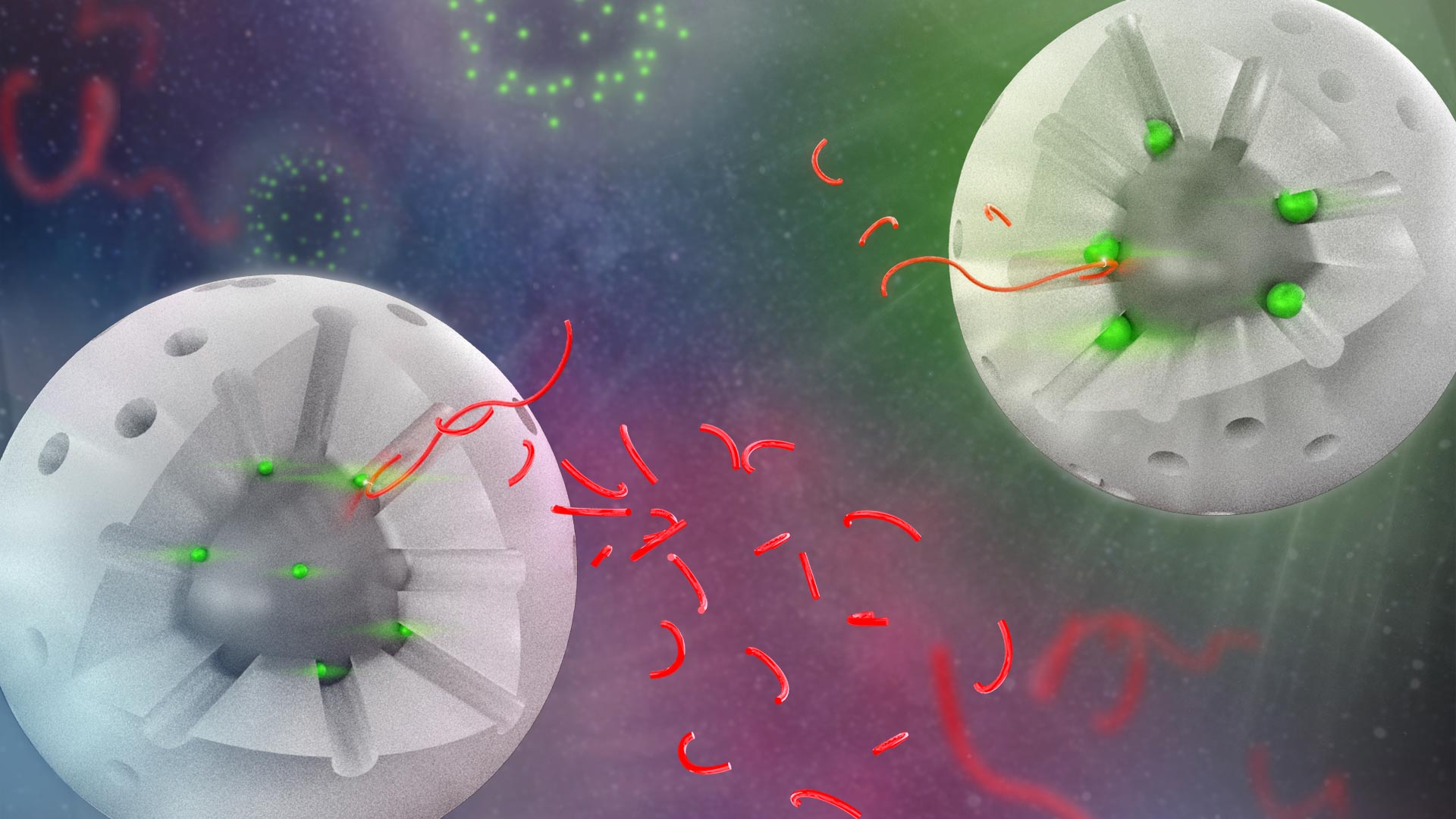
Ames Lab’s new catalyst boosts plastic upcycling efficiency by using smaller platinum particles to speed up the breakdown process.
Plastic upcycling technologies are being advanced by a recently developed catalyst for breaking down plastics. A team of scientists lead by Ames Laboratory scientists discovered the first processive inorganic catalyst in 2020 to deconstruct polyolefin plastics into molecules that can be used to create more valuable products. The team has now developed and validated a strategy to speed up the transformation without sacrificing desirable products.
The catalyst was originally designed by Wenyu Huang, a scientist at Ames Laboratory. It consists of platinum particles supported on a solid silica core and surrounded by a silica shell with uniform pores that provide access to catalytic sites. The total amount of platinum needed is quite small, which is important because of platinum’s high cost and limited supply. During deconstruction experiments, the long polymer chains thread into the pores and contact the catalytic sites, and then the chains are broken into smaller-sized pieces that are no longer plastic material (see image above for more details).
According to Aaron Sadow, a scientist at Ames Lab and director of the Institute for Cooperative Upcycling of Plastics (iCOUP), the team crafted three variations of the catalyst. Each variation had identically sized cores and porous shells, but varying diameters of platinum particles, from 1.7 to 2.9 to 5.0 nm.
Chain Lengths and Reaction Rates
The researchers hypothesized that the differences in platinum particle size would affect the lengths of the product chains, so large platinum particles would make longer chains and small ones would make shorter chains. However, the team discovered that the lengths of the product chains were the same size for all three catalysts.
“In the literature, the selectivity for carbon-carbon bond cleavage reactions usually varies with the size of the platinum nanoparticles. By placing platinum at the bottom of the pores, we saw something quite unique,” said Sadow.
Instead, the rate at which the chains were broken into smaller molecules was different for the three catalysts. The larger platinum particles reacted with the long polymer chain more slowly while the smaller ones reacted more quickly. This increased rate could result from the higher percentage of edge and corner platinum sites on the surfaces of the smaller nanoparticles. These sites are more active in cleaving the polymer chain than the platinum located in the faces of the particles.
Implications for Catalyst Design and Plastic Upcycling
According to Sadow, the results are important because they show that activity can be adjusted independently from the selectivity in these reactions. “Now, we are confident that we can make a more active catalyst that would chew up the polymer even faster, while using catalyst structural parameters to dial in specific product chain lengths,” he said.
Huang explained that this type of larger molecule reactivity in porous catalysts in general are not widely studied. So, the research is important for understanding the fundamental science as well as how it performs for upcycling plastics.
“We really need to further understand the system because we’re still learning new things every day. We are exploring other parameters that we can tune to further increase the production rate and shift the product distribution,” said Huang. “So there are a lot of new things in our list waiting for us to discover.”
Reference: “Size-Controlled Nanoparticles Embedded in a Mesoporous Architecture Leading to Efficient and Selective Hydrogenolysis of Polyolefins” by Xun Wu, Akalanka Tennakoon, Ryan Yappert, Michaela Esveld, Magali S. Ferrandon, Ryan A. Hackler, Anne M. LaPointe, Andreas Heyden, Massimiliano Delferro, Baron Peters, Aaron D. Sadow and Wenyu Huang, 23 February 2022, Journal of the American Chemical Society.
DOI: 10.1021/jacs.1c11694
The research was conducted by the Institute for Cooperative Upcycling of Plastics (iCOUP), led by Ames Laboratory. iCOUP is an Energy Frontier Research Center consisting of scientists from Ames Laboratory, Argonne National Laboratory, UC Santa Barbara, University of South Carolina, Cornell University, Northwestern University, and the University of Illinois Urbana-Champaign.
Never miss a breakthrough: Join the SciTechDaily newsletter.
Follow us on Google and Google News.