
Researchers at Imperial College London have designed a new self-assembling nanoparticle that targets tumors, helping doctors diagnose cancer earlier.
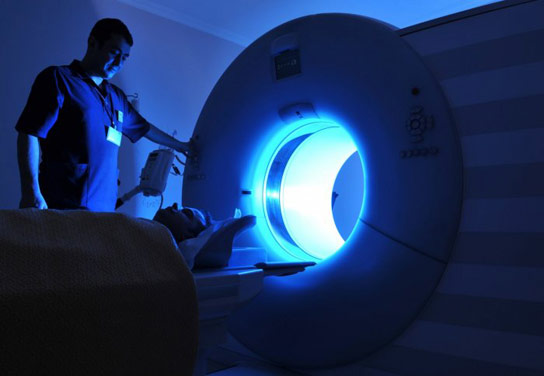
The new nanoparticle, developed by researchers at Imperial College London, boosts the effectiveness of Magnetic Resonance Imaging (MRI) scanning by specifically seeking out receptors that are found in cancerous cells.
The nanoparticle is coated with a special protein, which looks for specific signals given off by tumors, and when it finds a tumor it begins to interact with the cancerous cells. This interaction strips off the protein coating, causing the nanoparticle to self-assemble into a much larger particle so that it is more visible on the scan.
A new study published in the journal Angewandte Chemie, used cancer cells and mouse models to compare the effects of the self-assembling nanoparticle in MRI scanning against commonly used imaging agents and found that the nanoparticle produced a more powerful signal and created a clearer MRI image of the tumor.
The scientists say the nanoparticle increases the sensitivity of MRI scanning and will ultimately improve doctor’s ability to detect cancerous cells at much earlier stages of development.
Professor Nicholas Long from the Department of Chemistry at Imperial College London said the results show real promise for improving cancer diagnosis. “By improving the sensitivity of an MRI examination, our aim is to help doctors spot something that might be cancerous much more quickly. This would enable patients to receive effective treatment sooner, which would hopefully improve survival rates from cancer.”
“MRI scanners are found in nearly every hospital up and down the country and they are vital machines used every day to scan patients’ bodies and get to the bottom of what might be wrong. But we are aware that some doctors feel that even though MRI scanners are effective at spotting large tumors, they are perhaps not as good at detecting smaller tumors in the early stages”, added Professor Long.
The newly designed nanoparticle provides a tool to improve the sensitivity of MRI scanning, and the scientists are now working to enhance its effectiveness. Professor Long said: “We would like to improve the design to make it even easier for doctors to spot a tumor and for surgeons to then operate on it. We’re now trying to add an extra optical signal so that the nanoparticle would light up with a luminescent probe once it had found its target, so combined with the better MRI signal it will make it even easier to identify tumors.”
Before testing and injecting the non-toxic nanoparticle into mice, the scientists had to make sure that it would not become so big when it self-assembled that it would cause damage. They injected the nanoparticle into a saline solution inside a petri dish and monitored its growth over a four-hour period. The nanoparticle grew from 100 to 800 nanometers – still small enough to not cause any harm.
The scientists are now improving the nanoparticle and hope to test their design in a human trial within the next three to five years.
Dr Juan Gallo from the Department of Surgery and Cancer at Imperial College London said: “We’re now looking at fine tuning the size of the final nanoparticle so that it is even smaller but still gives an enhanced MRI image. If it is too small the body will just secrete it out before imaging, but too big and it could be harmful to the body. Getting it just right is really important before moving to a human trial.”
The research was funded by Cancer Research UK, Engineering and Physical Sciences Research Council (EPSRC), the Medical Research Council (MRC) and the Department of Health (grant C2536/A10337).
Reference: “CXCR4-Targeted and MMP-Responsive Iron Oxide Nanoparticles for Enhanced Magnetic Resonance Imaging” by Juan Gallo, Nazila Kamaly, Ioannis Lavdas, Elizabeth Stevens, Quang-De Nguyen, Marzena Wylezinska-Arridge, Eric O. Aboagye and Nicholas J. Long, 15 July 2014, Angewandte Chemie International Edition.
DOI: 10.1002/anie.201405442
Never miss a breakthrough: Join the SciTechDaily newsletter.
Follow us on Google and Google News.