
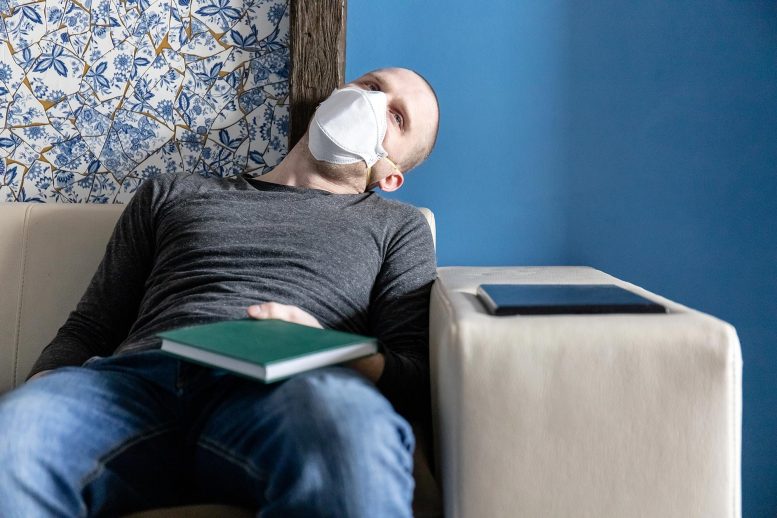
Previous research points to the effect of social stressors on developing upper respiratory infections, holding clues to COVID-19 risk.
Months of self-isolation and social distancing have taken their toll. Sheldon Cohen, the Robert E. Doherty Professor of Psychology at Carnegie Mellon University, has produced a body of research that suggests that interpersonal stressors many are experiencing during quarantine are associated with an increased vulnerability to upper respiratory viruses and perhaps coronavirus. A summary of his work is available online in the July 8 issue of Perspectives on Psychological Science.
“We know little about why some of the people exposed to the coronavirus that causes COVID-19, are more likely to develop the disease than others. However, our research on psychological factors that predict susceptibility to other respiratory viruses may provide clues to help identify factors that matter for COVID-19,” said Cohen.
Cohen has spent his career examining the impact of different behavioral, social, and psychological factors on the development of upper respiratory illnesses. Through a series of viral challenge studies, he examined how such factors can affect whether or not healthy adults exposed to respiratory viruses become ill. His work has focused on eight viral strains that cause a common cold (rhinovirus types 2, 9, 14, 21, 39 and Hanks, as well as respiratory syncytial virus and coronavirus 229E) and two that cause influenza (A/Kawasaki/86 H1N1; and A/Texas/36/91).
“The focus on the pandemic up until now has been changing behaviors to avoid exposure to the virus,” said Cohen. “In our work, we intentionally exposed people to cold and influenza viruses and studied whether psychological and social factors predict how effective the immune system is in suppressing infection, or preventing or mitigating the severity of illness.”
Cohen’s work has pointed to the importance of social and psychological factors in the development of infection and illness. This work may hold clues to the health implications of the on-going quarantine.
To slow the spread of coronavirus, many communities issued stay-at-home measures, increasing interpersonal stressors, like loneliness, loss of employment, and familial conflict. According to Cohen, these stressors may be powerful predictors of how a person will respond if exposed to coronavirus.
In a series of studies, he found participants experiencing interpersonal stressors had a greater chance of developing upper respiratory illnesses when exposed to cold viruses. Cohen believes interpersonal stressors might play a similar role in response to the coronavirus causing COVID-19, increasing a person’s vulnerability to infection and illness.
In addition, both social and psychological stressors increased the production of cytokines, molecules that promote inflammation in response to infection. In Cohen’s work, psychological and social stressors were associated with an overproduction of pro-inflammatory cytokines in response to cold and influenza viruses. In turn, this excess of inflammation was associated with an increased risk of becoming ill. Similarly, research on COVID-19 has shown that producing an excess of pro-inflammatory cytokines is associated with more severe COVID-19 infections suggesting the hypothesis that a stress-triggered excessive cytokine response might similarly contribute to excessive inflammation and symptoms in COVID-19.
While social and psychological stressors increase susceptibility, Cohen’s work also indicates that social integration and social support offer a protective shield against respiratory infection and illness.
“If you have a diverse social network (social integration), you tend to take better care of yourself (no smoking, moderate drinking, more sleep, and exercise),” said Cohen. “Also if people perceive that those in their social network will help them during a period of stress or adversity (social support) then it attenuates the effect of the stressor and is less impactful on their health.”
Reference: “Psychosocial Vulnerabilities to Upper Respiratory Infectious Illness: Implications for Susceptibility to Coronavirus Disease 2019 (COVID-19)” by Sheldon Cohen, 8 July 2020, Perspectives in Psychological Science.
DOI: 10.1177/1745691620942516
Cohen received support from National Heart, Lung, and Blood Institute, the National Institute for Allergy and Infectious Diseases and the National Institute of Mental Health. Cohen also received support from the National Institutes of Health through the University of Pittsburgh Clinical and Translational Science Institute and the John D. and Catherine T. MacArthur Foundation Research Network on Socioeconomic Status and Health.
Never miss a breakthrough: Join the SciTechDaily newsletter.
Follow us on Google and Google News.
6 Comments
This is just a bad take — the research is just saying that with people you tend to be less stressed so staying alone is bad
SciTechDaily should be ashamed of themselves for writing such a misleading article that will likely result in death
Why don’t you all knowledgeable professionals get together, figure everything out and tell us, the normal people, what to do. We have been jerked around for a long time, moving different ways, following your advice. Apparently, you (professionals) don’t know yourselves how to battle this COVID-19.
This article is absolutely ridiculous. They have not had enough time to actually study this and get the facts.
Since I am reclusive by nature and live alone, I find sheltering in place to be very relaxing, if occasionally a little dull. I have stacks of books that I now have time to read, cooking experiments to do, clearing out the apartment and other like chores, etc. If I want to contact people I go on Facebook and chat with friends. I don’t understand people who are unable to spend time alone. Perhaps they should do a little inner work to figure out why their own company is not enough. Perhaps over-socializing is their way of avoiding dealing with themselves. Having time for introspection is something I think we have lost in modern society. Just a thought.
Great. Encourage people to go out. Good job. Not.
This entire article is pop sci pablum. Its the equivalent to saying people are mor susceptible to die from wearing a seatbelt, because they are stressed about having to put it on, and that causes distracted driving.
Might people be stressed having to wear a seatbelt? Maybe….But any affect of that has to be compared to the alternative. And in this case the susceptibility of catching the coronavirus by NOT sequestering is MUCH higher than the stress of sequestering. In shorter terms, this is bulls#!t.