
Close Menu
    Facebook X (Twitter) Instagram
    SciTechDaily
    • Biology
    • Chemistry
    • Earth
    • Health
    • Physics
    • Science
    • Space
    • Technology
    Facebook X (Twitter) Pinterest YouTube RSS
    SciTechDaily
    Home»Health»Sensitive New Test Detects COVID-19 Antibodies in Only 10 Minutes
    Health

    Sensitive New Test Detects COVID-19 Antibodies in Only 10 Minutes

    By American Chemical SocietyApril 30, 2020No Comments3 Mins Read
    Facebook Twitter Pinterest Telegram LinkedIn WhatsApp Email Reddit
    Share
    Facebook Twitter LinkedIn Pinterest Telegram Email Reddit
    SARS-CoV-2 Antibodies Test
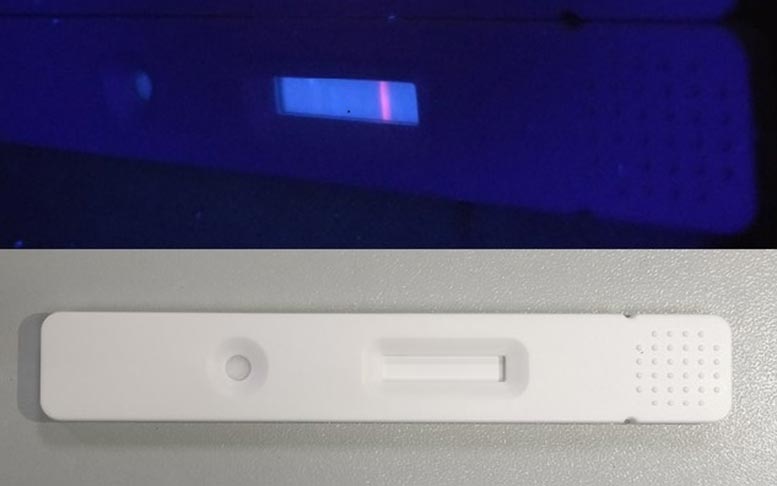
    A new lateral flow immunoassay can detect antibodies against SARS-CoV-2, which appear as a bright orange line when placed on a fluorescence reader (right). Credit: Guanfeng Lin

    As the COVID-19 curve shows signs of flattening in the U.S. and elsewhere, public health officials are trying to grasp just how many people have been infected. Now, a proof-of-concept study in ACS’ Analytical Chemistry describes a quick, sensitive test for antibodies against the coronavirus in human blood. The test could help doctors track a person’s exposure to the disease, as well as confirm suspected COVID-19 cases that tested negative by other methods.

    Because COVID-19 symptoms range from mild to severe, with some people apparently having no symptoms, the number of people who have been infected with the SARS-CoV-2 virus at some point is likely much higher than the number of confirmed cases. As U.S. states begin to ease lockdown restrictions, widespread testing of the general population will be important to identify people at the early stages of the disease, or people who lack symptoms but can still infect others. Also, although more research needs to be done, it is possible that people with antibodies to the virus could be immune to future COVID-19 outbreaks. To help identify people with current or past exposure to SARS-CoV-2, Lei Yu, Yingsong Wu, Guanfeng Lin, and colleagues wanted to develop a fast, sensitive antibody test.

    The researchers based their test on a technique called a lateral flow immunoassay (LFA); a home pregnancy test is an example of this kind of assay. They attached a viral coat protein to a specific region on a strip of nitrocellulose, and then added human serum. The serum flowed from one end of the strip to the other, and any antibodies against the viral protein bound to that region on the strip. Then, the team detected the anti-SARS-CoV-2 antibodies with a fluorescently labeled antibody. This fluorescence-based detection is much more sensitive than some other LFAs, such as pregnancy tests, that can be read by the naked eye. The researchers tested the new assay on seven serum samples from COVID-19 patients and 12 samples from people who had tested negative for the disease by reverse transcriptase-polymerase chain reaction (RT-PCR), a common diagnostic test that occasionally fails to detect positive cases. The new assay correctly diagnosed all seven samples as positive — as well as an additional “negative” case that had suspicious clinical symptoms — in only 10 minutes per sample. The immunoassay could be helpful in confirming negative diagnoses, monitoring a patient’s recovery, studying past exposures, and identifying recovered individuals with high levels of antibodies as potential convalescent plasma donors, the researchers say.

    Reference: “Rapid and sensitive detection of anti-SARS-CoV-2 IgG using lanthanide-doped nanoparticles-based lateral flow immunoassay” by Zhenhua Chen, Zhigao Zhang, Xiangming Zhai, Yongyin Li, Li Lin, Hui Zhao, Lun Bian, Peng Li, Lei Yu, Yingsong Wu and Guanfeng Lin, 23 April 2020, Analytical Chemistry.
    DOI: 10.1021/acs.analchem.0c00784

    The authors acknowledge funding from the National Natural Science Foundation of China and the China Postdoctoral Science Foundation.

    Never miss a breakthrough: Join the SciTechDaily newsletter.
    Follow us on Google and Google News.

    American Chemical Society COVID-19 Public Health
    Share. Facebook Twitter Pinterest LinkedIn Email Reddit

    Related Articles

    COVID, One Year Later: What Do We Know Now? [Video]

    The Latest in the Scientific Race to Develop an Effective COVID-19 Vaccine

    Not Sure if You’ve Already Had Coronavirus? This Test Might Tell You (Video)

    Researchers Develop a Replaceable, More Efficient Filter for N95 Masks

    A Polio Vaccine That Hasn’t Been Used in the U.S. for Two Decades Might Protect Against Coronavirus [Video]

    How Effective Are Cloth Masks Against Coronavirus? [Video]

    Best Materials for Homemade Coronavirus Face Masks – Performance Close to N95

    New COVID-19 Test Accurately Detects Viral DNA in Minutes

    Where Are We on a Coronavirus Vaccine: And What’s Next? [Video]

    Leave A Reply Cancel Reply

    • Facebook
    • Twitter
    • Pinterest
    • YouTube

    Don't Miss a Discovery

    Subscribe for the Latest in Science & Tech!

    Trending News

    Millions Take These IBS Drugs, But a New Study Finds Serious Risks

    Scientists Unlock Hidden Secrets of 2,300-Year-Old Mummies Using Cutting-Edge CT Scanner

    Bread Might Be Making You Gain Weight Even Without Eating More Calories

    Scientists Discover Massive Magma Reservoir Beneath Tuscany

    Europe’s Most Active Volcano Just Got Stranger – Here’s Why Scientists Are Rethinking It

    Alzheimer’s Symptoms May Start Outside the Brain, Study Finds

    Millions Take This Popular Supplement – Scientists Discover a Concerning Link to Heart Failure

    The Universe Is Expanding Too Fast and Scientists Can’t Explain Why

    Follow SciTechDaily
    • Facebook
    • Twitter
    • YouTube
    • Pinterest
    • Newsletter
    • RSS
    SciTech News
    • Biology News
    • Chemistry News
    • Earth News
    • Health News
    • Physics News
    • Science News
    • Space News
    • Technology News
    Recent Posts
    • Scientists Say Adding This Unusual Seafood to Your Diet Could Reverse Signs of Aging
    • U.S. Waste Holds $5.7 Billion Worth of Crop Nutrients
    • Scientists Say a Hidden Structure May Exist Inside Earth’s Core
    • Doctors Surprised by the Power of a Simple Drug Against Colon Cancer
    • Why Popular Diabetes Drugs Like Ozempic Don’t Work for Everyone: The “Genetic Glitch”
    Copyright © 1998 - 2026 SciTechDaily. All Rights Reserved.
    • Science News
    • About
    • Contact
    • Editorial Board
    • Privacy Policy
    • Terms of Use

    Type above and press Enter to search. Press Esc to cancel.