

Scientists used a laser-based technique to reveal hidden quantum properties of the material Ta2NiSe5, potentially advancing the development of quantum light sources.
Certain materials have desirable properties that are hidden, and just as you would use a flashlight to see in the dark, scientists can use light to uncover these properties.
Researchers at the University of California San Diego have used an advanced optical technique to learn more about a quantum material called Ta2NiSe5 (TNS). Their work was published in the journal Nature Materials.
Materials can be perturbed through different external stimuli, often with changes in temperature or pressure; however, because light is the fastest thing in the universe, materials will respond very quickly to optical stimuli, revealing properties that would otherwise remain hidden.
Advanced Optical Techniques in Quantum Materials
“In essence, we shine a laser on a material and it’s like stop-action photography where we can incrementally follow a certain property of that material,” said Professor of Physics Richard Averitt, who led the research and is one of the paper’s authors. “By looking at how constituent particles move around in that system, we can tease out these properties that are really tricky to find otherwise.”
The experiment was conducted by lead author Sheikh Rubaiat Ul Haque, who graduated from UC San Diego in 2023 and is now a postdoctoral scholar at Stanford University. He, along with Yuan Zhang, another graduate student in Averitt’s lab, improved upon a technique called terahertz time-domain spectroscopy. This technique allows scientists to measure a material’s properties over a range of frequencies, and Haque’s improvements allowed them access to a broader range of frequencies.
Quantum States and Light Amplification
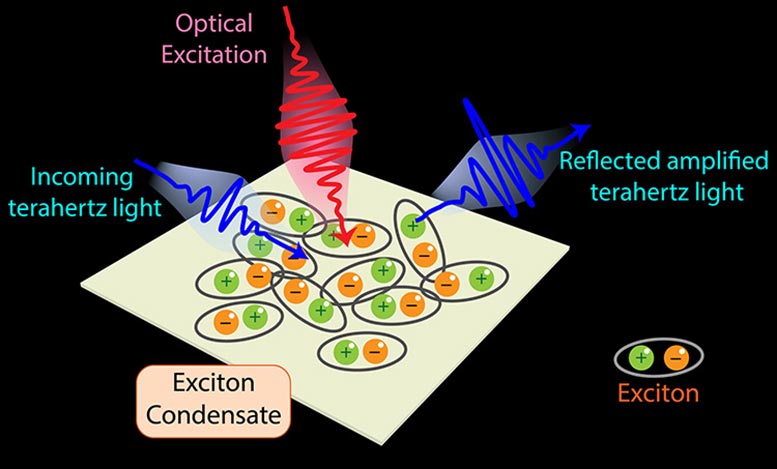
The work was based on a theory created by another of the paper’s authors, Eugene Demler, a professor at ETH Zürich. Demler and his graduate student Marios Michael developed the idea that when certain quantum materials are excited by light, they may turn into a medium that amplifies terahertz frequency light. This led Haque and colleagues to look closely into the optical properties of TNS.
When an electron is excited to a higher level by a photon, it leaves behind a hole. If the electron and hole are bound, an exciton is created. Excitons may also form a condensate — a state that occurs when particles come together and behave as a single entity.
Haque’s technique, backed by Demler’s theory and using density functional calculations by Angel Rubio’s group at Max Planck Institute for the Structure and Dynamics of Matter, the team was able to observe anomalous terahertz light amplification, which uncovered some of the hidden properties of the TNS exciton condensate.
Condensates are a well-defined quantum state and using this spectroscopic technique could allow some of their quantum properties to be imprinted onto light. This may have implications in the emerging field of entangled light sources (where multiple light sources have interconnected properties) utilizing quantum materials.
“I think it’s a wide-open area,” stated Haque. “Demler’s theory can be applied to a suite of other materials with nonlinear optical properties. With this technique, we can discover new light-induced phenomena that haven’t been explored before.”
Reference: “Terahertz parametric amplification as a reporter of exciton condensate dynamics” by Sheikh Rubaiat Ul Haque, Marios H. Michael, Junbo Zhu, Yuan Zhang, Lukas Windgätter, Simone Latini, Joshua P. Wakefield, Gu-Feng Zhang, Jingdi Zhang, Angel Rubio, Joseph G. Checkelsky, Eugene Demler and Richard D. Averitt, 3 January 2024, Nature Materials.
DOI: 10.1038/s41563-023-01755-2
Funding provided by the DARPA DRINQS Program (D18AC00014), the Swiss National Science Foundation (200021_212899), Army Research Office (W911NF-21-1-0184), the European Research Council (ERC-2015-AdG694097), the Cluster of Excellence ‘Advanced Imaging of Matter’ (AIM), Grupos Consolidados (IT1249-19), Deutsche Forschungsgemeinschaft (170620586), and the Flatiron Institute.
Never miss a breakthrough: Join the SciTechDaily newsletter.
Follow us on Google and Google News.
1 Comment
Condensates are a well-defined quantum state.
Do researchers truly understand the physical essence of quantum states? Do researchers know where quantum spin and quantum gravity come from?
I hope researchers are not fooled by the pseudoscientific theories of the Physical Review Letters (PRL), and hope more people dare to stand up and fight against rampant pseudoscience.
The so-called academic journals (such as Physical Review Letters, Nature, Science, etc.) firmly believe that two objects (such as two sets of cobalt-60) of high-dimensional spacetime rotating in opposite directions can be transformed into two objects that mirror each other, is a typical case of pseudoscience rampant.
If researchers are really interested in science, you can browse https://zhuanlan.zhihu.com/p/595280873.