
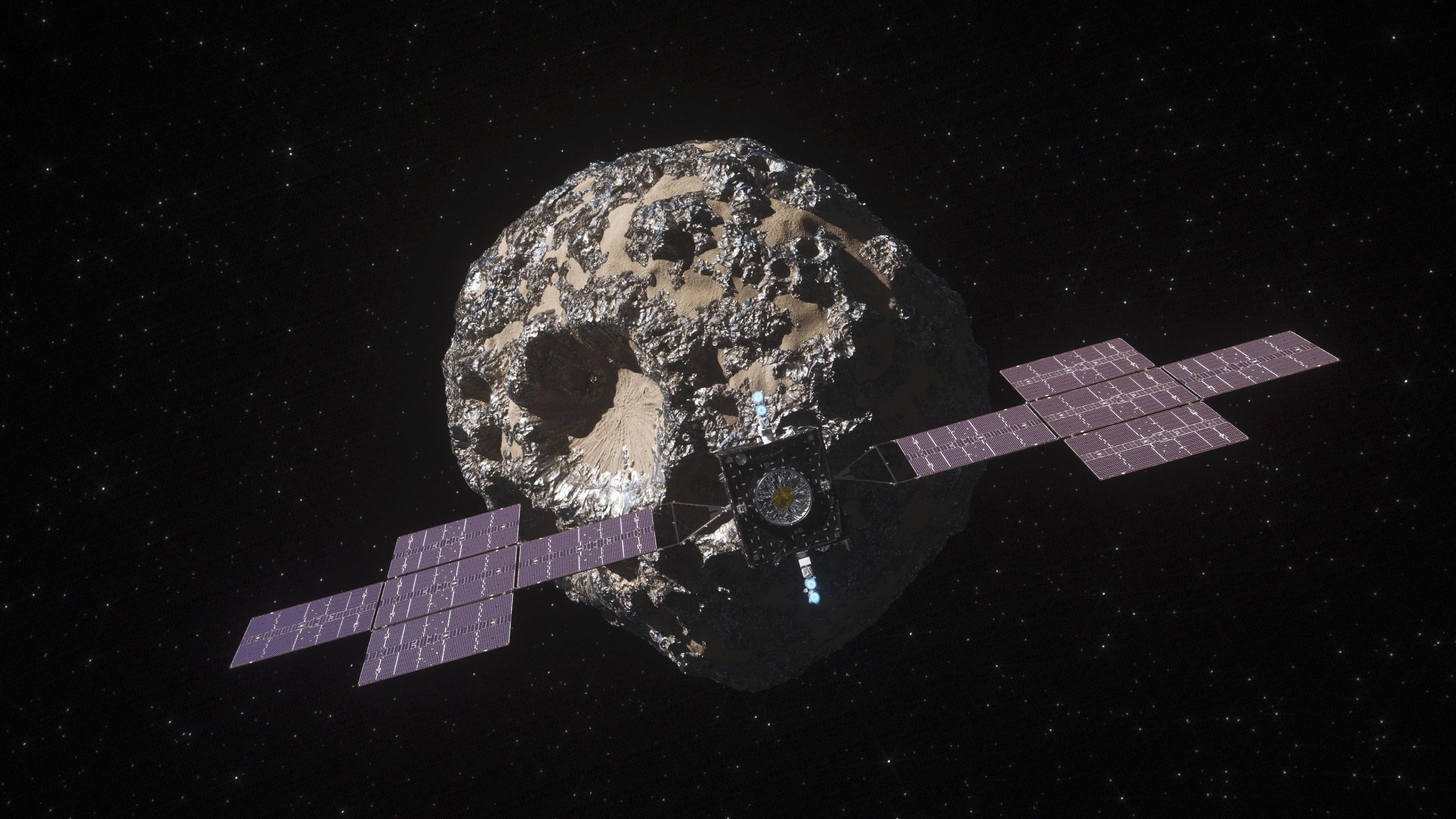
To prepare for its launch in August, the Psyche spacecraft was tested to ensure it can operate in the extreme conditions it will face on its trip to a metal-rich asteroid.
The conditions that a NASA spacecraft endures are extreme: the violent shaking and cacophony of a rocket launch, the jolt of separating from the launch vehicle, the extreme temperature fluctuations in and out of the Sun’s rays, the unforgiving vacuum of space.
Before launch, engineers do their best to replicate these harsh conditions in a rigorous series of tests to ensure the spacecraft can withstand them. NASA’s Psyche spacecraft just completed its own gauntlet of electromagnetic, thermal-vacuum, vibration, shock, and acoustic testing at the agency’s Jet Propulsion Laboratory in Southern California. Psyche was deemed healthy and ready to proceed toward launch.
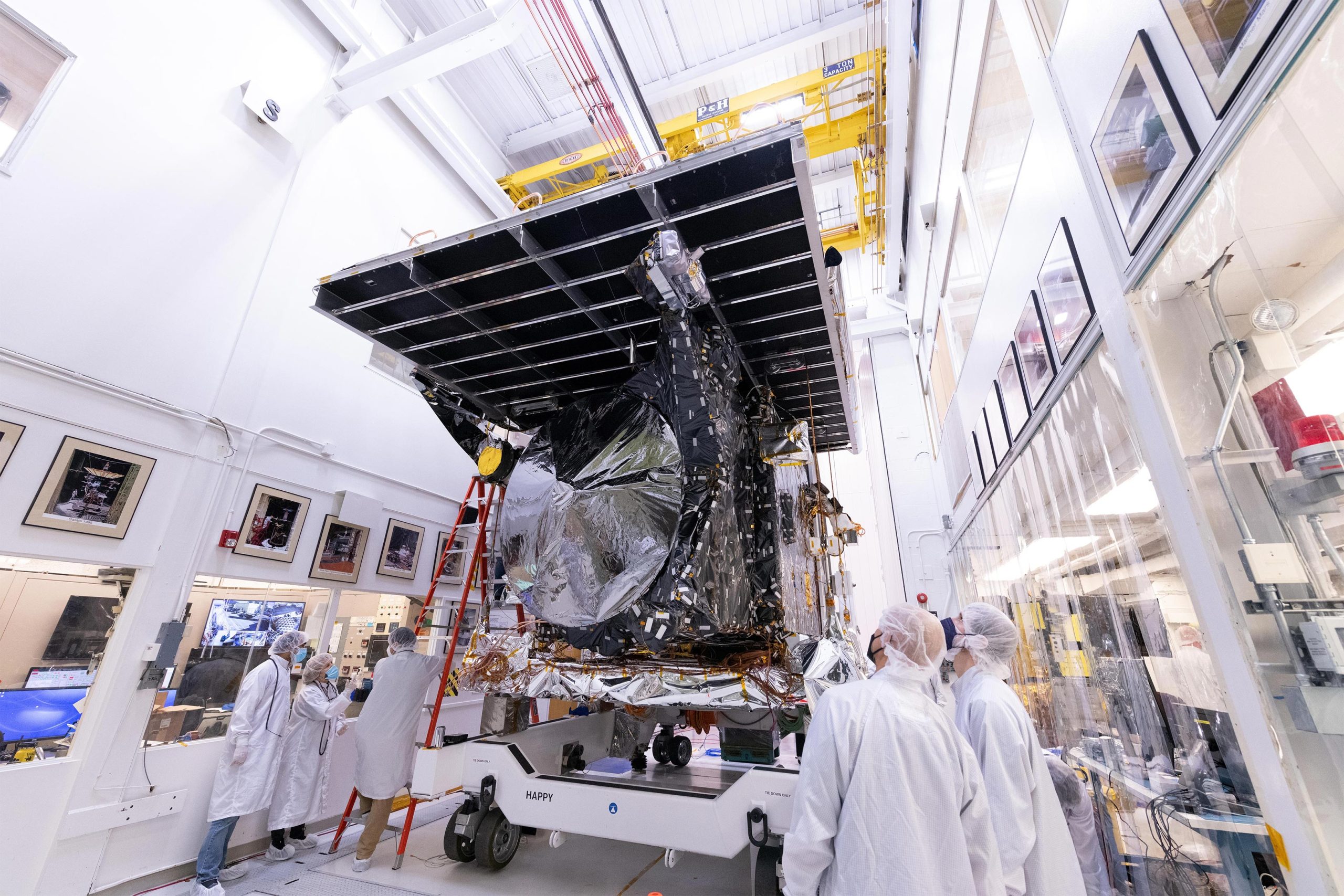
“This is the proof that everybody’s done their job right. Not only those who have brought flight hardware into assembly, test, and launch operations [ATLO] but also the ATLO team in putting it all together,” said Randy Lindemann, the JPL engineer who oversaw Psyche’s dynamics testing, which includes vibration, separation shock, and acoustic testing. “The tests show that, yes, the spacecraft is flight worthy.”
This spring, the spacecraft will be shipped from JPL to NASA’s Kennedy Space Center in Florida, where it will be prepared to launch from Cape Canaveral. The launch period opens August 1, and nine months after leaving Earth’s atmosphere, Psyche will sail past Mars. It will use the Red Planet’s gravitational force to slingshot it toward its target, a metal-rich asteroid, also named Psyche, that lies in the main asteroid belt.
It’s a journey of about 1.5 billion miles (2.4 billion kilometers). The spacecraft will reach the asteroid in 2026 and will spend 21 months collecting science data during progressively lower orbits. Scientists believe the asteroid may consist largely of metal from the core of a planetesimal, a building block of the rocky planets in our solar system. Learning more about it could tell us more about how our own planet formed.
Put Through Its Paces
But to learn about the asteroid, the orbiter has to get there first, which is why testing is so critical. Engineers call this particular regimen “environmental tests,” as the spacecraft is subjected to a simulation of the harsh environment it will have to survive.
The campaign began in December with electromagnetic testing, to ensure the spacecraft will operate correctly in the electrical and magnetic conditions of space – and that the electrical and magnetic components that make up the spacecraft are compatible and don’t interfere with one another.
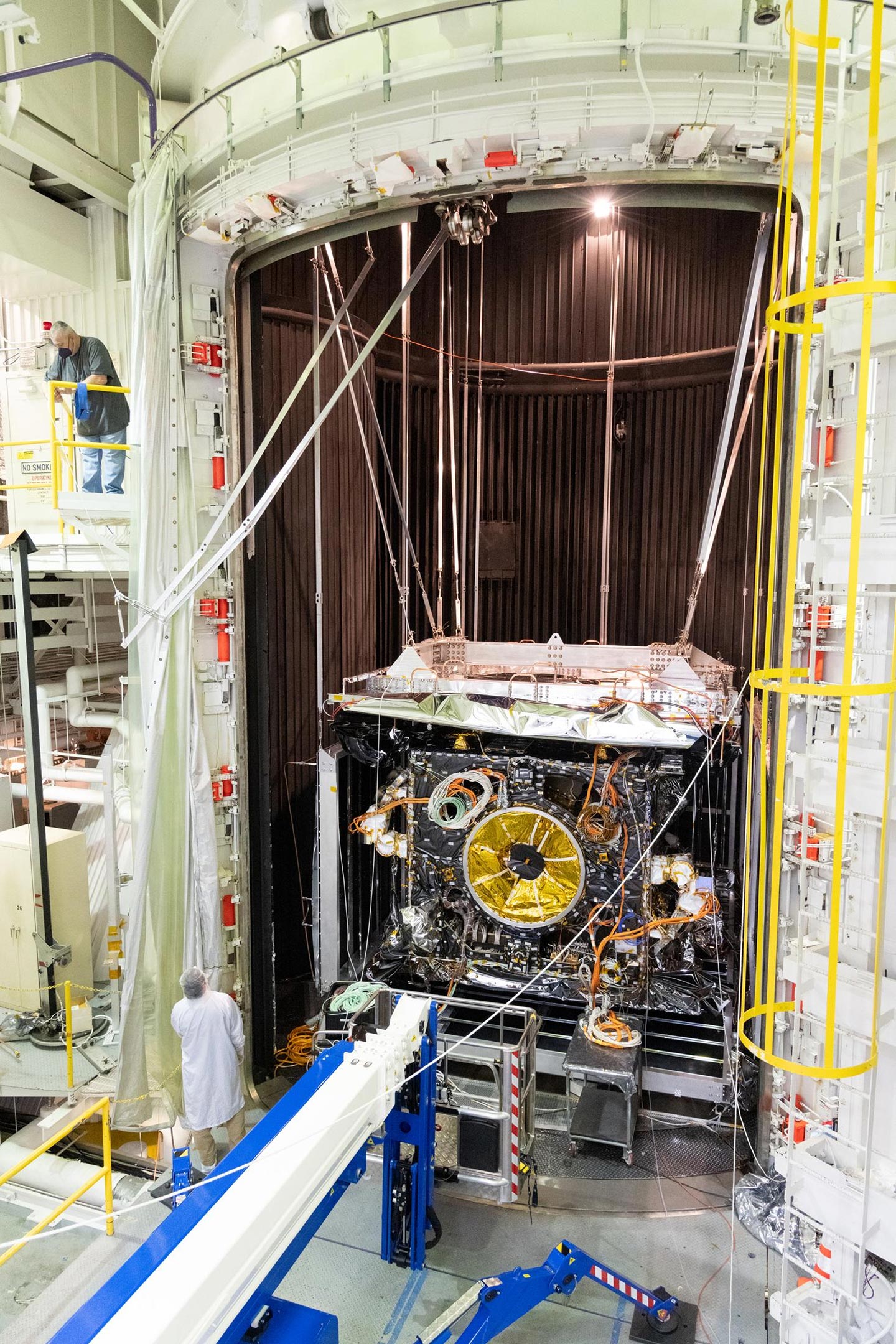
The team then rolled the spacecraft into JPL’s 85-foot-tall, 25-foot-wide (26-meter-by-8-meter) ultra-sturdy vacuum chamber for thermal-vacuum (TVAC) testing. All of the air was sucked out of the chamber to replicate the airless vacuum of space. This test ensures that the spacecraft can survive the vacuum of space, and it helps engineers see how the spacecraft heats and cools itself without the movement of air to help it regulate temperature.
“Here on Earth, when you have air around the spacecraft, that changes how heat moves around it. Picture having a fan blowing on you that changes your temperature. In space, we don’t have that kind of heat movement,” said JPL’s Kristina Hogstrom, a flight systems engineer who helped lead Psyche’s TVAC testing.
The temperatures around the spacecraft will fluctuate wildly. The hardware will be hot in the hours after launch, when it’s still close to Earth and facing the Sun, especially with its electronics running. Later, when the spacecraft gets farther from the Sun, it faces intense cold, especially when flying in the asteroid’s shadow.
Over 18 days of TVAC testing, engineers exposed the spacecraft to the coldest and warmest conditions it will experience in flight, to prove that it is capable of regulating its own temperature. The orbiter has louvers that open and close, insulation blankets, electric heaters, and a network of tubing that carries fluid to move heat around; all of these devices are tested to be sure they’ll work in flight.
TVAC isn’t just an endurance test. The data about how the spacecraft performs helps engineers refine models they’ll use when Psyche is in flight so they can better understand how the spacecraft is performing.
After Psyche’s ordeal in the TVAC chamber came dynamics testing, which included vibration, shock, and acoustics. In vibration testing, the spacecraft gets shaken repeatedly – up and down and side to side. Shock testing ensures that the spacecraft won’t be damaged by the sudden push the orbiter will get when it separates from the rocket after launch.
Finally, acoustic testing ensures Psyche can withstand the noise of launch, when the rumbling of the rocket is so loud it can actually damage the hardware if a spacecraft isn’t sturdy enough. In JPL’s acoustic chamber, the spacecraft was strapped in and blasted with noise a hundred times louder than a typical rock concert.
More About the Mission
Arizona State University leads the Psyche mission. JPL is responsible for the mission’s overall management, system engineering, integration and test, and mission operations. Maxar Technologies in Palo Alto, California, provided the high-power solar electric propulsion spacecraft chassis.
JPL also is providing a technology demonstration instrument called Deep Space Optical Communications that will fly on Psyche in order to test high-data-rate laser communications that could be used by future NASA missions.
Psyche is the 14th mission selected as part of NASA’s Discovery Program.
Never miss a breakthrough: Join the SciTechDaily newsletter.
Follow us on Google and Google News.