

Theory-guided development of an easier, more versatile process for synthesizing unsymmetric ligands provides new avenues of exploration in transitional metal catalysis.
Scientists have discovered the key to synthesizing a molecular tool that could greatly expand the variety of catalytic reactions possible with transition metals. The research team has taken a well-established set of compounds that can be used to make transition metal catalysts and developed a simple, radical-based reaction for creating unsymmetric variants of these molecules using mild conditions. A realm of new possibilities for designing transition metal catalysts is opened through easier access to a wider variety of these unsymmetric compounds.
Published today (November 21) in the journal Nature Communications, the research was conducted by scientists at Hokkaido University’s Institute for Chemical Reaction Design and Discovery (WPI-ICReDD) in Japan.
The focus of this research is on a class of compounds called 1,2-bis(diphenylphosphino)ethane derivatives (DPPEs). DPPEs are bidentate — i.e., they attach to the metal center of a catalyst in two locations. However, DPPEs have typically been symmetric, with each attachment arm being the same, which limits the possible structural variety and reactivity. This study overcomes that limit, reporting a versatile method for developing unsymmetric DPPEs using ethylene, an abundantly available feedstock chemical.
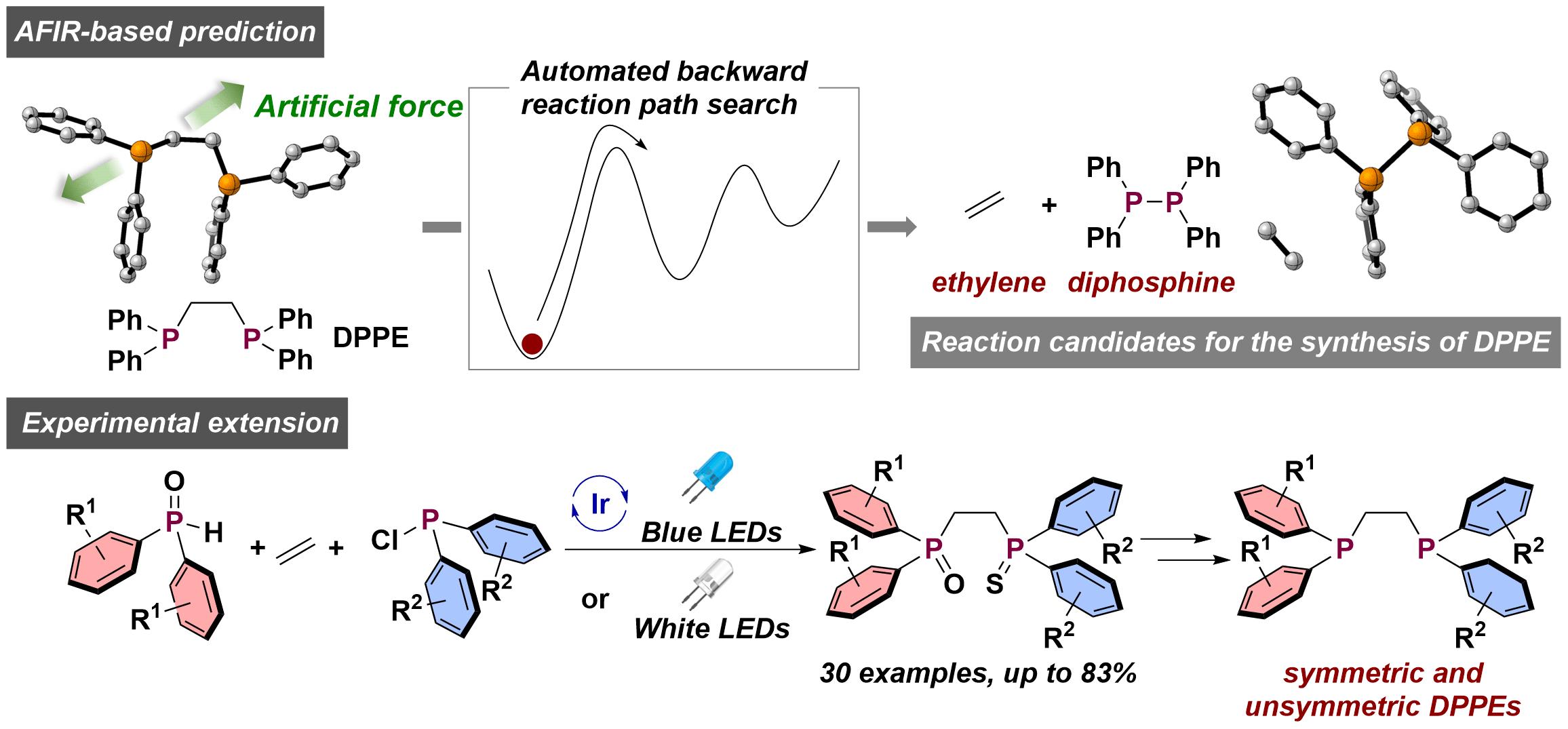
To guide their efforts, researchers initially performed quantum chemical computations via the artificial force induced reaction (AFIR) method to identify possible starting materials that could react to form DPPE. Computations showed a viable process whereby phosphine radicals reacted readily with ethylene to form DPPE. Based on this, the team experimentally verified a straightforward process for making symmetric DPPEs that forms phosphine radicals in solution simply by mixing three readily available compounds. This significantly improves upon previous methods that involved multiple steps and the use of unstable, highly reactive compounds.
Expanding DPPE Variety with Mild Reaction Conditions
This process was then extended to unsymmetric DPPEs, mixing ethylene with both chlorophosphines and phosphine oxides that covered a wide range of electronic properties and sizes. The difference in sizes and electronic properties creates a push-pull effect that could lead to beneficial reactivity or selectivity. Optimization studies found the use of a photocatalyst with blue LED irradiation provided the best yield.
As a test, the team then formed metal complexes using one of the unsymmetric DPPE derivatives. They compared the properties of palladium complexed with DPPE and with the unsymmetric DPPE derivative. The two complexes had significantly different properties, including color, absorption spectrum, and molecular orbital energy, showing the potential for unsymmetric DPPE derivatives to enable different reactivity when used as ligands in catalysts. Researchers see both the application to catalyst design and the use of a low-cost, abundant material as advantages of this method.
“We succeeded in synthesizing DPPE derivatives that are useful as ligands for transition metal catalysts, and we did this using cheap, readily-available ethylene,” said lead author Hideaki Takano. “This result was realized due to the synergistic effect of using AFIR quantum chemical computations combined with the experimental skill and experience of organic chemists. Moving forward, I would like to develop new, revolutionary reactions using novel ligands synthesized by the method we reported here.”
Reference: “A theory-driven synthesis of symmetric and unsymmetric 1,2-bis(diphenylphosphino)ethane analogues via radical difunctionalization of ethylene” by Hideaki Takano, Hitomi Katsuyama, Hiroki Hayashi, Wataru Kanna, Yu Harabuchi, Satoshi Maeda and Tsuyoshi Mita, 21 November 2022, Nature Communications.
DOI: 10.1038/s41467-022-34546-5
Funding: Japan Science and Technology Agency, Japan Society for the Promotion of Science, Fugaku Trust for Medicinal Research, Uehara Memorial Foundation, Naito Foundation
Never miss a breakthrough: Join the SciTechDaily newsletter.
Follow us on Google and Google News.