
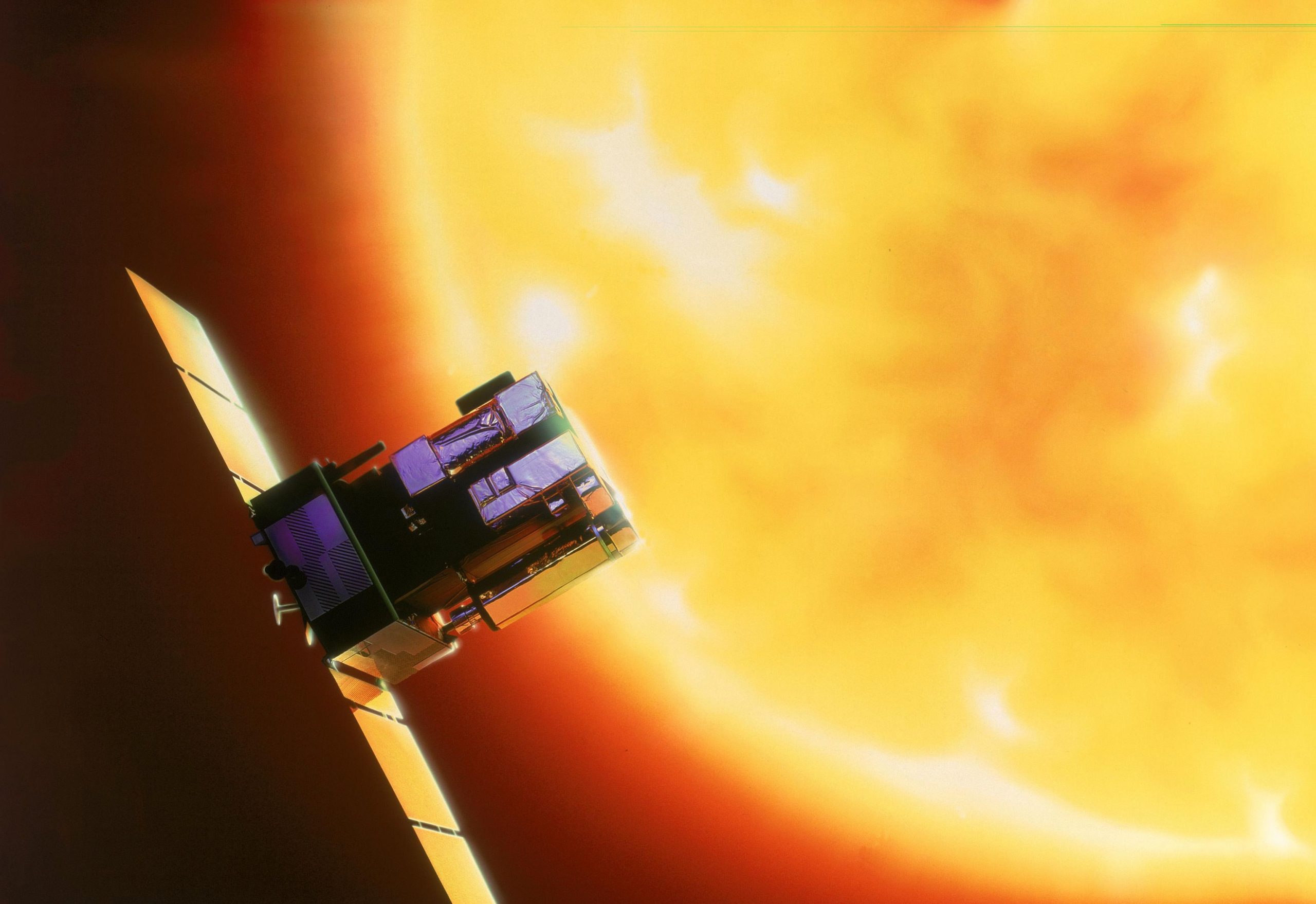
SOHO, intended for solar observation, has become a prolific comet finder, with the 5,000th comet discovery marking a significant milestone and showcasing the contribution of volunteer comet hunters.
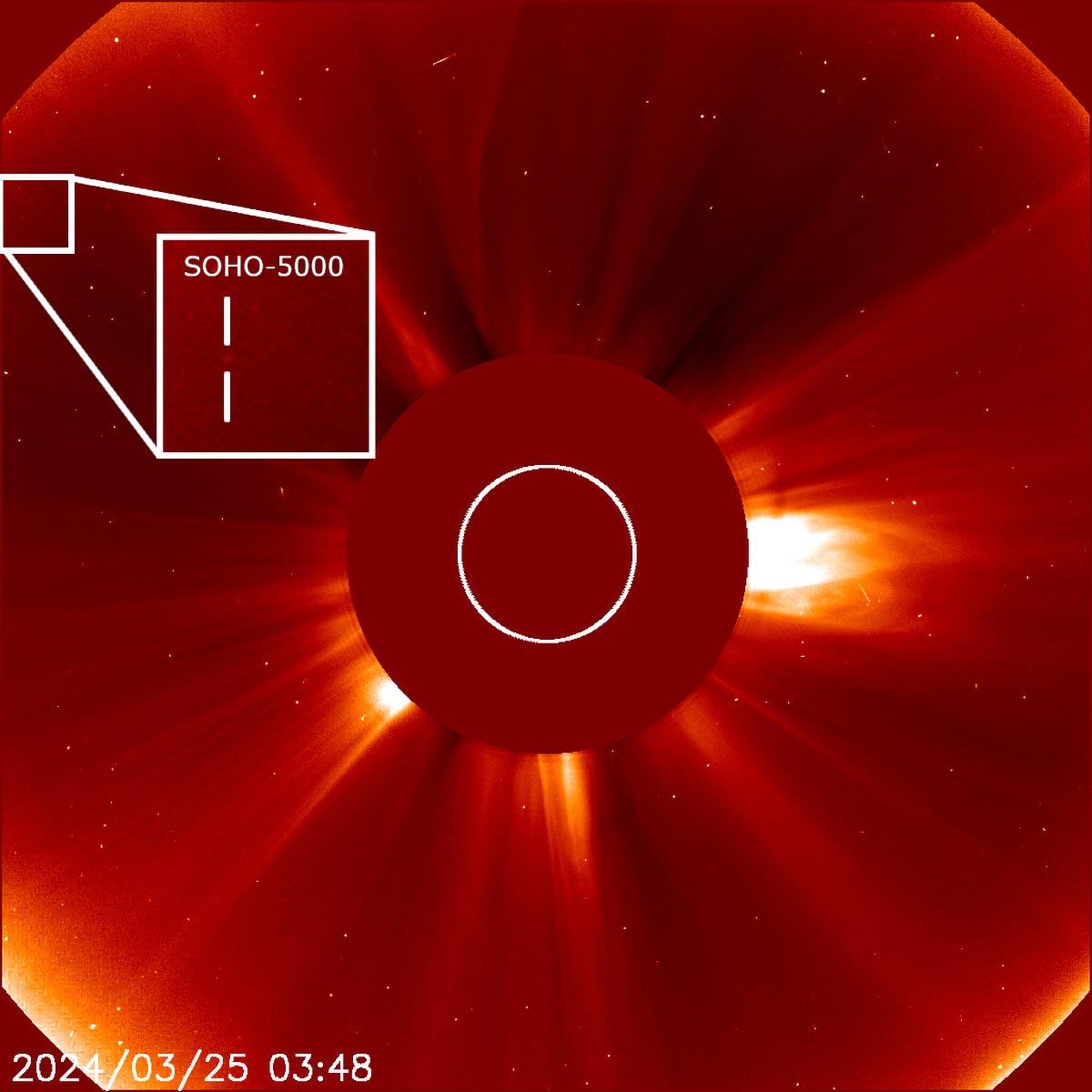
On March 25, 2024, a citizen scientist in the Czech Republic spotted a comet in an image from the Solar and Heliospheric Observatory (SOHO) spacecraft, which has now been confirmed to be the 5,000th comet discovered using SOHO data. SOHO has achieved this milestone over 28 years in space, even though it was never designed to be a comet hunter.
The comet is a small body made of ice and rock that takes only a few years to orbit the Sun. It belongs to the “Marsden group” of comets. This group is thought to be related to comet 96P/Machholz (which SOHO observes when Machholz passes near the Sun every 5.3 years) and is named for the late scientist Brian Marsden who first recognized the group using SOHO observations. Only about 75 of the 5,000 comets discovered with SOHO belong to the Marsden group.
SOHO’s Unexpected Role
A joint mission of ESA (European Space Agency) and NASA, SOHO launched in December 1995 to study the Sun and the dynamics in its outer atmosphere, called the corona. A science instrument on SOHO, called the Large Angle and Spectrometric Coronagraph (LASCO), uses an artificial disk to block the blinding light of the Sun so scientists can study the corona and environment immediately around the Sun.
This also allows SOHO to do something many other spacecraft cannot – see comets flying close to the Sun, known as “sungrazing” comets or “sungrazers.” Many of these comets only brighten when they’re too close to the Sun for other observatories to see and would otherwise go undetected, lost in the bright glare of our star. While scientists expected SOHO to serendipitously find some comets during its mission, the spacecraft’s ability to spot them has made it the most prolific comet-finder in history – discovering more than half of the comets known today.
Community Participation and Achievements
In fact, soon after SOHO launched, people around the world began spotting so many comets in its images that mission scientists needed a way to keep track of them all. In the early 2000s, they launched the NASA-funded Sungrazer Project which allows anyone to report comets they find in SOHO images.
This animation shows the Solar and Heliospheric Observatory’s 5,000th comet (circled) moving across the field relative to background stars. The images in this sequence were taken with the spacecraft’s Large Angle and Spectrometric Coronagraph (LASCO) instrument. Credit: NASA/ESA/SOHO
SOHO’s 5,000th comet was found by Hanjie Tan, a Sungrazer Project participant who is originally from Guangzhou, China, and is currently pursuing a doctoral degree in astronomy in Prague, Czech Republic. Tan has been participating in the Sungrazer Project since he was 13 years old and is one of the project’s youngest comet discoverers.
“Since 2009, I’ve discovered over 200 comets,” Tan said. “I got into the Sungrazer Project because I love looking for comets. It’s really exciting to be the first to see comets get bright near the Sun after they’ve been traveling through space for thousands of years.”
Most of the 5,000 comets discovered using SOHO have been found with the help of an international cadre of volunteer comet hunters – many with no formal scientific training – participating in the Sungrazer Project.
“Prior to the launch of the SOHO mission and the Sungrazer Project, there were only a couple dozen sungrazing comets on record – that’s all we knew existed,” said Karl Battams, a space scientist at the U.S. Naval Research Lab in Washington, D.C., and the principal investigator for the Sungrazer Project. “The fact that we’ve finally reached this milestone – 5,000 comets – is just unbelievable to me.”
SOHO’s 5,000th comet was discovered with the help of volunteers participating in the NASA-funded Sungrazer Project. Credit: NASA’s Goddard Space Flight Center
The vast number of comets discovered using SOHO has allowed scientists to learn more about sungrazing comets and groups of comets that orbit the Sun. Comets discovered by the Sungrazer Project have also helped scientists learn more about the Sun, by watching the comets plunge through our star’s atmosphere like small solar probes.
“The statistics of 5,000 comets, and looking at their orbits and trajectories through space, is a super unique dataset – it’s really valuable science,” Battams said. “It’s a testament to the countless hours the project participants have put into this. We absolutely would never had reached this milestone if it wasn’t for what the project volunteers have done.”
The Sungrazer Project is one of many opportunities that anyone can get involved with to help make discoveries with NASA during the Heliophysics Big Year, which extends through the end of 2024. Learn more about SOHO, the Sungrazer Project, and other NASA science projects you can participate in:
- NASA SOHO mission website
- ESA SOHO website
- The Sungrazer Project
- Why ESA and NASA’s SOHO Spacecraft Spots So Many Comets
- 4,000th Comet Discovered by ESA & NASA Solar Observatory
- NASA Citizen Science
Never miss a breakthrough: Join the SciTechDaily newsletter.
Follow us on Google and Google News.