
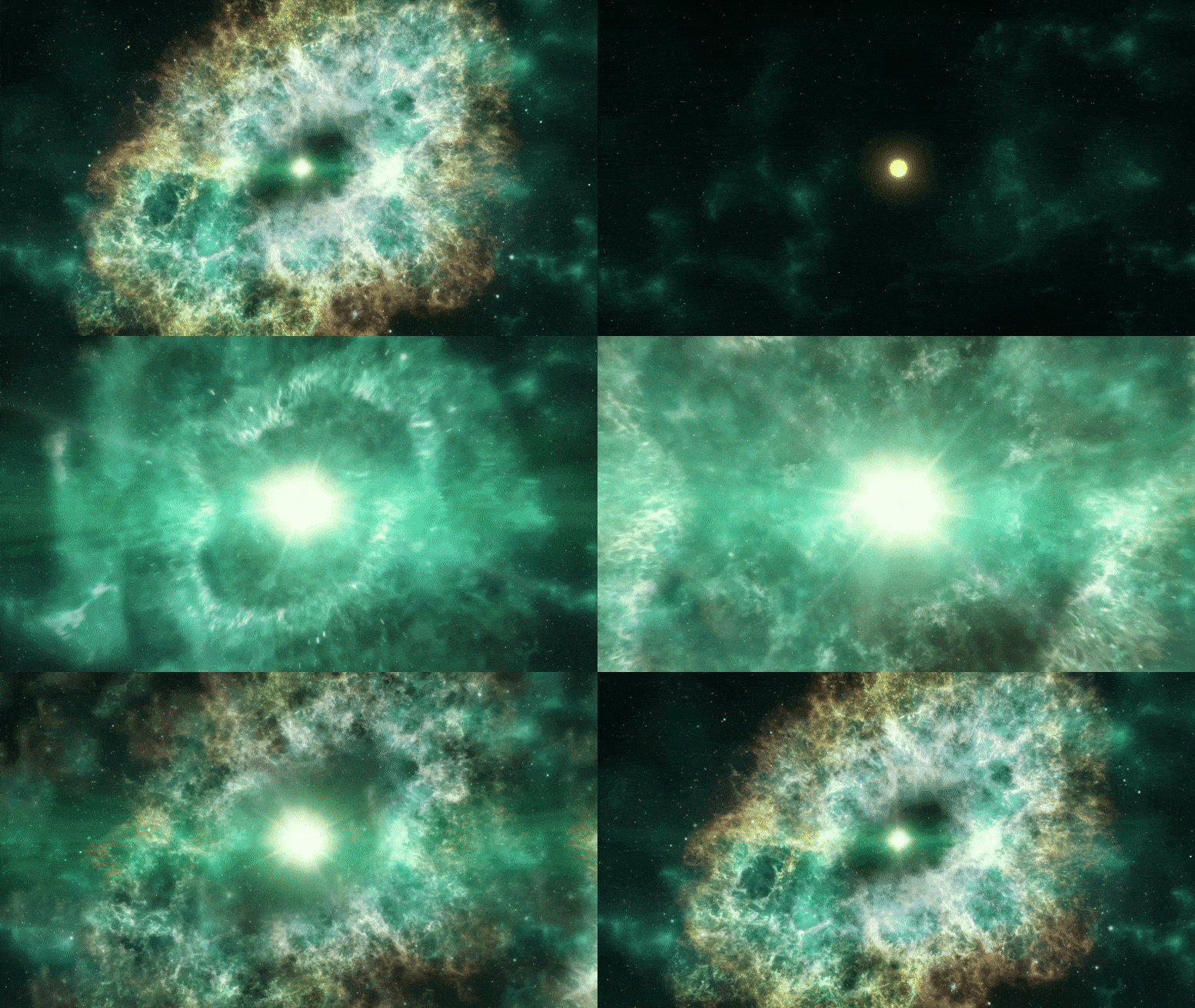
A mystery surrounding the space around our solar system is unfolding thanks to evidence of supernovae found in deep-sea sediments.
Professor Anton Wallner, a nuclear physicist at ANU, led the study which shows the Earth has been traveling for the last 33,000 years through a cloud of faintly radioactive dust.
“These clouds could be remnants of previous supernova explosions, a powerful and super bright explosion of a star,” Professor Wallner said.
Professor Wallner conducted the research at the ANU Heavy Ion Accelerator Facility (HIAF). He also holds joint positions at the Helmholtz-Zentrum Dresden-Rossendorf (HZDR) and Technical University Dresden (TUD) in Germany.
The researchers searched through several deep-sea sediments from two different locations that date back 33,000 years using the extreme sensitivity of HIAF’s mass spectrometer. They found clear traces of the isotope iron-60, which is formed when stars die in supernova explosions.
Iron-60 is radioactive and completely decays away within 15 million years, which means any iron-60 found on the earth must have been formed much later than the rest of the 4.6-billion-year-old earth and arrived here from nearby supernovae before settling on the ocean floor.
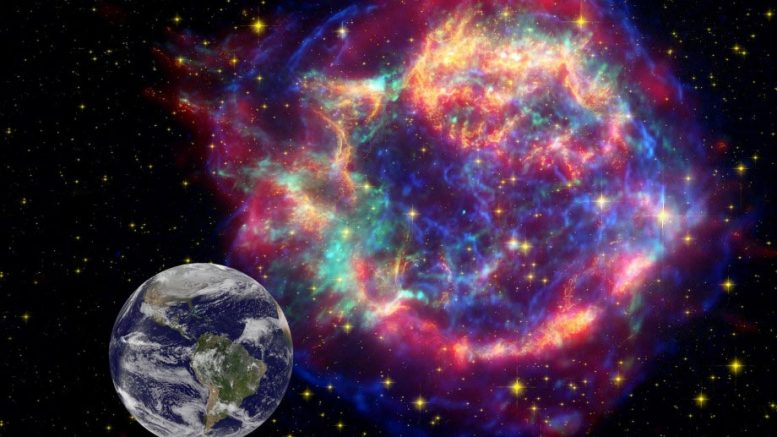
Professor Wallner previously found traces of iron-60 at about 2.6 million years ago, and possibly another at around 6 million years ago, suggesting Earth had traveled through fallout clouds from nearby supernovae.
For the last few thousand years, the solar system has been moving through a denser cloud of gas and dust, known as the local interstellar cloud, (LIC), whose origins are unclear. If this cloud had originated during the past few million years from a supernova, it would contain iron-60, and so the team decided to search for more recent sediment to find out.
Sure enough, there was iron-60 in the sediment at extremely low levels – equating to radioactivity levels in space far below the Earth’s natural background levels – and the distribution of the iron-60 matched Earth’s recent travel through the local interstellar cloud. But the iron-60 extended further back and was spread throughout the entire 33,000-year measurement period.
The lack of correlation with the solar system’s time in the current local interstellar cloud seems to pose more questions than it answers. Firstly, if the cloud was not formed by a supernova, where did it come from? And secondly, why is there iron-60 so evenly spread throughout space?
“There are recent papers that suggest iron-60 trapped in dust particles might bounce around in the interstellar medium,” Professor Wallner said. “So the iron-60 could originate from even older supernovae explosions, and what we measure is some kind of echo. More data is required to resolve these details.”
The findings have been published in the journal PNAS.
Reference: “60Fe deposition during the late Pleistocene and the Holocene echoes past supernova activity” by A. Wallner, J. Feige, L. K. Fifield, M. B. Froehlich, R. Golser, M. A. C. Hotchkis, D. Koll, G. Leckenby, M. Martschini, S. Merchel, S. Panjkov, S. Pavetich, G. Rugel and S. G. Tims, 24 August 2020, Proceedings of the National Academy of Sciences.
DOI: 10.1073/pnas.1916769117
Scientists from ANU, the Australian Nuclear Science and Technology Organization, HZDR, the University of Vienna and the TU Berlin were involved in the study.
Never miss a breakthrough: Join the SciTechDaily newsletter.
Follow us on Google and Google News.
2 Comments
“Iron-60 is radioactive and completely decays away within 15 million years” is sheer nonsense. What we might say is that Iron-60 is an iron isotope with a half-life of 2.6 million years. This means that in 15 million years there are close to 6 half life periods. Put simply, less than one percent of the Iron-60 will remain after 15 million years. One percent is not the same thing as nothing. If you doubt this perhaps you would like to discuss what the difference of consuming a litre of one percent solution of thallium weekly will do to the human body compared to drinking a one litre bottle of water weekly.
“Completely” for the purpose of the measurement and observation of supplied iron-60.
But yes, it is somewhat akin to the language incontinence of labeling large amounts as ‘infinite’. You have to remember that the university press office tries to make the reported science attractive and understandable. The published paper is unlikely to so imprecise.