
Close Menu
    Facebook X (Twitter) Instagram
    SciTechDaily
    • Biology
    • Chemistry
    • Earth
    • Health
    • Physics
    • Science
    • Space
    • Technology
    Facebook X (Twitter) Pinterest YouTube RSS
    SciTechDaily
    Home»Earth»Alien Radioactive Element Discovered in the Ocean Crust
    Earth

    Alien Radioactive Element Discovered in the Ocean Crust

    By Australian National UniversityMay 17, 20212 Comments3 Mins Read
    Facebook Twitter Pinterest Telegram LinkedIn WhatsApp Email Reddit
    Share
    Facebook Twitter LinkedIn Pinterest Telegram Email Reddit
    Tycho Supernova Remnant
    Tycho supernova remnant. Credit: NASA/CXC/SAO

    Plutonium-244 found in ocean crust offers first physical evidence of heavy element formation from ancient cosmic explosions.

    The first-ever discovery of an extraterrestrial radioactive isotope on Earth has scientists rethinking the origins of the elements on our planet.

    The tiny traces of plutonium-244 were found in the ocean crust alongside radioactive iron-60. The two isotopes are evidence of violent cosmic events in the vicinity of Earth millions of years ago.

    Star explosions, or supernovae create many of the heavy elements in the periodic table, including those vital for human life, such as iron, potassium, and iodine.

    To form even heavier elements, such as gold, uranium, and plutonium it was thought that a more violent event may be needed, such as two neutron stars merging.

    However, a study led by Professor Anton Wallner from The Australian National University (ANU) suggests a more complex picture.

    “The story is complicated — possibly this plutonium-244 was produced in supernova explosions or it could be left over from a much older, but even more spectacular event such as a neutron star detonation,” lead author of the study, Professor Wallner said.

    Tracing the Cosmic Timeline Through Isotope Decay

    Any plutonium-244 and iron-60 that existed when the Earth formed from interstellar gas and dust over four billion years ago has long since decayed, so current traces of them must have originated from recent cosmic events in space.

    The dating of the sample confirms two or more supernova explosions occurred near Earth.
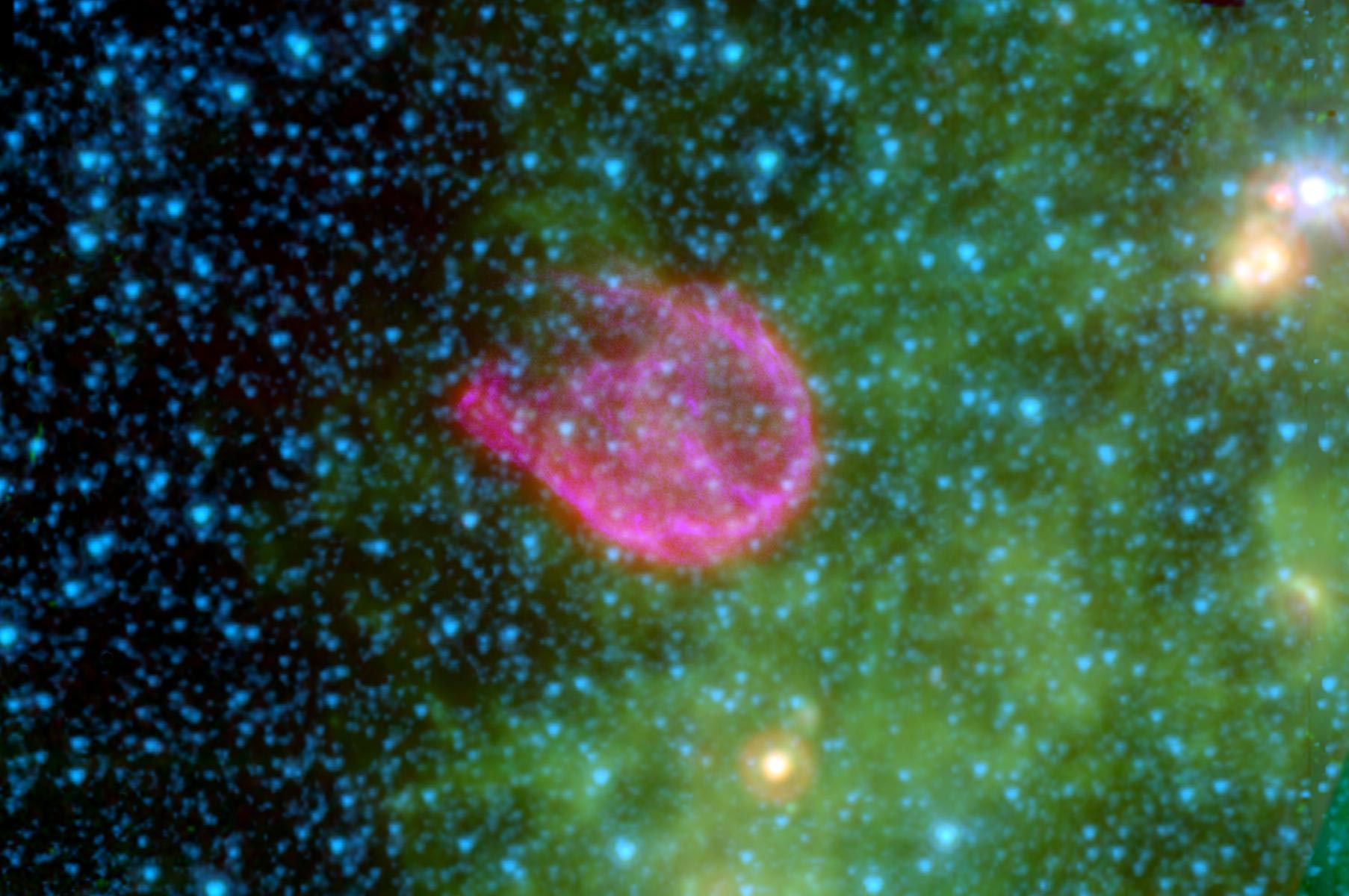
    Supernova's Shockwaves
    This false-color composite from NASA Spitzer Space Telescope and NASA Chandra X-ray Observatory shows the remnant of N132D. Credit: NASA/JPL-Caltech/Harvard-Smithsonian CfA

    “Our data could be the first evidence that supernovae do indeed produce plutonium-244,” Professor Wallner said

    “Or perhaps it was already in the interstellar medium before the supernova went off, and it was pushed across the solar system together with the supernova ejecta.”

    Professor Wallner also holds joint positions at the Helmholtz-Zentrum Dresden-Rossendorf (HZDR) and Technical University Dresden in Germany, and conducted this work with researchers from Australia, Israel, Japan, Switzerland, and Germany.

    The VEGA accelerator at Australian Nuclear Science and Technology Organisation, (ANSTO) in Sydney was used to identify the tiny traces of the plutonium-244.

    The study has been published in Science.

    References: “60Fe and 244Pu deposited on Earth constrain the r-process yields of recent nearby supernovae” by A. Wallner, M. B. Froehlich, M. A. C. Hotchkis, N. Kinoshita, M. Paul, M. Martschini, S. Pavetich, S. G. Tims, N. Kivel, D. Schumann, M. Honda, H. Matsuzaki and T. Yamagata, 14 May 2021, Science.
    DOI: 10.1126/science.aax3972

    “Trace seabed plutonium points to stellar forges of heavy elements” by Daniel Clery, 13 May 2021, Science.
    DOI: 10.1126/science.abj4596

    Never miss a breakthrough: Join the SciTechDaily newsletter.
    Follow us on Google and Google News.

    Australian National University Popular Supernova
    Share. Facebook Twitter Pinterest LinkedIn Email Reddit

    Related Articles

    Earth’s Structure Has a Fifth Layer: Bouncing Seismic Waves Reveal Secrets of the Planet’s Inner Core

    Termination Shock: Trying To Cool the Earth by Dimming Sunlight Could Be Worse Than Global Warming

    Giant Supermountains Stretching Across Entire Supercontinents Controlled the Evolution of Life on Earth

    Remarkable Connection Discovered Between Supernovae and Life on Earth

    Deadwood Releasing 10.9 Gigatons of Carbon Every Year – More Than All Fossil Fuel Emissions Combined

    History of Antarctic Ice Sheets Holds Vital Clues for Our Future

    Stellar Explosion Blamed for Mass Extinction Event on Earth 360 Million Years Ago

    Solving a Solar System Mystery With Ancient Star Explosion Evidence From the Deep Sea

    Earthquake Doublets Reveal Changing Speed of the Earth’s Inner Core

    2 Comments

    1. Neel_03 on May 17, 2021 7:44 pm

      Truly a good news. I was wandering ’bout things these days. Didn’t know that this study is already going on. Thanks a lot for this article 👍

      Reply
    2. xABBAAA on May 18, 2021 12:39 am

      … now this got me thinking,
      Could that “natural atom bomb” be created in nature, because, when there are stuff from other planet, there might be different ratio of isotopes, naturally occurring, this might lead to a critical concentration, and since the rock is dropping through our atmosphere then it might ignite…
      … About this, I am not sure, just a question…

      Reply
    Leave A Reply Cancel Reply

    • Facebook
    • Twitter
    • Pinterest
    • YouTube

    Don't Miss a Discovery

    Subscribe for the Latest in Science & Tech!

    Trending News

    Don’t Miss: August Brings Two Eclipses and the Perseid Meteor Shower

    Brain Waves Once Dismissed As Noise May Help Build Our Reality

    Perseverance Finds Organic Carbon Preserved Just Beneath the Martian Surface

    Tick Found in Austin Apartment Linked to Rare Relapsing Fever

    Ozempic Changes Your Body, but Does It Change Your Life? A New Study Suggests Not

    Ancient Super-Eruptions May Have Frozen Earth for Centuries

    A Common Sugar May Loosen Cancer Cells and Help Them Spread

    Scientists Discover a Major Brain Change That Starts Around Age 50

    Follow SciTechDaily
    • Facebook
    • Twitter
    • YouTube
    • Pinterest
    • Newsletter
    • RSS
    SciTech News
    • Biology News
    • Chemistry News
    • Earth News
    • Health News
    • Physics News
    • Science News
    • Space News
    • Technology News
    Recent Posts
    • Researchers Map the Hidden 3D Geometry of a Quantum Wavefunction
    • Lost in Space: Rare Cosmic Flare Exposes a Wandering Black Hole Far From Its Galaxy’s Center
    • Dark Matter May Be Leaving a Signal in Earth’s Atmosphere
    • Scientists Find Remarkable New Snail Species in Montenegro’s Mountains
    • Scientists Discover a 300-Million-Year-Old Geological Time Capsule Inside Fossilized Wood
    Copyright © 1998 - 2026 SciTechDaily. All Rights Reserved.
    • Science News
    • About
    • Contact
    • Editorial Board
    • Privacy Policy
    • Terms of Use

    Type above and press Enter to search. Press Esc to cancel.