
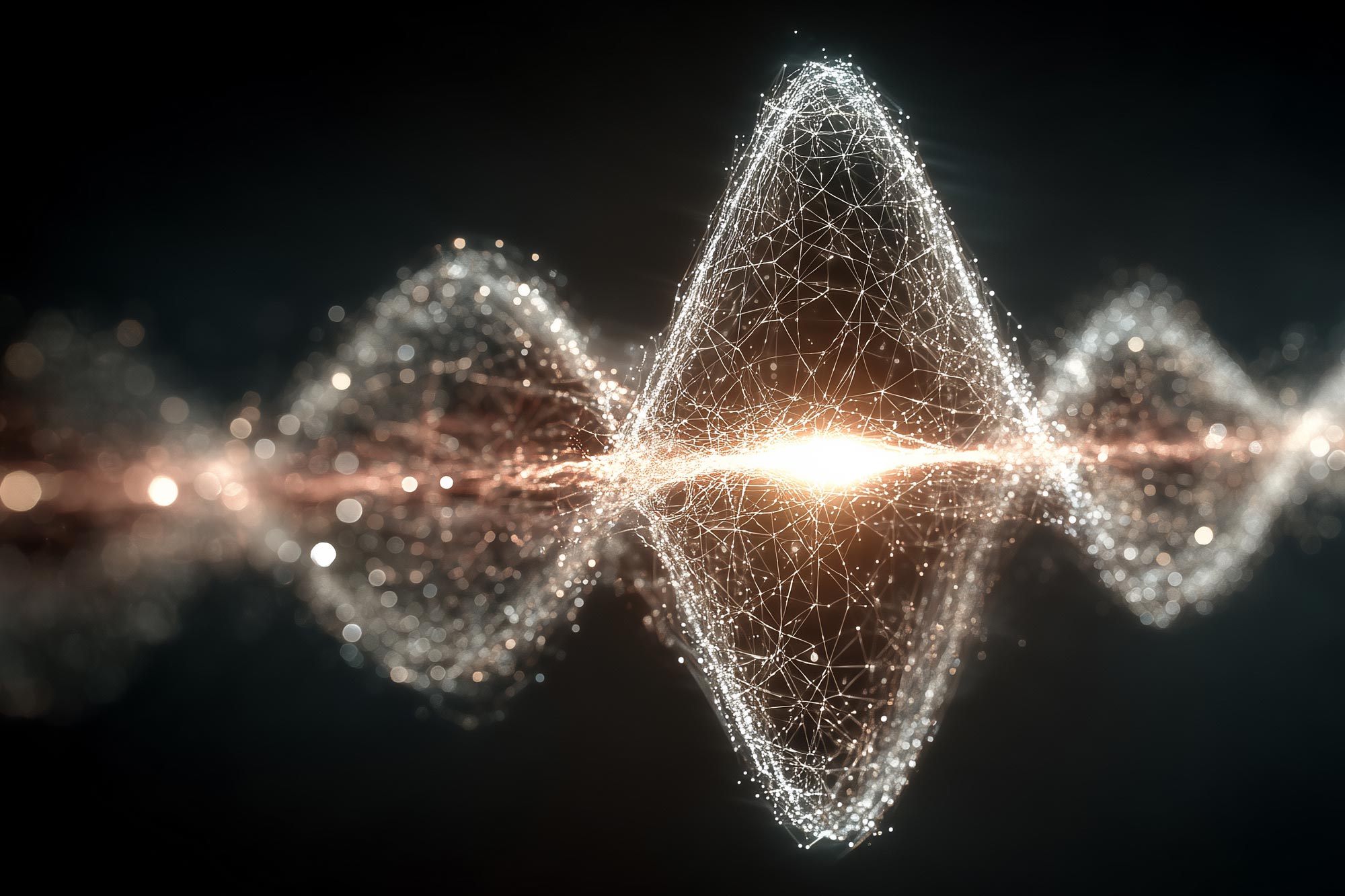
Caltech scientists have created a hybrid quantum memory that converts electrical information into sound, allowing quantum states to last 30 times longer than in standard superconducting systems.
Their mechanical oscillator, like a microscopic tuning fork, could pave the way for scalable and reliable quantum storage.
Quantum Bits vs. Classical Bits
While traditional computers rely on bits, the basic units of information that can only be 0 or 1, quantum computers operate with qubits. Unlike ordinary bits, qubits can exist as both 0 and 1 at the same time. This unusual behavior, a quantum physics effect called superposition, is what gives quantum computing its extraordinary potential to solve problems that are far beyond the reach of conventional machines.
Most quantum computers today are built using superconducting electronic systems, where electrons move without resistance at extremely low temperatures. Within these systems, carefully engineered resonators allow electrons to form superconducting qubits. These qubits excel at carrying out fast, complex operations, but they are not well-suited for long-term storage. Preserving information in the form of quantum states (mathematical descriptions of specific quantum systems) remains a major challenge. To address this, researchers have been working on creating “quantum memories” that can hold quantum information far longer than standard superconducting qubits.

Extending Quantum Memory with Sound
A team at Caltech has now developed a new hybrid method to extend quantum memory. By converting electrical signals into sound, they enabled quantum states from superconducting qubits to remain stable for up to 30 times longer than with earlier approaches.
The research, led by graduate students Alkim Bozkurt and Omid Golami under the supervision of Mohammad Mirhosseini, assistant professor of electrical engineering and applied physics, was published in Nature Physics.
“Once you have a quantum state, you might not want to do anything with it immediately,” Mirhosseini says. “You need to have a way to come back to it when you do want to do a logical operation. For that, you need a quantum memory.”
Harnessing Sound for Quantum Storage
Previously, Mirhosseini’s group showed that sound, specifically phonons, which are individual particles of vibration (in the way that photons are individual particles of light) could provide a convenient method for storing quantum information. The devices they tested in classical experiments seemed ideal for pairing with superconducting qubits because they worked at the same extremely high gigahertz frequencies (humans hear at hertz and kilohertz frequencies that are at least a million times slower). They also performed well at the low temperatures needed to preserve quantum states with superconducting qubits and had long lifetimes.
Now Mirhosseini and his colleagues have fabricated a superconducting qubit on a chip and connected it to a tiny device that scientists call a mechanical oscillator. Essentially a miniature tuning fork, the oscillator consists of flexible plates that are vibrated by sound waves at gigahertz frequencies. When an electric charge is placed on those plates, the plates can interact with electrical signals carrying quantum information. This allows information to be piped into the device for storage as a “memory” and be piped out, or “remembered,” later.
Storage Times Far Exceed Expectations
The researchers carefully measured how long it took for the oscillator to lose its valuable quantum content once information entered the device. “It turns out that these oscillators have a lifetime about 30 times longer than the best superconducting qubits out there,” Mirhosseini says.
This method of constructing a quantum memory offers several advantages over previous strategies. Acoustic waves travel much slower than electromagnetic waves, enabling much more compact devices. Moreover, mechanical vibrations, unlike electromagnetic waves, do not propagate in free space, which means that energy does not leak out of the system. This allows for extended storage times and mitigates undesirable energy exchange between nearby devices. These advantages point to the possibility that many such tuning forks could be included in a single chip, providing a potentially scalable way of making quantum memories.
The Path Forward
Mirhosseini says this work has demonstrated the minimum amount of interaction between electromagnetic and acoustic waves needed to probe the value of this hybrid system for use as a memory element. “For this platform to be truly useful for quantum computing, you need to be able to put quantum data in the system and take it out much faster. And that means that we have to find ways of increasing the interaction rate by a factor of three to 10 beyond what our current system is capable of,” Mirhosseini says. Luckily, his group has ideas about how that can be done.
Reference: “A mechanical quantum memory for microwave photons” by Alkım B. Bozkurt, Omid Golami, Yue Yu, Hao Tian and Mohammad Mirhosseini, 13 August 2025, Nature Physics.
DOI: 10.1038/s41567-025-02975-w
Additional authors of the paper are Yue Yu, a former visiting undergraduate student in the Mirhosseini lab; and Hao Tian, an Institute for Quantum Information and Matter postdoctoral scholar research associate in electrical engineering at Caltech. The work was supported by funding from the Air Force Office of Scientific Research and the National Science Foundation. Bozkurt was supported by an Eddleman Graduate Fellowship.
Never miss a breakthrough: Join the SciTechDaily newsletter.
Follow us on Google and Google News.
7 Comments
hello
good
Very good.
Please ask researchers to think deeply:
Which is easier to understand between, that quantum and quantum technology based on quantum theory, and that topological materials and manipulation techniques based on topological vortex theory? Which is more beneficial for materials science research? Why does physics consider quantum to be a cat that is both dead and alive?
Topology provides stability blueprints, but specific physics (spatial features, gravitational collapse, fluid viscosity, quantum measurement) dictates vortex generation, evolution, and decay. If researchers are interested in this, please visit https://zhuanlan.zhihu.com/p/1933484562941457487 and https://zhuanlan.zhihu.com/p/1925124100134790589.
Quantum is frequency.
I really do not understand why you do understand Quantum.
Its conciousness.
VERY GOOD!
Quantum is frequency. WHY? Is the frequency related to the period? WHY?………..
A generation severely were mislead and poisoned by so-called peer-reviewed publications. In today’s physics, so-called peer-reviewed publications, including Physical Review Letters, Nature, Science, etc., stubbornly insist on and promote:
1. Although θ and τ particles show differences in experiments, physics can assume that they are the same type of particle. This is science.
2. Although topological vortices have the same structure and opposite rotation direction as their anti vortices, physics can define their structures and directions as completely different. This is science.
3. Although two sets of cobalt-60 reverse rotation experiments showed asymmetry, physics can still define them as two objects that are mirror images of each other. This is science.
, etc. They openly define the Differences as the Same while the Same as the Differences, and deceive the public with so-called impact factors (IF), never knowing what shame is.
The universe is not a God, nor is it merely Particles; moreover, it is not Algebra, Formulas, or Fractions. The universe is the superposition, deflection, entanglement, and locking of spacetime vortex geometries, the interaction and balance of topological vortices and their fractal structures. Topological invariants are the identical intrinsic properties between two isomorphic topological spaces. Different civilizations may create distinct mathematical codes or tools to describe the universality and specificity of these topological invariants under different physical laws.
I am a senior secondary level student but I am very much interested for creating new formulae
Fascinating theory my friend. You are explaining the infinite (it is yet it is not and every thing between that those positions that are actually one position). Do I interpret you correctly?