
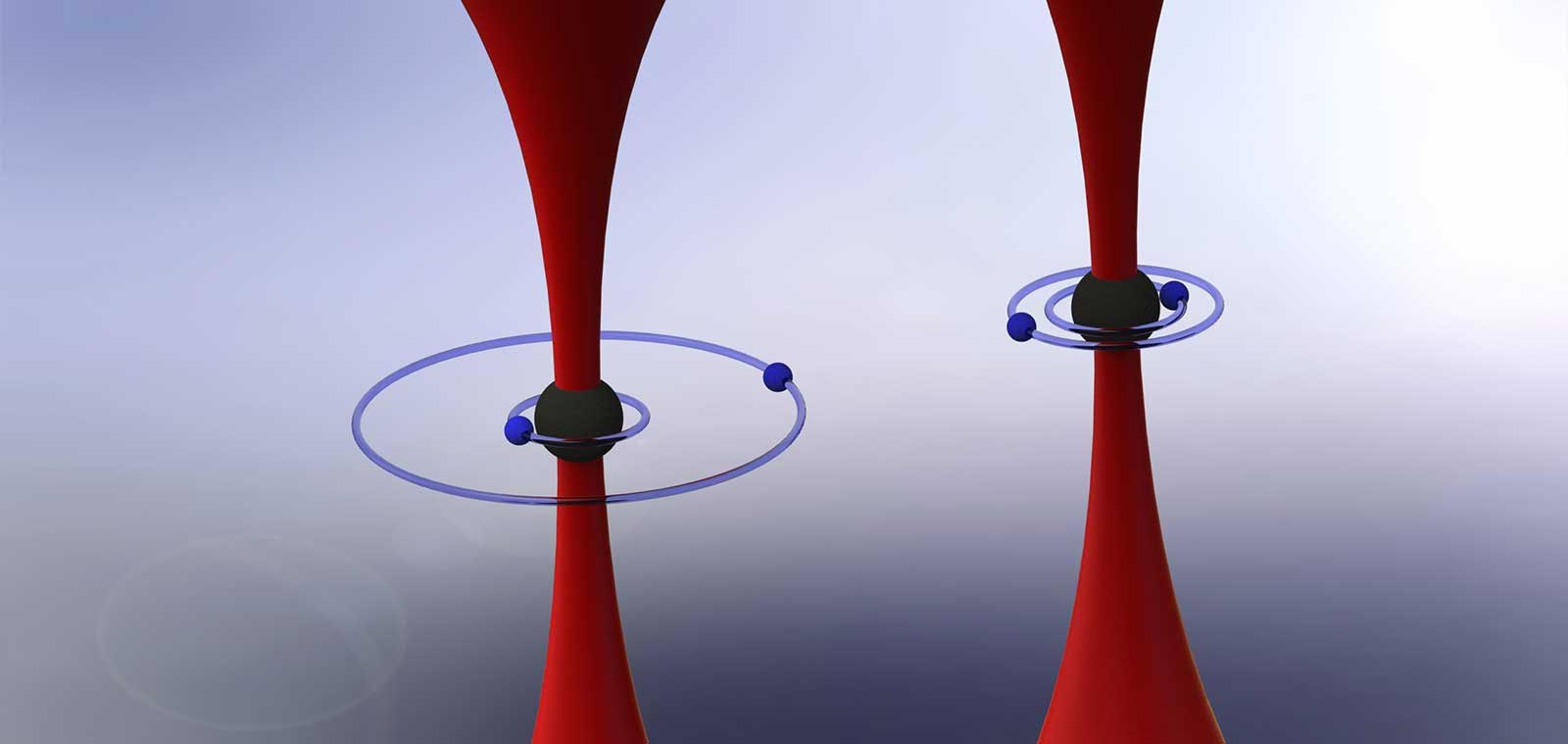
Physicists’ latest achievement with neutral atoms paves the way for new quantum computer designs.
In the quest to develop quantum computers, physicists have taken several different paths. For instance, Google recently reported that their prototype quantum computer might have made a specific calculation faster than a classical computer. Those efforts relied on a strategy that involves superconducting materials, which are materials that, when chilled to ultracold temperatures, conduct electricity with zero resistance. Other quantum computing strategies involve arrays of charged or neutral atoms.
Now, a team of quantum physicists at Caltech has made strides in work that uses a more complex class of neutral atoms called the alkaline-earth atoms, which reside in the second column of the periodic table. These atoms, which include magnesium, calcium, and strontium, have two electrons in their outer regions, or shells. Previously, researchers who experimented with neutral atoms had focused on elements located in the first column of the periodic table, which have just one electron in their outer shells.
In a paper published in the journal Nature Physics, the researchers demonstrate that they can use individually controlled alkaline-earth atoms to achieve a hallmark of quantum computing: entanglement. This seemingly paradoxical phenomenon occurs when two atoms remain intimately connected even when separated by vast distances. Entanglement is essential to quantum computers because it enables the computers’ internal “switches,” known as qubits, to be correlated with each other and to encode an exponential amount of information.
“Essentially, we are breaking a two-qubit entanglement record for one of the three leading quantum science platforms: individual neutral atoms,” says Manuel Endres, an assistant professor of physics and leader of the Caltech team. Endres is also a member of one of three new quantum research institutes established by the National Science Foundation’s (NSF’s) Quantum Leap Challenges Institutes program, and a member of one of five new Department of Energy quantum science centers.
“We are opening up a new tool box for quantum computers and other applications,” says Ivaylo Madjarov, a Caltech graduate student and lead author of the new study. “With alkaline-earth atoms, we have more opportunities for manipulating systems and new opportunities for precise manipulation and readout of the system.”
To achieve their goal, the researchers turned to optical tweezers, which are basically laser beams that can maneuver individual atoms. The team previously used the same technology to develop a new design for optical atomic clocks. In the new study, the tweezers were used to persuade two strontium atoms within an array of atoms to become entangled.
“We had previously demonstrated the first control of individual alkaline-earth atoms. In the present work, we have added a mechanism to generate entanglement between the atoms, based on highly excited Rydberg states, in which atoms separated by many microns feel large forces from each other,” says Jacob Covey, a postdoctoral scholar at Caltech. “The unique properties of the alkaline-earth atoms offer new ways to improve and characterize the Rydberg-interaction mechanism.”
What is more, the researchers were able to create the entangled state with a higher degree of accuracy than had been previously achieved through the use of neutral atoms, and with an accuracy on par with other quantum computing platforms.
In the future, the researchers hope to expand their ability to control individual qubits, and they plan to further investigate methods to entangle three or more atoms.
“The endgame is to reach a very high level of entanglement and programmability for many atoms in order to be able to perform calculations that are intractable by a classical computer,” says Endres. “Our system is also suited to investigate how such many-atom entanglement could improve the stability of atomic clocks.”
Reference: “High-fidelity entanglement and detection of alkaline-earth Rydberg atoms” by Ivaylo S. Madjarov, Jacob P. Covey, Adam L. Shaw, Joonhee Choi, Anant Kale, Alexandre Cooper, Hannes Pichler, Vladimir Schkolnik, Jason R. Williams and Manuel Endres, 25 May 2020, Nature Physics.
DOI: 10.1038/s41567-020-0903-z
CaltechAUTHORS: 20200312-141649005
The study, published in the August issue of Nature Physics was funded by NSF, the Sloan Foundation, F. Blum, Caltech, the Gordon and Betty Moore Foundation, and the Larson SURF Fellowship. Other authors include, at Caltech: graduate student Adam L. Shaw; Joonhee Choi, IQIM Postdoctoral Scholar in Physics; Anant Kale, laboratory assistant; Alexandre Cooper, former postdoctoral scholar in physics; and Hannes Pichler, former Moore Postdoctoral Scholar in Theoretical Physics; and Vladimir Schkolnik and Jason R. Williams of the Jet Propulsion Laboratory (JPL), which is managed by Caltech for NASA.
Never miss a breakthrough: Join the SciTechDaily newsletter.
Follow us on Google and Google News.
1 Comment
👍🤔