
By utilizing traditional semiconductor devices, researchers have unlocked new potentials in quantum communication, pushing us closer to realizing the vast potential of the quantum internet.
Building the quantum internet could be significantly simplified by leveraging existing telecommunications technologies and infrastructure. In recent years, researchers have identified defects in silicon—a widely used semiconductor material—that hold the potential for transmitting and storing quantum information across the prevalent telecommunications wavelengths. These silicon defects might just be the prime contenders to host qubits for efficient quantum communications.
Exploring Quantum Defects in Silicon
“It’s still a Wild West out there,” said Evelyn Hu, the Tarr-Coyne Professor of Applied Physics and of Electrical Engineering at the Harvard John A. Paulson School of Engineering and Applied Sciences (SEAS). “Even though new candidate defects are a promising quantum memory platform, there is often almost nothing known about why certain recipes are used to create them, and how you can rapidly characterize them and their interactions, even in ensembles. And ultimately, how can we fine-tune their behavior so they exhibit identical characteristics? If we are ever to make a technology out of this wide world of possibilities, we must have ways to characterize them better, faster, and more efficiently.”
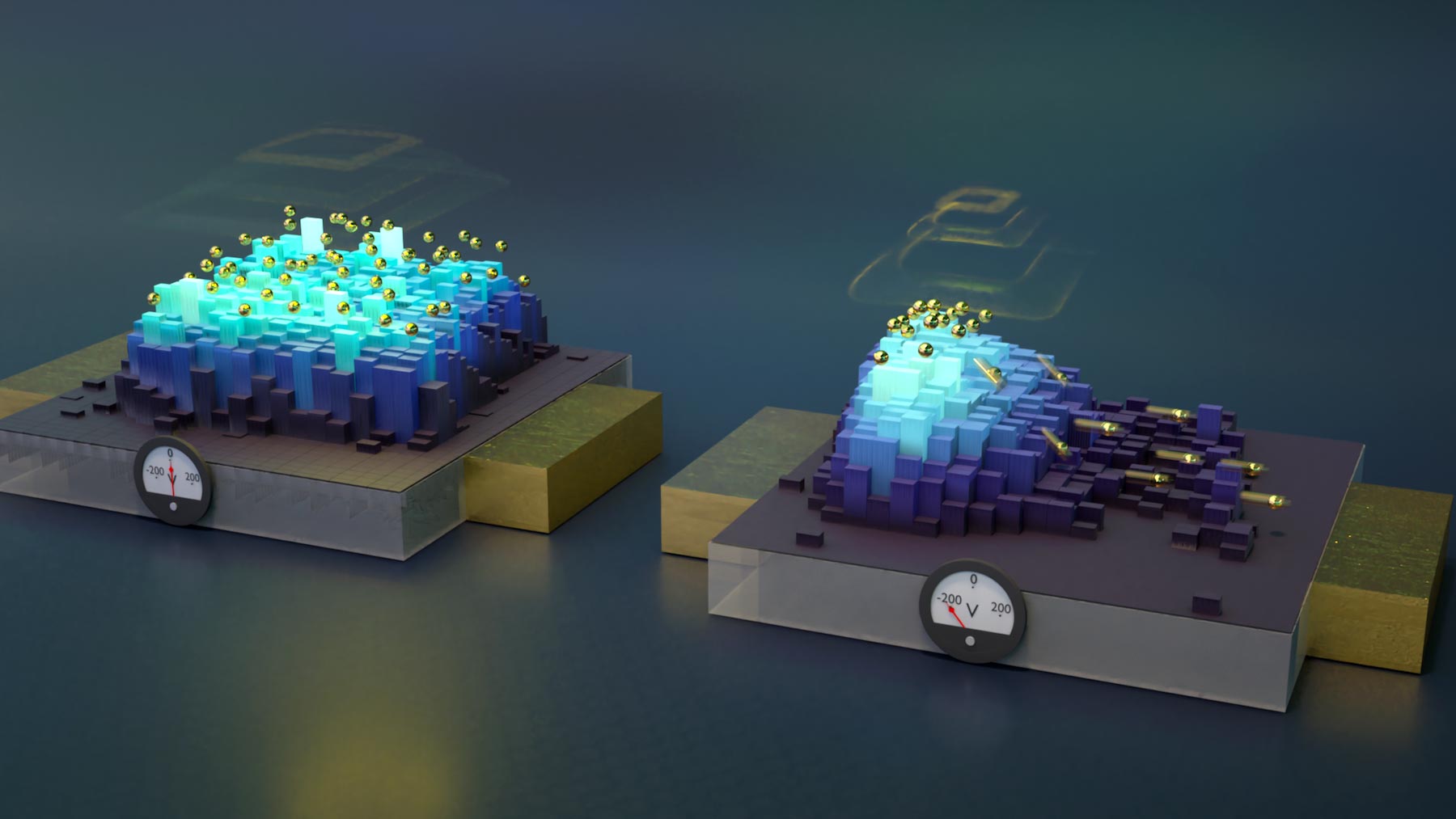
Now, Hu and a team of researchers have developed a platform to probe, interact with and control these potentially powerful quantum systems. The device uses a simple electric diode, one of the most common components in semiconductor chips, to manipulate qubits inside a commercial silicon wafer. Using this device, the researchers were able to explore how the defect responds to changes in the electric field, tune its wavelength within the telecommunications band and even turn it on and off.
“If we are ever to make a technology out of this wide world of possibilities, we must have ways to characterize them better, faster and more efficiently.”
Evelyn Hu, Tarr-Coyne Professor of Applied Physics and of Electrical Engineering
Harnessing Defects for Quantum Communications
“One of the most exciting things about having these defects in silicon is that you can use well-understood devices like diodes in this familiar material to understand a whole new quantum system and do something new with it,” said Aaron Day, a Ph.D. candidate at SEAS. Day co-led the work with Madison Sutula, a research fellow at Harvard.
While the research team used this approach to characterize defects in silicon, it could be used as a diagnostic and control tool for defects in other material systems.
The research is published in Nature Communications.
Quantum Emitters and Networking Applications
Quantum defects, also known as color centers or quantum emitters, are imperfections in otherwise perfect crystal lattices that can trap single electrons. When those electrons are hit with a laser, they emit photons in specific wavelengths. The defects in silicon that researchers are most interested in for quantum communications are known as G-centers and T-centers. When these defects trap electrons, the electrons emit photons in a wavelength called the O-band, which is widely used in telecommunications.
In this research, the team focused on G-center defects. The first thing they needed to figure out was how to make them. Unlike other types of defects, in which an atom is removed from a crystal lattice, G-center defects are made by adding atoms to the lattice, specifically carbon. But Hu, Day and the rest of the research team found that adding hydrogen atoms is also critical to consistently forming the defect.
Developing Tools for Quantum Networking
Next, the researchers fabricated electrical diodes using a new approach that optimally sandwiches the defect at the center of every device without degrading the performance of either the defect or the diode. The fabrication method can create hundreds of devices with embedded defects across a commercial wafer. Hooking the whole device up to apply a voltage, or electric field, the team found that when a negative voltage was applied across the device, the defects turned off and went dark.
“Understanding when a change in environment leads to a loss of signal is important for engineering stable systems in networking applications,” said Day,
The scientists also found that by using a local electric field, they could tune the wavelengths being emitted by the defect, which is important for quantum networking when disparate quantum systems need to be aligned.
The team also developed a diagnostic tool to image how the millions of defects embedded in the device change in space as the electric field is applied.
Future Directions and Commercial Potential
“We found that the way we’re modifying the electric environment for the defects has a spatial profile, and we can image it directly by seeing the changes in the intensity of light being emitted by the defects,” said Day. “By using so many emitters and getting statistics on their performance, we now have a good understanding of how defects respond to changes in their environment. We can use that information to inform how to build the best environments for these defects in future devices. We have a better understanding of what makes these defects happy and unhappy.”
Next, the research team aims to use the same techniques to understand the T-center defects in silicon.
Reference: “Electrical manipulation of telecom color centers in silicon” by Aaron M. Day, Madison Sutula, Jonathan R. Dietz, Alexander Raun, Denis D. Sukachev, Mihir K. Bhaskar and Evelyn L. Hu, 3 June 2024, Nature Communications.
DOI: 10.1038/s41467-024-48968-w
The research was co-authored by Sutula, Jonathan R. Dietz, Alexander Raun from SEAS, and AWS research scientists Denis D. Sukachev and Mihir K. Bhaskar.
This work was supported by AWS Center for Quantum Networking and the Harvard Quantum Initiative. Harvard’s Office of Technology Development has protected the intellectual property associated with this project and is pursuing commercialization opportunities.
Never miss a breakthrough: Join the SciTechDaily newsletter.
Follow us on Google and Google News.