

Quantum computing, just like traditional computing, requires a method to store the information it uses and processes. In the computer you’re using right now, information—whether it be photos of your dog, a reminder about a friend’s birthday, or the words you’re typing into your browser’s address bar—must be stored somewhere. Quantum computing, a relatively new field, is still exploring where and how to store quantum information.
Innovative Method for Quantum Information Storage
In a paper published recently in the journal Nature Physics, Mohammad Mirhosseini, assistant professor of electrical engineering and applied physics at the California Institute of Technology (Caltech), shows a new method his lab developed for efficiently translating electrical quantum states into sound and vice versa. This type of translation may allow for storing quantum information prepared by future quantum computers, which are likely to be made from electrical circuits.
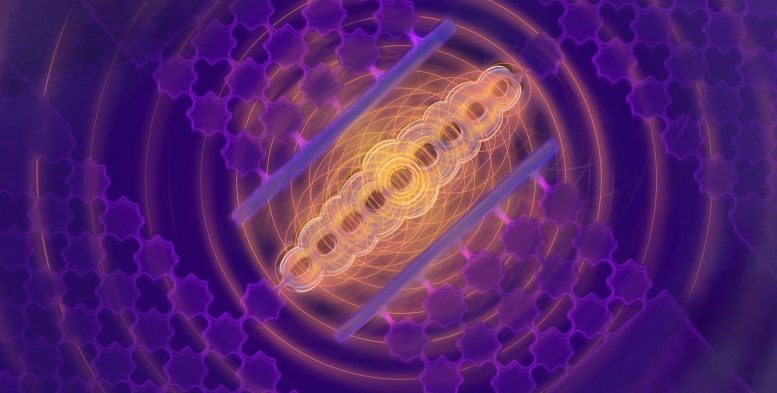
This method makes use of what are known as phonons, the sound equivalent of a light particle called a photon. (Remember that in quantum mechanics, all waves are particles and vice versa). The experiment investigates phonons for storing quantum information because it’s relatively easy to build small devices that can store these mechanical waves.
Using Sound Waves to Store Information
To understand how a sound wave can store information, imagine an extremely echoey room. Now, let’s say you need to remember your grocery list for the afternoon, so you open the door to that room and shout, “Eggs, bacon, and milk!” and shut the door. An hour later, when it’s time to go to the grocery store, you open the door, poke your head inside, and hear your own voice still echoing, “Eggs, bacon, and milk!” You just used sound waves to store information.

Of course, in the real world, an echo like that wouldn’t last very long, and your voice might end up so distorted you can no longer make out your own words, not to mention that using an entire room for storing a little bit of data would be ridiculous. The research team’s solution is a tiny device consisting of flexible plates that are vibrated by sound waves at extremely high frequencies. When an electric charge is placed on those plates, they become able to interact with electrical signals carrying quantum information. This allows that information to be piped into the device for storage, and be piped out for later use—not unlike the door to the room you were shouting into earlier in this story.
Previous Research and New Developments
According to Mohammad Mirhosseini, previous studies had investigated a special type of materials known as piezoelectrics as a means of converting mechanical energy to electrical energy in quantum applications.
“These materials, however, tend to cause energy loss for electrical and sound waves, and loss is a big killer in the quantum world,” Mirhosseini says. In contrast, the new method developed by Mirhosseini and his team is independent on the properties of specific materials, making it compatible with established quantum devices, which are based on microwaves.
Conclusion: Advancements and Challenges
Creating effective storage devices with small footprints has been another practical challenge for researchers working on quantum applications, says Alkim Bozkurt, a graduate student in Mirhosseini’s group and the lead author of the paper.
“However, our method enables the storage of quantum information from electrical circuits for durations two orders of magnitude longer than other compact mechanical devices,” he adds.
Reference: “A quantum electromechanical interface for long-lived phonons” by Alkim Bozkurt, Han Zhao, Chaitali Joshi, Henry G. LeDuc, Peter K. Day and Mohammad Mirhosseini, 22 June 2023, Nature Physics.
DOI: 10.1038/s41567-023-02080-w
Co-authors include Chaitali Joshi and Han Zhao, both postdoctoral scholars in electrical engineering and applied physics; and Peter Day and Henry LeDuc, who are scientists at the Jet Propulsion Laboratory, which Caltech manages for NASA. The research was funded in part by the KNI-Wheatley Scholars program.
Never miss a breakthrough: Join the SciTechDaily newsletter.
Follow us on Google and Google News.