
Close Menu
    Facebook X (Twitter) Instagram
    SciTechDaily
    • Biology
    • Chemistry
    • Earth
    • Health
    • Physics
    • Science
    • Space
    • Technology
    Facebook X (Twitter) Pinterest YouTube RSS
    SciTechDaily
    Home»Space»Spectroscopic Survey Reveals the Nature of Obscured Active Galactic Nuclei
    Space

    Spectroscopic Survey Reveals the Nature of Obscured Active Galactic Nuclei

    By Harvard-Smithsonian Center for AstrophysicsOctober 15, 2019No Comments3 Mins Read
    Facebook Twitter Pinterest Telegram LinkedIn WhatsApp Email Reddit
    Share
    Facebook Twitter LinkedIn Pinterest Telegram Email Reddit
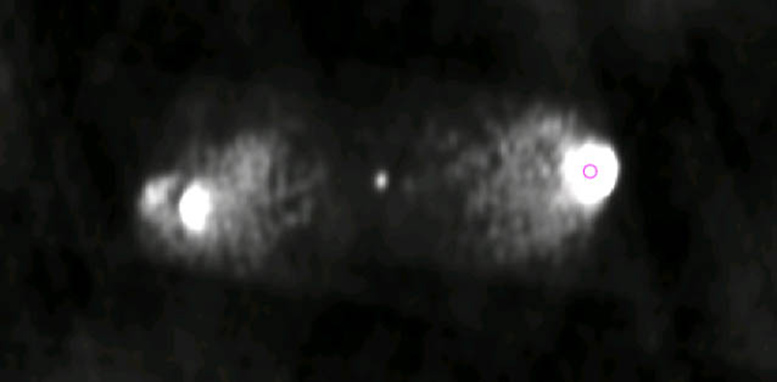
    Radio Image of the Galaxy 3C062
    A radio image of the galaxy 3C062 and the jets from its superluminous, supermassive black hole nucleus. The most luminous AGN, like this one, have over a trillion solar-luminosities. Astronomers have combined multiwavelength observations of a set of twenty-eight these objects to categorize their similarities and find no other distinctive properties in common. They argue that the emission is linked to episodes of major mergers. Credit: VLA

    Most galaxies host a supermassive black hole (SMBH) at their nucleus, one whose mass exceeds a million solar-masses. When material actively accretes onto the SMBH, associated processes can produce an active galactic nucleus (AGN) with a hot torus and dramatic bipolar jets of rapidly moving charged particles. The most luminous known AGN emit over ten trillion solar-luminosities. Astronomers are trying to understand what powers AGN, how they evolve, and how their jets and radiation affect their environments, and these extreme cases are expected to provide key insights.

    Quasars are perhaps the best-known luminous AGN, and their nuclei are visible and relatively unobscured by dust. But there are cases where the torus of material around the nuclei happens to block our line of sight. These obscured AGN have no visible emission lines and so are often omitted from studies, but they are needed to provide a more complete view of the population. A foremost question is whether these very luminous AGN are powered by moderate accretion onto very massive black holes, or instead by extreme accretion rates onto moderate-mass black holes, or perhaps something in between.

    CfA astronomer Fabio Pacucci was a member of a large international team of scientists that combined observations from the Swift satellite’s X-Ray Burst Alert Telescope AGN Spectroscopic Survey (BASS) with radio, optical, and infrared datasets. They studied twenty-eight of the most luminous, relatively nearby AGN, most of which are located in elliptical galaxies. Apart from their dramatic nuclear activity, the set have no other distinctive properties; their radio emission, for example, spans a factor of ten thousand, and the inferred masses of their supermassive black holes also cover a large range. Some of these results are surprising: since the jets are responsible for radio emission, it was thought that radio strength would correlate more closely with the X-ray emission or the black hole masses. The authors conclude by speculating that, if the results hold up in larger studies, the intense growth of supermassive black holes and correspondingly intense emission is not a property of any particular type of galaxy but rather is linked to the transformation of galaxies from star-forming spirals to quiescent ellipticals during episodes of major merging.

    Reference: “BAT AGN Spectroscopic Survey – XIII. The nature of the most luminous obscured AGN in the low-redshift universe” by Rudolf E. Bär, Benny Trakhtenbrot, Kyuseok Oh, Michael J. Koss, O. Ivy Wong, Claudio Ricci, Kevin Schawinski, Anna K. Weigel, Lia F. Sartori, Kohei Ichikawa, Nathan J. Secrest, Daniel Stern, Fabio Pacucci, Richard Mushotzky, Meredith C. Powell, Federica Ricci, Eleonora Sani, Krista L. Smith, Fiona A. Harrison, Isabella Lamperti and C. Megan Urry, 21 August 2019, Monthly Notices of the Royal Astronomical Society.
    DOI: 10.1093/mnras/stz2309

    Never miss a breakthrough: Join the SciTechDaily newsletter.
    Follow us on Google and Google News.

    Astrophysics Black Hole Harvard-Smithsonian Center for Astrophysics
    Share. Facebook Twitter Pinterest LinkedIn Email Reddit

    Related Articles

    Researchers Study Mysterious Gamma Ray Source with No Known Counterpart

    Researchers Trace the Evolution of Galaxies that Host Massive Black Holes

    Distinguishing Black Holes from Naked Singularities

    A Link Between Black Hole Accretion Rate and Star Formation Rate

    Astronomers Measure a Black Hole’s “Point of No Return”

    Cloud of Hydrogen and Helium Plunging Toward the Galactic Center

    Study Challenges Prevailing Ideas About How Supermassive Black Holes Grow

    Gamma-Ray Beams Suggest Milky Way’s Central Black Hole Had Active Past

    Astronomers Observed Evolved Star Being Devoured

    Leave A Reply Cancel Reply

    • Facebook
    • Twitter
    • Pinterest
    • YouTube

    Don't Miss a Discovery

    Subscribe for the Latest in Science & Tech!

    Trending News

    Scientists Uncover Promising New Strategy To Stop Parkinson’s in Its Tracks

    Experts Reveal the Surprising Cancer Link Behind a Common Vitamin

    This Strange “Golden Orb” Found 2 Miles Deep Stumped Scientists for Years

    Giant “Last Titan” Dinosaur Discovered in Thailand Was Bigger Than 9 Elephants

    This “Longevity Gene” May Protect the Brain From Aging and Dementia

    Common Cleaning Chemical Could Triple Your Risk of a Dangerous Liver Disease

    Scientists Discover Bizarre 100-Million-Year-Old Insect With Giant Claws

    Scientists Discover “Good” Gut Microbes That Could Protect Against Autism and ADHD

    Follow SciTechDaily
    • Facebook
    • Twitter
    • YouTube
    • Pinterest
    • Newsletter
    • RSS
    SciTech News
    • Biology News
    • Chemistry News
    • Earth News
    • Health News
    • Physics News
    • Science News
    • Space News
    • Technology News
    Recent Posts
    • Scientists Discover Hidden Sleep Switch That Boosts Brainpower, Builds Muscle, and Burns Fat
    • Scientists Turn Wool Into Bone-Healing Material in Medical Breakthrough
    • NASA’s Roman Space Telescope Nears Launch for Epic Hunt Across the Universe
    • Ancient Mega-Floods Once Ripped Across Mars and Left This Giant Scar
    • Scientists Just Used Sunlight To Pull Off a Quantum Physics Feat Once Thought Impossible
    Copyright © 1998 - 2026 SciTechDaily. All Rights Reserved.
    • Science News
    • About
    • Contact
    • Editorial Board
    • Privacy Policy
    • Terms of Use

    Type above and press Enter to search. Press Esc to cancel.