

Scientists develop an energy-efficient strategy to reversibly change ‘spin orientation’ or magnetization direction in magnetite at room temperature.
Over the last few decades, conventional electronics has been rapidly reaching its technical limits in computing and information technology, calling for innovative devices that go beyond the mere manipulation of electron current. In this regard, spintronics, the study of devices that exploit the “spin” of electrons to perform functions, is one of the hottest areas in applied physics. But, measuring, altering, and, in general, working with this fundamental quantum property is no mean feat.
Current spintronic devices — for example, magnetic tunnel junctions — suffer from limitations such as high-power consumption, low operating temperatures, and severe constraints in material selection. To this end, a team of scientists at Tokyo University of Science and the National Institute for Materials Science (NIMS), Japan, has published a study in ACS Nano, in which they present a surprisingly simple yet efficient strategy to manipulate the magnetization angle in magnetite (Fe3O4), a typical ferromagnetic material.

The team fabricated an all-solid reduction-oxidation (“redox”) transistor containing a thin film of Fe3O4 on magnesium oxide and a lithium silicate electrolyte doped with zirconium (Figure 1). The insertion of lithium ions in the solid electrolyte made it possible to achieve rotation of the magnetization angle at room temperature and significantly change the electron carrier density.
Voltage-Controlled Magnetization via Lithium Ions
Associate Professor Tohru Higuchi from Tokyo University of Science, one of the authors of this published paper, says “By applying a voltage to insert lithium ions in a solid electrolyte into a ferromagnet, we have developed a spintronic device that can rotate the magnetization with lower power consumption than that in magnetization rotation by spin current injection. This magnetization rotation is caused by the change of spin-orbit coupling due to electron injection into a ferromagnet.”
Unlike previous attempts that relied on using strong external magnetic fields or injecting spin-tailored currents, the new approach leverages a reversible electrochemical reaction. After applying an external voltage, lithium ions migrate from the top lithium cobalt oxide electrode and through the electrolyte before reaching the magnetic Fe3O4 layer. These ions then insert themselves into the magnetite structure, forming LixFe3O4 and causing a measurable rotation in its magnetization angle owing to an alteration in charge carriers.
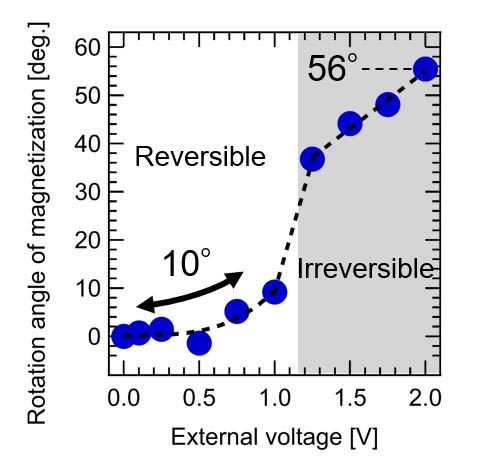
This effect allowed the scientists to reversibly change the magnetization angle by approximately 10°. Although a much greater rotation of 56° was achieved by upping the external voltage further, they found that the magnetization angle could not be switched back entirely (Figure 2). “We determined that this irreversible magnetization angle rotation was caused by a change in the crystalline structure of magnetite due to an excess of lithium ions,” explains Higuchi, “If we could suppress such irreversible structural changes, we could achieve a considerably larger magnetization rotation.”
Simple Design, Scalable Potential
The novel device developed by the scientists represents a big step in the control of magnetization for the development of spintronic devices. Moreover, the structure of the device is relatively simple and easy to fabricate. Dr. Takashi Tsuchiya, Principal Researcher at NIMS, the corresponding author of the study says, “By controlling the magnetization direction at room temperature due to the insertion of lithium ions into Fe3O4, we have made it possible to operate with much lower power consumption than the magnetization rotation by spin current injection. The developed element operates with a simple structure.”
Although more work remains to be done to take full advantage of this new device, the imminent rise of spintronics will certainly unlock many novel and powerful applications. “In the future, we will try to achieve a rotation of 180° in the magnetization angle,” says Dr. Kazuya Terabe, Principal Investigator at the International Center for Materials Nanoarchitectonics at NIMS and a co-author of the study, “This would let us create high-density spintronic memory devices with large capacity and even neuromorphic devices that mimic biological neural systems.” Some other applications of spintronics are in the highly coveted field of quantum computing.
Only time will tell what this frontier technology has in line for us!
Reference: “Room-Temperature Manipulation of Magnetization Angle, Achieved with an All-Solid-State Redox Device” by Wataru Namiki, Takashi Tsuchiya, Makoto Takayanagi, Tohru Higuchi and Kazuya Terabe, 2 November 2020, ACS Nano.
DOI: 10.1021/acsnano.0c07906
Never miss a breakthrough: Join the SciTechDaily newsletter.
Follow us on Google and Google News.