
Close Menu
    Facebook X (Twitter) Instagram
    SciTechDaily
    • Biology
    • Chemistry
    • Earth
    • Health
    • Physics
    • Science
    • Space
    • Technology
    Facebook X (Twitter) Pinterest YouTube RSS
    SciTechDaily
    Home»Space»Spitzer Views Newborn Stars Blowing Bubbles in the Cat’s Paw Nebula
    Space

    Spitzer Views Newborn Stars Blowing Bubbles in the Cat’s Paw Nebula

    By Calla Cofield, Jet Propulsion LaboratoryOctober 24, 2018No Comments3 Mins Read
    Facebook Twitter Pinterest Telegram LinkedIn WhatsApp Email Reddit
    Share
    Facebook Twitter LinkedIn Pinterest Telegram Email Reddit

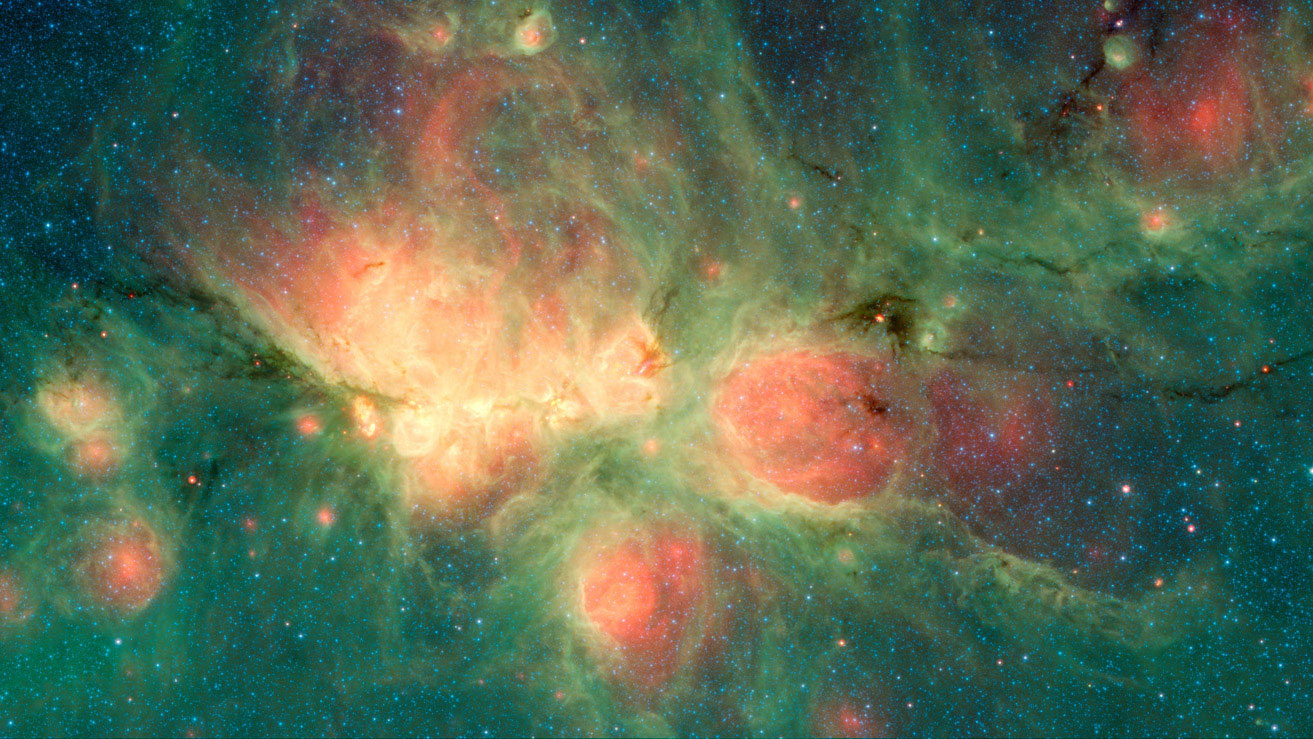
    Stars Blow Bubbles in the Cat's Paw Nebula

    This image from NASA’s Spitzer Space Telescope shows the Cat’s Paw Nebula, so named for the large, round features that create the impression of a feline footprint. The nebula is a star-forming region in the Milky Way galaxy, located in the constellation Scorpius. Estimates of its distance from Earth range from about 4,200 to about 5,500 light-years.

    Framed by green clouds, the bright red bubbles are the dominant feature in the image, which was created using data from two of Spitzer’s instruments. After gas and dust inside the nebula collapse to form stars, the stars may in turn heat up the pressurized gas surrounding them, causing it to expand into space and create bubbles.

    The green areas show places where radiation from hot stars collided with large molecules called “polycyclic aromatic hydrocarbons,” causing them to fluoresce.

    In some cases, the bubbles may eventually “burst,” creating the U-shaped features that are particularly visible in the image below, which was created using data from just one of Spitzer’s instruments.
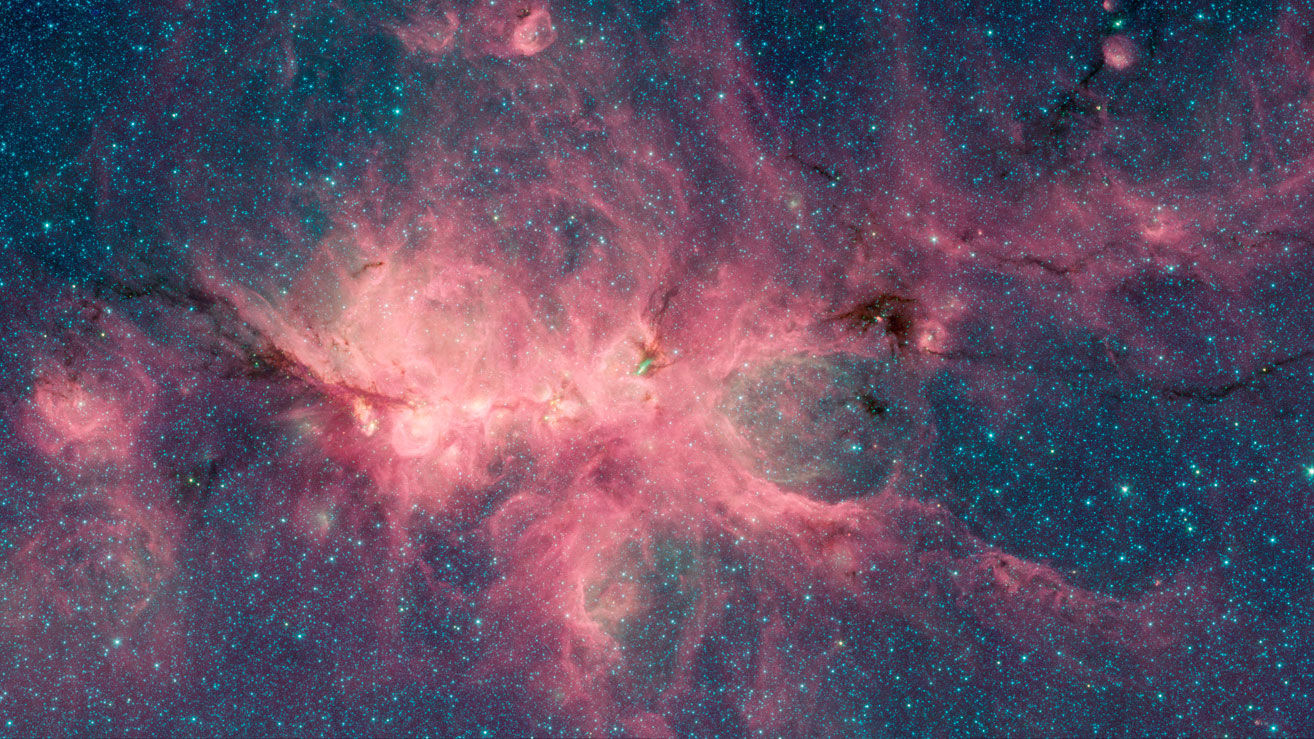
    Cat's Paw Nebula
    The Cat’s Paw Nebula, imaged here by NASA’s Spitzer Space Telescope using the IRAC instrument, is a star-forming region inside the Milky Way Galaxy. The dark filament running through the middle of the nebula is a particularly dense region of gas and dust. Credit: NASA/JPL-Caltech

    Spitzer is an infrared telescope, and infrared light is useful to astronomers because it can penetrate thick clouds of gas and dust better than optical light (the kind visible to the human eye). The black filaments running horizontally through the nebula are regions of gas and dust so dense, not even infrared light can pass through them. These dense regions may soon be sites where another generation of stars will form.

    The Cat’s Paw star-forming region is estimated to be between 24 and 27 parsecs (80 and 90 light years) across. It extends beyond the left side of these images and intersects with a similar-sized star-forming region, NGC 6357. That region is also known as the Lobster Nebula – an unlikely companion for a cat.

    The top image was compiled using data from the Infrared Array Camera (IRAC) and the Multiband Imaging Photometer (MIPS) aboard Spitzer. MIPS collects an additional “color” of light in the infrared range, which reveals the red-colored features, created by dust that has been warmed by the hot gas and the light from nearby stars. The second image is based on data from IRAC alone, so this dust is not visible.

    The images were pulled from data collected for the Galactic Legacy Mid-Plane Survey Extraordinaire project (GLIMPSE). Using data from Spitzer, GLIMPSE created the most accurate map ever of the large central bar of the galaxy and showed that the galaxy is riddled with gas bubbles like those seen here.

    Never miss a breakthrough: Join the SciTechDaily newsletter.
    Follow us on Google and Google News.

    Astronomy Spitzer Space Telescope
    Share. Facebook Twitter Pinterest LinkedIn Email Reddit

    Related Articles

    Ultra-Hot “Super-Earth” Exoplanet 65 Light-Years Away Could Have No Atmosphere

    Incredibly Sharp Webb Space Telescope Test Images Hint at New Possibilities for Science

    “Space Butterfly” Is Actually a Nursery for Hundreds of Baby Stars

    Hot Jupiter Exoplanet Provides New Insights Into Seasons on a Planet Outside Our Solar System

    Scores of Baby Stars Revealed in the Orion Constellation

    NASA’s Spitzer Space Telescope Illuminates Exoplanets

    Godzilla Nebula: A “Monster” Star-Forming Region Spied by NASA’s Spitzer Space Telescope

    A Cosmic Powder Keg: When a Stable Star Explodes

    Hidden Supernova: Stars Are Exploding in Dusty Galaxies – We Just Can’t Always See Them

    Leave A Reply Cancel Reply

    • Facebook
    • Twitter
    • Pinterest
    • YouTube

    Don't Miss a Discovery

    Subscribe for the Latest in Science & Tech!

    Trending News

    Your Blood Pressure Reading Could Be Wrong Because of One Simple Mistake

    Astronomers Stunned by Ancient Galaxy With No Spin

    Physicists May Be on the Verge of Discovering “New Physics” at CERN

    Scientists Solve 320-Million-Year Mystery of Reptile Skin Armor

    Scientists Say This Daily Walking Habit May Be the Secret to Keeping Weight Off After Dieting

    New Therapy Rewires the Brain To Restore Joy in Depression Patients

    Giant Squid Detected off Western Australia in Stunning Deep-Sea Discovery

    Popular Sugar-Free Sweetener Linked to Liver Disease, Study Warns

    Follow SciTechDaily
    • Facebook
    • Twitter
    • YouTube
    • Pinterest
    • Newsletter
    • RSS
    SciTech News
    • Biology News
    • Chemistry News
    • Earth News
    • Health News
    • Physics News
    • Science News
    • Space News
    • Technology News
    Recent Posts
    • New Stroke Study Challenges Decades-Old Medical Beliefs
    • These Simple Plant Foods Are Linked to Lower Blood Pressure
    • Common Blood Pressure Drug Supercharges Cancer Treatment in Surprising New Study
    • Key Magic Mushroom Ingredient Increases Laziness and Reduces Aggression
    • Researchers Solve 15-Year Mystery Behind Cancer-Causing Gut Toxin
    Copyright © 1998 - 2026 SciTechDaily. All Rights Reserved.
    • Science News
    • About
    • Contact
    • Editorial Board
    • Privacy Policy
    • Terms of Use

    Type above and press Enter to search. Press Esc to cancel.