

NIST’s CURBy beacon transforms quantum “spooky action” into certified random numbers, guarded by a blockchain-like Twine protocol and broadcast for public use—from jury selection to cryptography.
- Quantum breakthrough: NIST and the University of Colorado Boulder have built the first random-number generator powered by quantum entanglement, producing numbers no one can predict.
- Free public stream: The Colorado University Randomness Beacon (CURBy) broadcasts these numbers daily, ready for fair jury selection, public lotteries, audit sampling, and more.
- Tamper-proof trust: A NIST-designed system called Twine lets anyone trace and verify each bit, protecting the beacon from manipulation.
Randomness Drives Fairness & Security
Randomness drives everything from fair games to cybersecurity. We draw straws, roll dice, and flip coins because we trust unpredictable outcomes. Auditors rely on random picks to avoid bias, and cryptographers build unbreakable passwords from strings no one can foresee.
Yet most “random” numbers come from computer tricks that only look unpredictable. Given enough knowledge, a clever hacker or even a practiced coin-flipper can spot patterns and cheat the system.
“True randomness is something that nothing in the universe can predict in advance,” said Krister Shalm, a physicist at the National Institute of Standards and Technology (NIST). Even if a random number generator used seemingly random processes in nature, it would be hard to verify that those numbers are truly random, Shalm added.
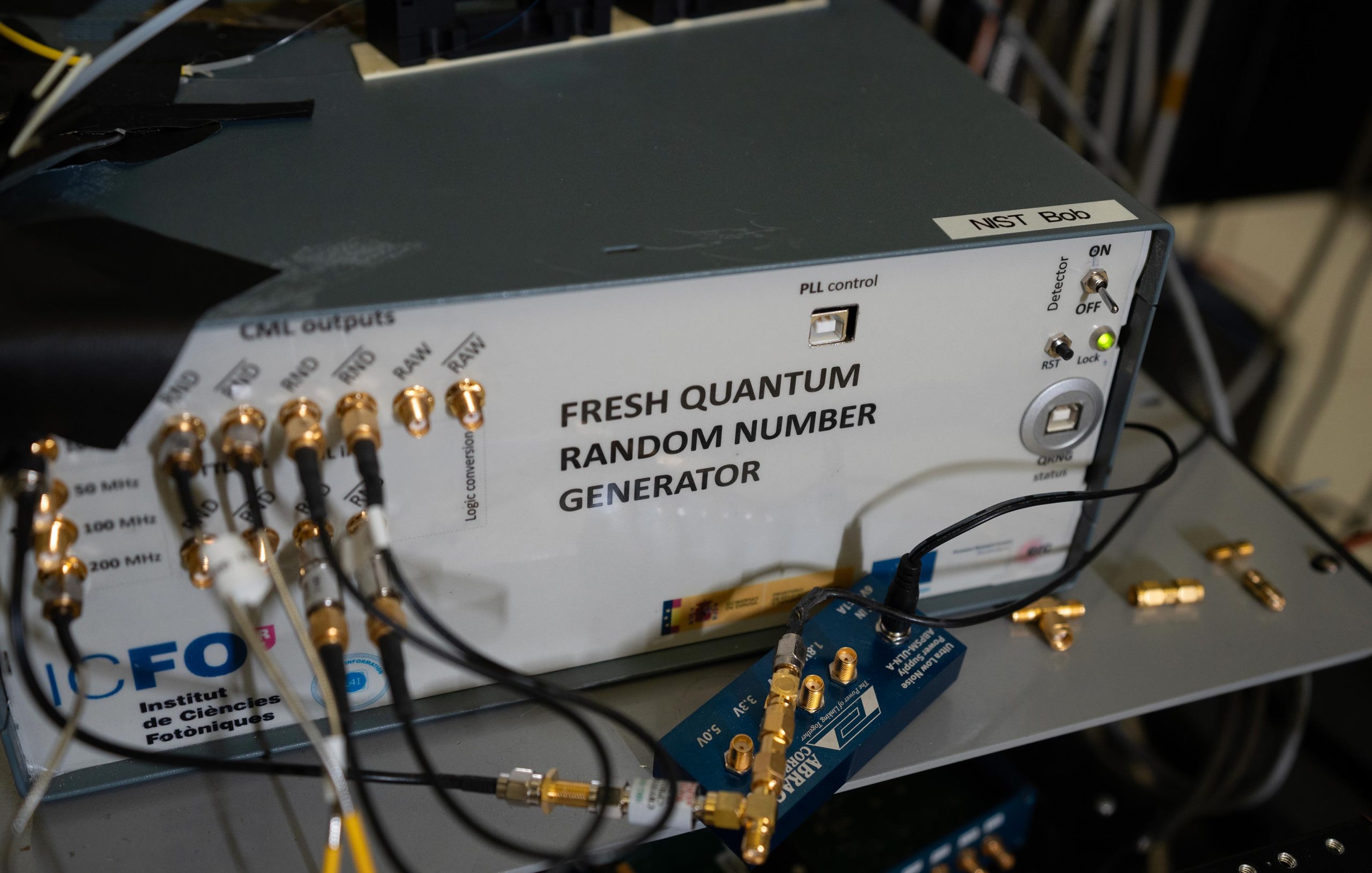
From Einstein’s Doubt to Quantum Beacon
Enter quantum mechanics. Einstein once doubted nature’s chaos, saying, “God does not play dice with the universe.” Modern experiments prove otherwise. Using a Bell test—an experiment that taps the inherent unpredictability of entangled particles—Shalm’s team has turned quantum chance into a stream of verifiable random numbers. Their work, just published in Nature, shows that if the universe really does roll dice, we can harness those rolls for rock-solid security and public trust.
“If God does play dice with the universe, then you can turn that into the best random number generator that the universe allows,” Shalm said. “We really wanted to take that experiment out of the lab and turn it into a useful public service.”
To make that happen, NIST researchers and their colleagues at the University of Colorado Boulder created the Colorado University Randomness Beacon (CURBy). CURBy produces random numbers automatically and broadcasts them daily through a website for anyone to use.
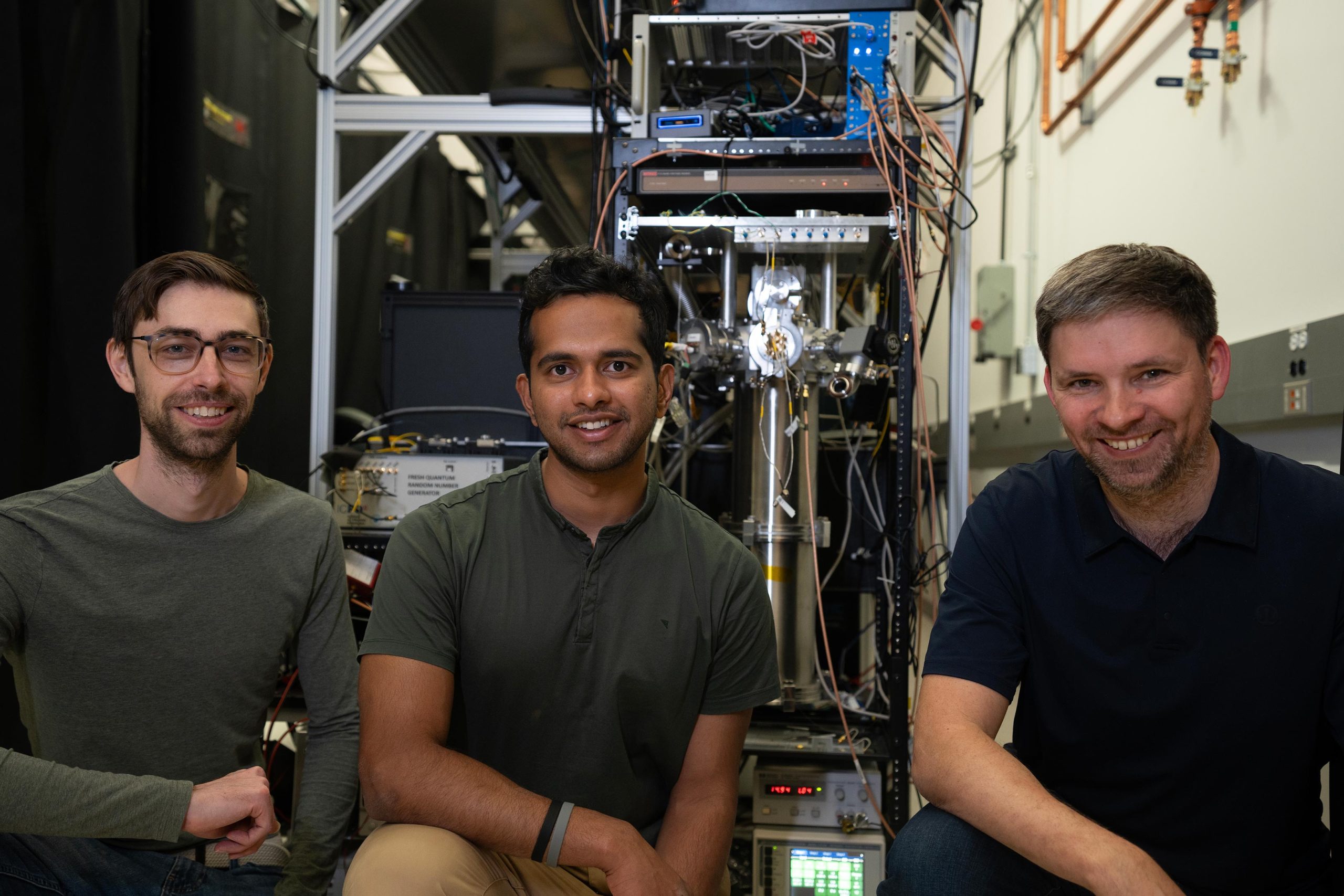
At the heart of this service is the NIST-run Bell test, which provides truly random results. This randomness acts as a kind of raw material that the rest of the researchers’ setup “refines” into random numbers published by the beacon.
The Bell test measures pairs of “entangled” photons whose properties are correlated even when separated by vast distances. When researchers measure an individual particle, the outcome is random, but the properties of the pair are more correlated than classical physics allows, enabling researchers to verify the randomness. Einstein called this quantum nonlocality “spooky action at a distance.”
This is the first random number generator service to use quantum nonlocality as a source of its numbers, and the most transparent source of random numbers to date. That’s because the results are certifiable and traceable to a greater extent than ever before.
Quantum Advantage Made Public
“CURBy is one of the first publicly available services that operates with a provable quantum advantage. That’s a big milestone for us,” Shalm explained. “The quality and origin of these random bits can be directly certified in a way that conventional random number generators are unable to.”
NIST performed one of the first complete experimental Bell tests in 2015, which firmly established that quantum mechanics is truly random. In 2018, NIST pioneered methods to use these Bell tests to build DOI: 10.1038/s41586-025-09054-3
Never miss a breakthrough: Join the SciTechDaily newsletter.
Follow us on Google and Google News.
4 Comments
Scitechdaily gives me fabulously exciting information, everyday, about all the new and exciting discoveries in…..well, science and technology. It’s absolutely fascinating! The pictures, themselves, should make everyone subscribe!
“Einstein once doubted nature’s chaos, saying, ‘God does not play dice with the universe.’ Modern experiments prove otherwise.”
Or, as someone else suggested, the dice could be loaded.
I’m going with the loaded option. Is that (B?
Einstein and the gods could all be playing craps right now! Apparently they’ve been around forever, so they’re probably looking for any kind of entertainment and humans have to be the biggest source of hilarity in the universe!
This research was conducted by NIST and taxpayer funded, yet the cited Nature article is not open access. Ridiculous. Make every published research paper open access and have ads to pay for it if need be, but make the final published work available. (Arxiv articles are preliminary, not final.) This “system” needs to change!