
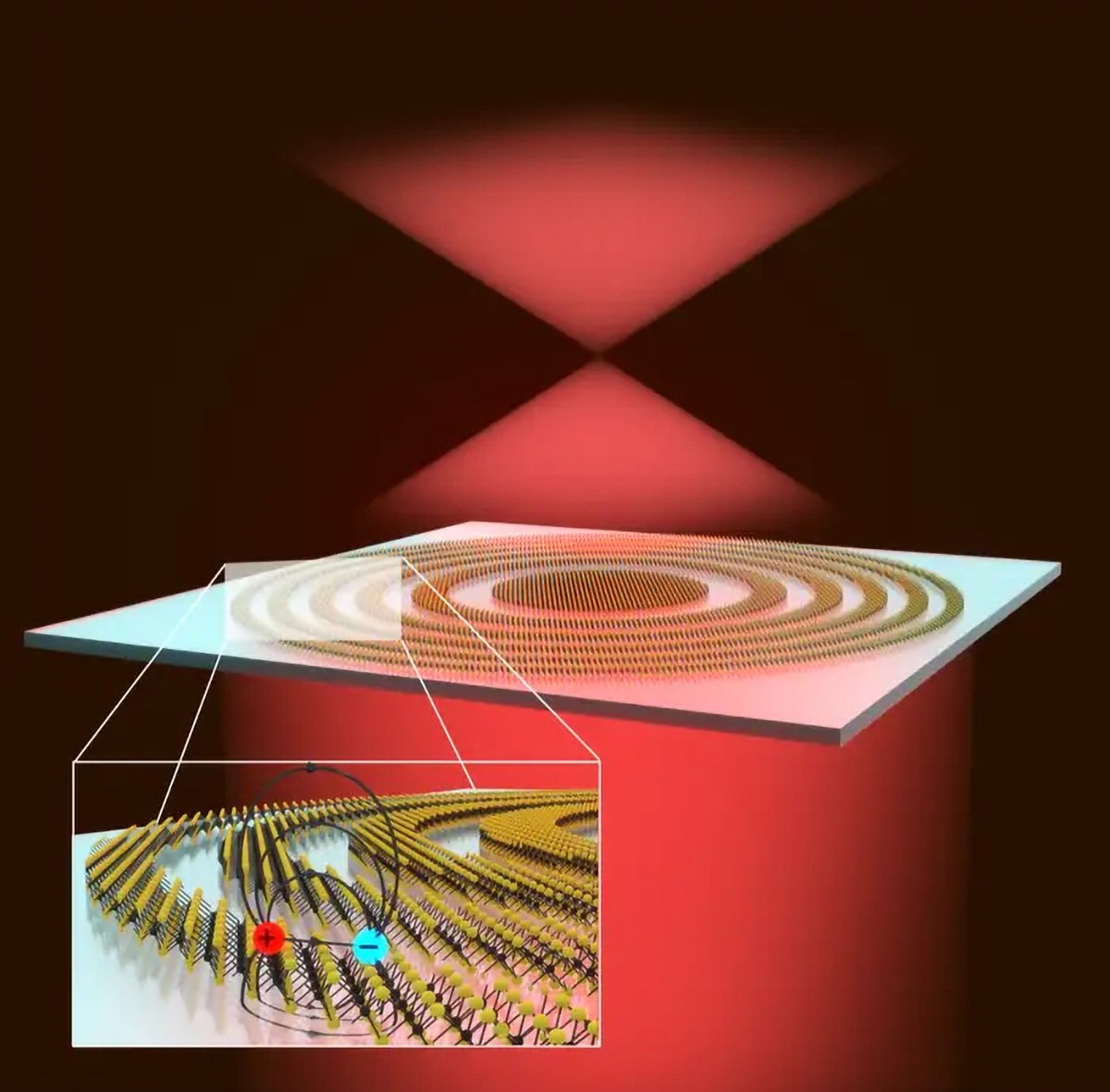
Researchers have created a groundbreaking flat lens only three atoms thick using quantum effects, potentially transforming augmented reality by offering less obstructive visual enhancements.
Lenses typically manipulate light through their curved surfaces. However, researchers from the University of Amsterdam and Stanford University have developed a flat lens that is just three atoms thick, utilizing quantum effects to bend and focus light. This innovative lens might be incorporated into augmented reality glasses in the future.
When you imagine a lens, you probably picture a piece of curved glass. This type of lens works because light is refracted (bent) when it enters the glass, and again when it exits, allowing us to make things appear larger or closer than they actually are. We have used curved lenses for more than two millennia, allowing us to study the movements of distant planets and stars, reveal tiny microorganisms, and improve our vision.
Ludovico Guarneri, Thomas Bauer, and Jorik van de Groep of the University of Amsterdam, together with colleagues from Stanford University in California, took a different approach. Using a single layer of a unique material called tungsten disulfide (WS2 for short), they constructed a flat lens that is half a millimeter wide, but just 0.0000006 millimeters, or 0.6 nanometres, thick. This makes it the thinnest lens on Earth!
Rather than relying on a curved shape, the lens is made of concentric rings of WS2 with gaps in between. This is called a ‘Fresnel lens’ or ‘zone plate lens’, and it focuses light using diffraction rather than refraction. The size of, and distance between the rings (compared to the wavelength of the light hitting it) determines the lens’s focal length. The design used here focuses on red light 1 mm from the lens.
Quantum Enhancement
A unique feature of this lens is that its focusing efficiency relies on quantum effects within WS2. These effects allow the material to efficiently absorb and re-emit light at specific wavelengths, giving the lens the built-in ability to work better for these wavelengths.
This quantum enhancement works as follows. First, WS2 absorbs light by sending an electron to a higher energy level. Due to the ultra-thin structure of the material, the negatively charged electron and the positively charged ‘hole’ it leaves behind in the atomic lattice stay bound together by the electrostatic attraction between them, forming what is known as an ‘exciton’. These excitons quickly disappear again by the electron and hole merging together and sending out light. This re-emitted light contributes to the lens’s efficiency.
The scientists detected a clear peak in lens efficiency for the specific wavelengths of light sent out by the excitons. While the effect is already observed at room temperature, the lenses are even more efficient when cooled down. This is because excitons do their work better at lower temperatures.
Augmented Reality
Another one of the lens’s unique features is that, while some of the light passing through it makes a bright focal point, most light passes through unaffected. While this may sound like a disadvantage, it actually opens new doors for use in technology of the future. “The lens can be used in applications where the view through the lens should not be disturbed, but a small part of the light can be tapped to collect information. This makes it perfect for wearable glasses such as for augmented reality,” explains Jorik van de Groep, one of the authors of the paper.
The researchers are now setting their sights on designing and testing more complex and multifunctional optical coatings whose function (such as focussing light) can be adjusted electrically. “Excitons are very sensitive to the charge density in the material, and therefore we can change the refractive index of the material by applying a voltage,” says Van de Groep. The future of excitonic materials is bright!
Reference: “Temperature-Dependent Excitonic Light Manipulation with Atomically Thin Optical Elements” by Ludovica Guarneri, Qitong Li, Thomas Bauer, Jung-Hwan Song, Ashley P. Saunders, Fang Liu, Mark L. Brongersma and Jorik van de Groep, 5 April 2024, Nano Letters.
DOI: 10.1021/acs.nanolett.4c00694
Never miss a breakthrough: Join the SciTechDaily newsletter.
Follow us on Google and Google News.
1 Comment
Fusion reactors just a question would it be possible to control the reaction better in a smaller space to perfect the experiment with less costs than running a massive Fusion reactor till you know how to control it to the point of stability maybe you can shape the size of the magnetic field your creating by adjustable magnetic force by moving them inwards or outwards cross the fields one lapping through another using different magnetic points I don’t know that much but science interests me Grateley.
Oh yeah just one more thing you do know you can explode water within a cylinder hence no petrol needed use electricity and brass bars ignite with electricity through distributor just increase the voltage just plain old water and you don’t need to ask if it’s a theory it works and you know it now give this idea to someone who would love to rule the world of cars tankers cargo ships anything really it’s three times more explosive than petrol.