
Scientists have mapped a little-understood class of earthquakes that originate deep within Earth’s mantle rather than in the crust.
Stanford scientists have produced the first comprehensive global map of an unusual kind of earthquake that begins deep inside Earth’s mantle rather than in the crust. The mantle lies between the planet’s thin outer crust and its molten core. By charting where these rare events occur, researchers now have a new tool to better understand how mantle earthquakes work and what they might reveal about the forces behind all earthquakes.
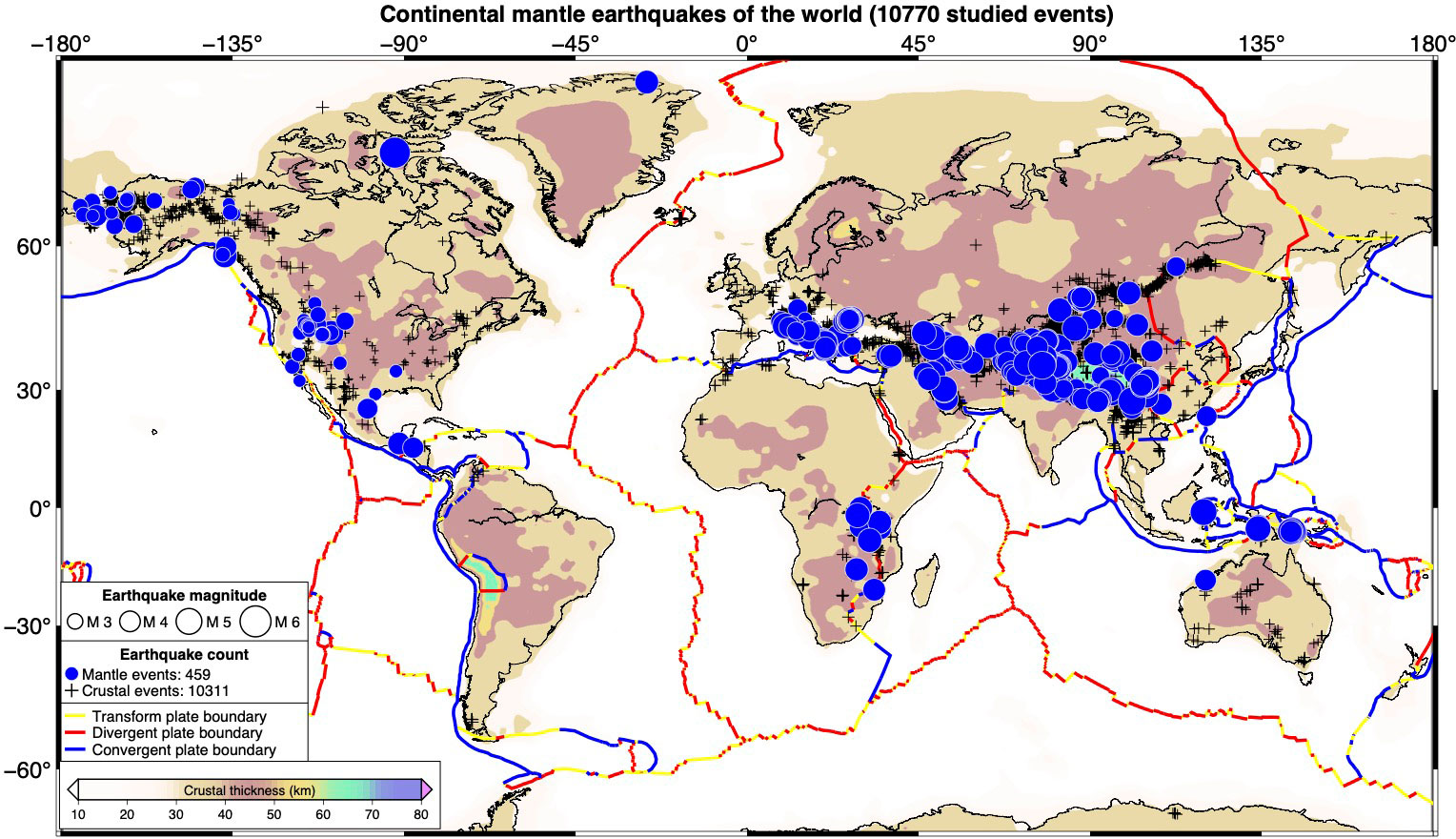
According to a study published in Science, continental mantle earthquakes happen around the world but are concentrated in certain regions. Large clusters appear beneath the Himalayas in southern Asia and near the Bering Strait between Asia and North America, just south of the Arctic Circle. Studying these deep events could provide valuable information about the boundary between the crust and mantle, as well as the behavior of the upper mantle – the source of volcanic magma that partially drives tectonic plate movements.
“Until this study, we haven’t had a clear global perspective on how many continental mantle earthquakes are really happening and where,” said lead study author Shiqi (Axel) Wang, a former PhD student in the lab of geophysics professor Simon Klemperer at the Stanford Doerr School of Sustainability. “With this new dataset, we can start to probe at the various ways these rare mantle earthquakes initiate.”
Because they originate so far below the surface, continental mantle earthquakes rarely produce noticeable shaking or pose direct danger to people. Even so, understanding how and why they occur could advance several areas of Earth science. That knowledge may ultimately improve scientists’ understanding of the risks linked to more common, shallow earthquakes.
“Although we know the broad strokes that earthquakes generally happen where stress releases at fault lines, why a given earthquake happens where it does and the main mechanisms behind it are not well grasped,” added Klemperer, senior study author. “Mantle earthquakes offer a novel way to explore earthquake origins and the internal structure of Earth beyond ordinary crustal earthquakes.”
Above and below the Moho
Earth’s crust is relatively cool and brittle, while the mantle beneath it is warmer and made of dense, semisolid rock. Stretching about 1,800 miles thick, the mantle makes up most of the planet’s interior. The dividing line between the crust and mantle is called the Mohorovičić discontinuity, often shortened to “the Moho.”
Scientists have long questioned whether the mantle, which behaves more like a slowly flowing solid than rigid rock, can generate significant earthquakes. Most continental earthquakes begin at depths of about 6 to 18 miles, placing them well above the Moho in the crust. A major exception occurs in subduction zones, where heavier oceanic plates sink beneath lighter continental plates and can trigger earthquakes hundreds of miles deep.
In some cases, however, seismic instruments have detected earthquake origins much deeper beneath continental regions that are far from subduction zones. These suspected sub-Moho hypocenters have been located as much as 50 miles below the Moho, raising important questions about how earthquakes can occur within the mantle itself.
Over the past decade, growing lines of evidence have persuaded most scientists that a small number of earthquakes do begin in the mantle. These events appear to be far less common than quakes in the crust, occurring perhaps about 100 times less frequently. Even so, confirming that a specific earthquake originated in the mantle has been difficult because of limited and incomplete data.
To address that challenge, Wang and Klemperer created a technique that compares two different kinds of seismic waves. Earthquakes and other disturbances send these vibrations traveling through the planet, causing Earth to resonate much like a struck bell.
One type is known as Sn, or “lid,” waves. These are shear waves that move along the top portion of the mantle, an area referred to as the “lid.” The second type, called Lg waves, consists of high frequency vibrations that travel efficiently through the crust. By measuring the relative strength of these two wave types, researchers can determine whether an earthquake began in the crust or deeper in the mantle.
“Our approach is a complete game-changer because now you can actually identify a mantle earthquake purely based on the waveforms of earthquakes,” said Wang.
Rarities galore
The team analyzed records from seismic monitoring stations around the globe and factored in additional details such as the thickness of the crust. Starting with more than 46,000 recorded earthquakes, they narrowed the list to 459 continental mantle earthquakes that have occurred since 1990.
The researchers caution that this total likely underestimates the true number. Expanding seismic networks, especially in remote regions like the Tibetan Plateau north of the Himalayas, would probably reveal many more mantle events. Klemperer has devoted much of his career to studying seismic activity in this isolated area. Early indications of continental mantle earthquakes there later inspired Wang to explore the phenomenon in greater depth.
Now equipped with a growing catalog of confirmed mantle earthquakes and a dependable way to identify them, Wang and Klemperer plan to investigate how these unusual quakes begin. Some seem to be aftershocks triggered by seismic waves traveling outward from crustal earthquakes. Others may originate from heat-driven convection within the mantle as it circulates and recycles subducted slabs of Earth’s crust.
As their research continues, the Stanford team expects to gain deeper insight into the processes unfolding far beneath the surface and to develop a clearer understanding of how Earth’s interior operates.
“Continental mantle earthquakes might be part of an inherently interconnected earthquake cycle, both from the crust and also the upper mantle,” said Wang. “We want to understand how these layers of our world function as a whole system.”
Reference: “Continental mantle earthquakes of the world” by Shiqi Wang and Simon L. Klemperer, 5 February 2026, Science.
DOI: 10.1126/science.adz4367
This research was supported by the National Science Foundation.
Never miss a breakthrough: Join the SciTechDaily newsletter.
Follow us on Google and Google News.
2 Comments
“Stanford scientists” Would that be seismologists, geophysicists, or geologists? Does Stanford still engage in geology research?
“These suspected sub-Moho hypocenters have been located as much as 50 miles below the Moho, raising important questions about how earthquakes can occur within the mantle itself.”
Inasmuch as a sudden release of energy from stress in rocks, by brittle failure, is essentially the definition of an earthquake, it follows that brittle failure in a region assumed to flow plastically is anomalous behavior. How can it be that some areas are not behaving as expected? The obvious answer is that if a subducted, embedded plated is still brittle, it is different than the surrounding material. That could be as simple as a plate subducting more rapidly than usual and therefore has not yet equilibrated completely to the same temperature as the material that it is diving into, or that it is much thicker than most plates. Thus, as the lithostatic pressure and associated stress increases, it is effectively ‘crushed’ by differential pressures because it isn’t hot enough to deform plastically. Occam’s Razor would seem to apply.