
Stanford researchers linked Campi Flegrei’s earthquakes to groundwater pressure, not magma. Managing water flow could reduce seismic risk in the region.
Since 2022, southern Italy has experienced increasingly intense swarms of earthquakes, putting hundreds of thousands of people at risk in the volcanic region of Campi Flegrei, where the ground slowly rises and falls. As officials continue to weigh evacuation plans and disaster response strategies, researchers may have identified a potential method to stop this recurring unrest: managing surface water runoff or reducing groundwater levels to lower fluid pressure in the geothermal reservoir.
Using subsurface imaging and laboratory experiments, scientists at Stanford have demonstrated that pressure from trapped water and vapor beneath Campi Flegrei can cause earthquakes when the caprock, or surface layer, becomes sealed. Published in Science Advances, the study found that this buildup of pressure was responsible for seismic activity and ground deformation in both the early 1980s and more recently, over the past 15 years, leading the team to uncover the key driving mechanism.
These results challenge the long-standing belief that earthquakes in the area are caused by magma or gas rising to the surface from deeper melt zones. Instead, the study reveals how the gradual recharge of water into the reservoir affects land deformation and elevation changes over time.
“To address the problem, we can manage surface runoff and water flow, or even reduce pressure by withdrawing fluids from wells,” said senior study author Tiziana Vanorio, an associate professor of Earth and planetary sciences at the Stanford Doerr School of Sustainability.
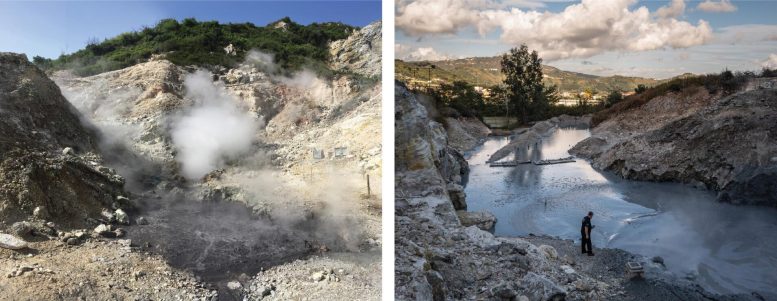
The researchers analyzed recurring patterns and common characteristics in the imaging of subsurface structures and earthquakes from Campi Flegrei’s two most recent periods of unrest. Characterized by land uplift and burst-like shaking, accompanied by rumbling sounds that have become a signature feature for the population, scientists suspect this activity signals steam-driven explosions, triggered when liquid water rapidly flashes to steam during fracturing caused by earthquakes. The study includes data from the unrest of 1982-1984 and 2011-2024.
“We have been looking at something that occurred decades apart, but there are profound similarities in the imaging, which point not only to a cyclical pattern of the phenomenon but also to a common underlying cause,” said co-author Grazia De Landro, a researcher at the University of Naples Federico II, Italy, and visiting scholar at Stanford. “From there started the idea to work together, especially looking at rock physics. Using rock physics is the only way to say something quantitative about the imaging of the subsurface.”
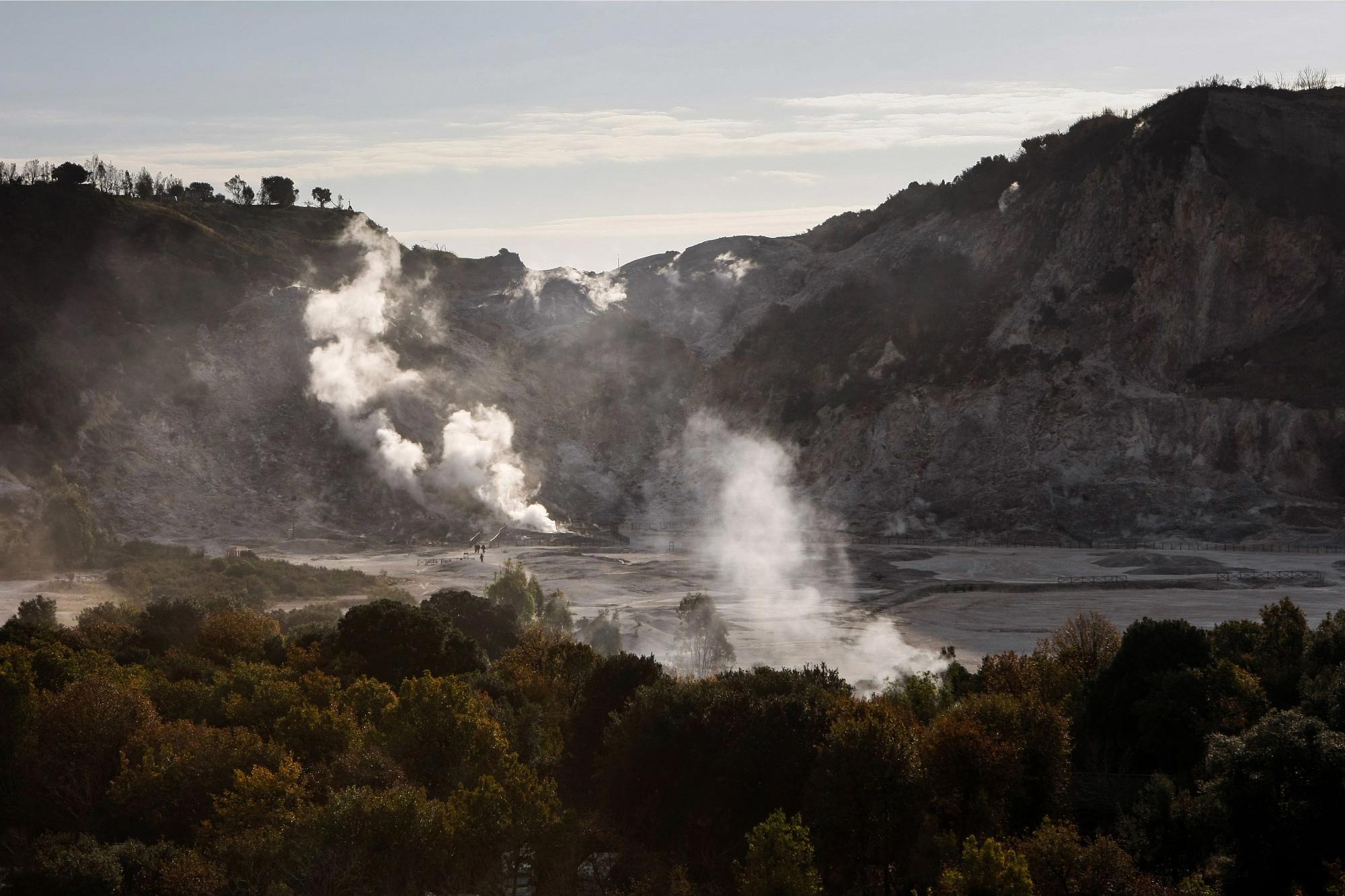
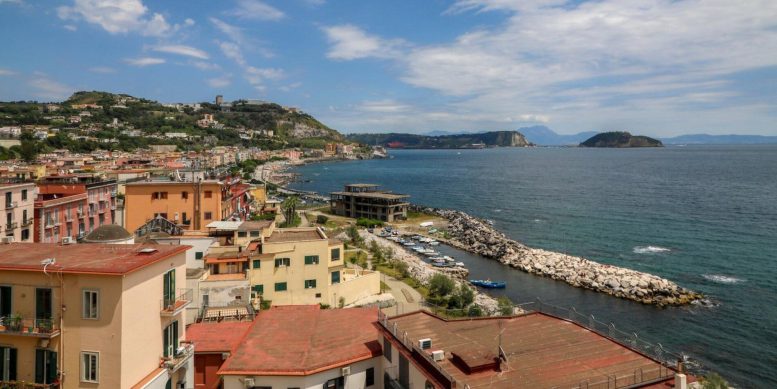
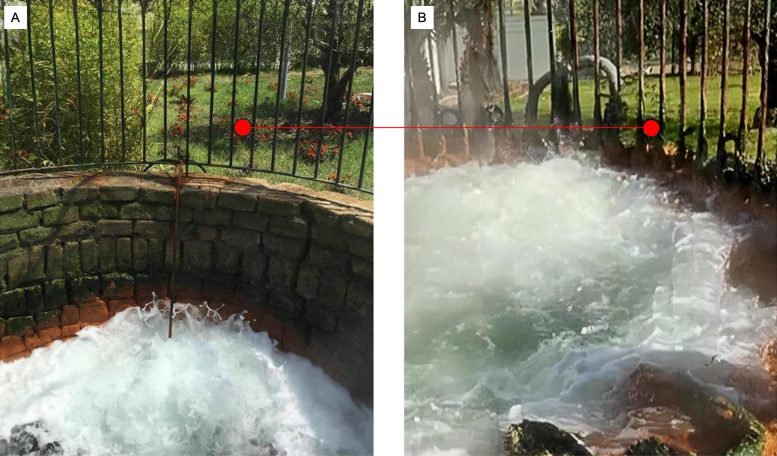
The Campi Flegrei volcanic area hosts a capped geothermal reservoir beneath the town of Pozzuoli, west of Naples and Mount Vesuvius. The area has been continuously monitored since the unrest in 1982-1984, when the land rose more than 6 feet and Pozzuoli’s harbor became so shallow that ships could no longer dock. After that, a magnitude-4 earthquake and thousands of microquakes prompted the evacuation of 40,000 people from Pozzuoli.
“It’s been a challenge for the last three years. Many buildings have been damaged by the continuous shaking, and some people don’t have homes,” said Vanorio, who grew up in Pozzuoli and was forced to evacuate in the 1980s. “This project is my goal as a citizen now, not just as a geophysicist, because the study suggests that unrest can be managed, rather than just monitored, opening the way to prevention.”
Land that ‘breathes’
Campi Flegrei is an 8-mile-wide caldera, a vast depression formed by major eruptions about 39,000 and 15,000 years ago, which caused the collapse of Earth’s surface. The caldera experiences uplift and subsidence, with the land rising and sinking, even without an eruption. After the unrest in 1982-1984, the area sank by about 3 feet. For subsidence to occur, mass must be released from the subsurface, which can include magma, water, vapor, and carbon dioxide.
Residents of Pozzuoli note the way the caldera “breathes,” emitting fumes and moving the ground, sometimes meters up or down over a short time.
A time-lapse evolution of earthquakes in the Campi Flegrei volcanic area since 2015. On the surface, earthquake epicenters initially cluster around Pozzuoli-Pisciarelli Spring, where water ultimately accumulates downstream. Over time, earthquakes expand to cover an increasingly wider circular area within the hydrological watershed, mirroring rock and soil physics experiments from the mid-20th century in which water from a point source spreads in a roughly spherical pattern. Data are from Istituto Nazionale di Geofisica e Vulcanologia (INGV). Credit: Tiziana Vanorio and INGV
Historically, the uplift in volcanic areas has been widely accepted as being linked to magma-related refilling processes, which assumes magma and/or its gases are primary drivers of deformation and then earthquakes – but this may not always be the case, according to the study’s findings. While some researchers began exploring the relationship between precipitation and seismicity in the last decade, the study clarifies that it’s not the rainfall itself, but rather the pressure resulting from the slow but steady accumulation of water in a sealed reservoir that leads to fracturing – and, consequently, shaking, Vanorio said.
“We know that annual variation in rainfall has been increasing over the last 24 years, so what needs to be monitored is the level of groundwater accumulating in the subsurface, or ensuring the direct channeling of water runoff,” Vanorio added.
A closed system
One notable feature of Campi Flegrei is the fibrous nature of the caprock atop the geothermal reservoir. Fibrous materials are used in engineering for structural reinforcement, as they can deform without immediately fracturing. They can accumulate strain, which in the volcanic system could eventually be released through a sudden eruption of superheated water, steam, and volcanic ash.
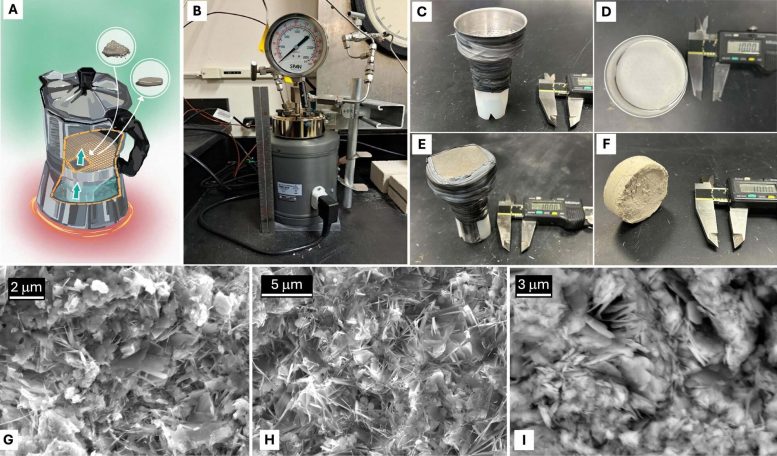
The researchers examined 24 years of rainfall patterns, the directions of subsurface water flow, and the process of caprock sealing to understand the recharge of the geothermal reservoir and its pressure buildup. In Vanorio’s Rock Physics and Geomaterials Lab, they demonstrated how cracks in the caprock seal through interactions of the rock’s minerals with hydrothermal water and steam.
To test the caprock’s characteristics, the study authors conducted experiments using a hydrothermal vessel that functions like a tool familiar to many Italians: a moka pot, or stovetop espresso maker. They filled the bottom chamber with brine and the top with volcanic ash and crushed rocks typical of Campi Flegrei, then heated the vessel to the temperature found in the geothermal reservoir. Within a day, mineral fibers formed, and cracks in the rock layer rapidly sealed through cementation.
This creates a closed system that allows fluid pressure to build up until it fractures the surrounding rock. Fracturing from earthquakes causes a sudden drop in fluid pressure as liquid water flashes into steam and escapes. “That produces explosive bursts and booming sounds typical of the area,” Vanorio said.
The researchers applied multiple disciplines to reveal how Campi Flegrei operates as a closed system, including tomography of the subsurface, which De Landro carried out using earthquake records to construct images of the subsurface that can be analyzed like a CT scan.
“Imaging the subsurface through geophysical methods is like an old-fashioned doorbell: It tells us that someone is ringing at the door, but it doesn’t say who it is. Thus, the interpretation of tomography images must be tested in the laboratory – that’s what makes this collaboration between seismology and rock physics so powerful,” Vanorio said.
A new model
Analyses of the tomography along with the location and reach of earthquakes contributed to the researchers’ theory that recurrent rumbling may not be driven by magma refill or emission of gases from the system. During both episodes of unrest, earthquakes began within the caprock at a relatively shallow depth of around 1 mile.
“After the visualization of the temporal evolution of earthquakes you can see a very clear pattern – the earthquakes deepen over time,” said co-author Tianyang Guo, a postdoctoral scholar in Earth and planetary sciences who combined earthquake data from the two episodes for visual interpretation.
If magma or its gases rising to shallower depths were the primary driver of unrest, we would expect the opposite pattern – earthquakes starting closer to the deeper melt region, about 5 miles below the surface, and progressively becoming shallower over time, according to the researchers. Furthermore, magma rising without an eruption cannot explain subsidence following the unrest, Vanorio said. A plausible explanation for subsidence is the observed discharge of water and vapor after fracturing from seismic activity, which naturally releases pressure within the reservoir.
With their new model of Campi Flegrei’s inner workings, the researchers hope to communicate the mechanisms that cause unrest in the simmering system to local Italian government officials.
“I call it a perfect storm of geology – you have all the ingredients to have the storm: the burner of the system – the molten magma, the fuel in the geothermal reservoir, and the lid,” Vanorio said. “We can’t act on the burner but we do have the power to manage the fuel. By restoring water channels, monitoring groundwater, and managing reservoir pressure, we can shift Earth sciences toward a more proactive approach – like preventive health care – to detect risks early and prevent unrest before it unfolds. That’s how science serves society.”
Reference: “The recurrence of geophysical manifestations at the Campi Flegrei caldera” by Tiziana Vanorio, Davide Geremia, Grazia De Landro and Tianyang Guo, 2 May 2025, Science Advances.
DOI: 10.1126/sciadv.adt2067
Never miss a breakthrough: Join the SciTechDaily newsletter.
Follow us on Google and Google News.
7 Comments
“One notable feature of Campi Flegrei is the fibrous nature of the caprock atop the geothermal reservoir.”
Wollastonite? Aragonite?
“…, the Stanford Doerr School of Sustainability.”
Who would have guessed that the “School of Sustainability” had anything to do with geophysics or geology? Does someone actually think that earth sciences are in danger of being exhausted or polluted? Only in California (hopefully!) would marketing take precedence over clear, descriptive language of the focus or purpose of an institution. What is in greater need is a “School of Common Sense.”
Well said.
We are not GOD! Mother nature should be able to cleanse herself the way she has for millions of years. You play God and there are repercussions that are more dangerous then the natural order of things.
I have a question. Is it about putting the volcano to extinct status or is it about harnessing energy safely? I really don’t advocate extinction of volcano but what I really advocate is somehow manage or control the eruption pattern or system such that it can be used for harnessing electricitg
Oh RIGHT !
Like “ALL” the rest of the (LOL) scientists gonnle guk B.S.”!
Rewrite history….hourly !
I have a question. Is it about putting the volcano to extinct status or is it about harnessing energy safely? I really don’t advocate extinction of volcano but what I really advocate is somehow manage or control the eruption pattern or system such that it can be used for harnessing electricitg