
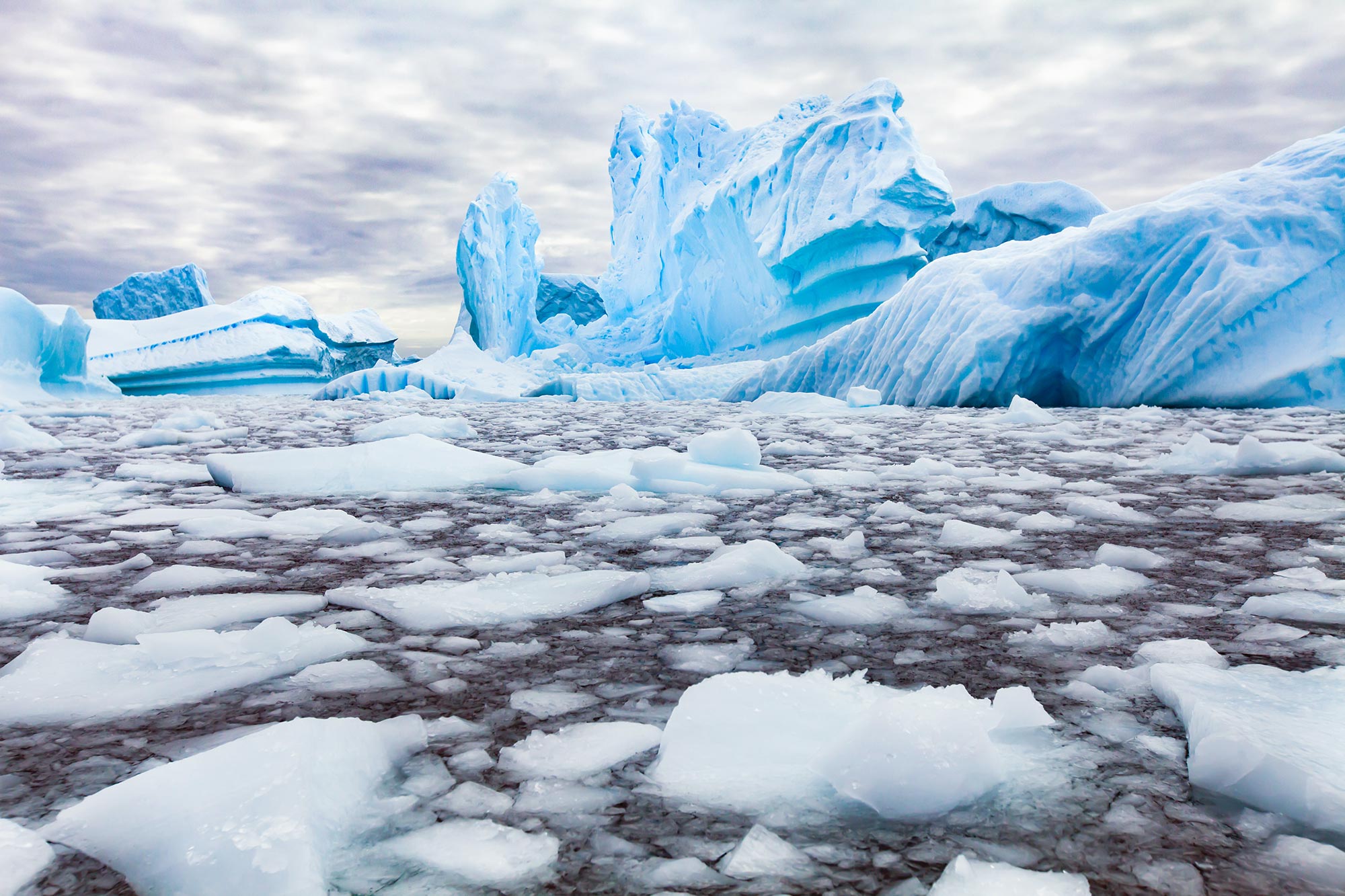
Stanford researchers discovered that increased meltwater and rainfall account for 60% of the decades-long gap between predicted and actual ocean temperatures around Antarctica.
Global climate models have long predicted that the ocean surrounding Antarctica should be warming. However, observations show that these waters have actually cooled over much of the past 40 years.
According to new research from Stanford University, this mismatch is largely due to two overlooked factors in the models: the effects of meltwater from Antarctic ice and an underestimation of regional rainfall.
“We found that the Southern Ocean cooling trend is actually a response to global warming, which accelerates ice sheet melting and local precipitation,” said Earle Wilson, an assistant professor of Earth system science in the Stanford Doerr School of Sustainability and senior author of the March 27 study in Geophysical Research Letters.
As rising temperatures melt Antarctica’s ice sheet and cause more precipitation, the Southern Ocean’s upper layer is growing less salty – and thus, less dense. This creates a lid that limits the exchange of cool surface waters with warmer waters below. “The fresher you make that surface layer, the harder it is to mix warm water up,” Wilson explained.
But this freshening is not fully represented in state-of-the-art climate models – a flaw that scientists have long recognized as a major source of uncertainty in projections of future sea level rise. “The impact of glacial meltwater on ocean circulation is completely missing from most climate models,” Wilson said.
Reconciling global discrepancies
The mismatch between observed and simulated sea surface temperatures around Antarctica is part of a larger challenge for scientists and governments seeking to prepare for climate impacts. Global climate models generally do not accurately simulate the cooling observed over the past 40 years in the Southern Ocean and the eastern Pacific around the equator or the intensity of the warming observed in the Indian and western Pacific Oceans. There is also a discrepancy between simulations and the observed frequency of La Niña weather conditions, defined by the eastern Pacific being colder than average.
Warming events in the Southern Ocean over roughly the past eight years have somewhat diminished the 40-year-long cooling trend. But if sea surface temperature trends around the globe continue to resemble patterns that have emerged in recent decades, rather than shifting toward the patterns predicted in simulations, it would change scientists’ expectations for some near-term impacts from climate change. “Our results may help reconcile these global discrepancies,” Wilson said.
Oceans globally have absorbed more than a quarter of the carbon dioxide emitted by human activities and more than 90% of the excess heat trapped in our climate system by greenhouse gases. “The Southern Ocean is one of the primary places that happens,” said lead study author Zachary Kaufman, a postdoctoral scholar in Earth system science.
As a result, the Southern Ocean has an outsized influence on global sea level rise, ocean heat uptake, and carbon sequestration. Its surface temperatures affect El Niño and La Niña weather patterns, which influence rainfall as far away as California.
A surprising discovery
To understand the physical mechanism for Southern Ocean cooling – and enable more reliable projections of its future impacts on Earth’s climate system – Wilson and Kaufman set out to determine how much sea surface temperatures around Antarctica in simulations have cooled in response to freshening. “We naively figured it wouldn’t matter exactly where you put the freshwater,” Wilson said.
The researchers were surprised to discover that surface temperatures are much more sensitive to freshwater fluxes concentrated along the coast than those splashing more broadly across the ocean as rain.
“Applying freshwater near the Antarctic margin has a bigger influence on sea ice formation and the seasonal cycle of sea ice extent, which then has downstream impacts on sea surface temperature,” Wilson said. “This was a surprising result that we are eager to explore further in future work.”
Quantifying the effect of missing meltwater
Previous studies have sought to quantify how Antarctic meltwater affects the global climate system by adding some amount of freshwater to a single climate model simulation, in what scientists have dubbed “hosing” experiments. “You get very divergent results, because people set up their experiments slightly differently, and the models are a little different, and it’s unclear if these are really apples-to-apples comparisons,” Wilson explained.
For the new study, the researchers sought to avoid this issue by working with a collection of simulations. Using a new ensemble of coupled climate and ocean models from the recently launched Southern Ocean Freshwater Input from Antarctica (SOFIA) Initiative, as well as an older set of models simulating ocean density and circulation changes, the authors analyzed how much simulated sea surface temperatures changed in response to the actual freshwater inputs between 1990 and 2021.
“There’s been some debate over whether that meltwater is enough over the historical period to really matter,” said Kaufman. “We show that it does.”
With the new method, which incorporates simulations from 17 different climate models, the researchers found missing freshwater explains up to 60% of the mismatch in observed and predicted Southern Ocean surface temperatures between 1990 and 2021.
“We’ve known for some time that ice sheet melting will impact ocean circulation over the next century and beyond,” Wilson said. “Our results provide new evidence that these meltwater trends are already altering ocean dynamics and possibly the global climate.”
Reference: “The Impact of Underestimated Southern Ocean Freshening on Simulated Historical Sea Surface Temperature Trends” by Zachary Kaufman, Earle Wilson, Ariaan Purich, Rebecca Beadling and Yuchen Li, 27 March 2025, Geophysical Research Letters.
DOI: 10.1029/2024GL112639
This research was supported by Stanford University, a grant from the NSF Division of Polar Programs, and the Australian Research Council Special Research Initiative for Securing Antarctica’s Environmental Future. Li was supported by the Sustainability, Engineering and Science – Undergraduate Research (SESUR) program in the Stanford Doerr School of Sustainability.
Never miss a breakthrough: Join the SciTechDaily newsletter.
Follow us on Google and Google News.
8 Comments
“Surface waters in the Southern Ocean have been cooling in recent decades, contrary to the warming predicted by climate models.”
Yet, we are deluged with reports of shrinking ice-shelf area and accelerated glacial melting.
“We found that the Southern Ocean cooling trend is actually a response to global warming, which accelerates ice sheet melting and local precipitation,”
Heads I win, tails you lose.
“Stanford researchers discovered that increased meltwater and rainfall account for 60% of the decades-long gap between predicted and actual ocean temperatures around Antarctica.”
What is the 2-sigma uncertainty range (margin of error) on that nominal estimate of 60%? What is responsible for the remaining ~40%, which is also contrary to the extant models?
“With the new method, … the researchers found missing freshwater explains UP TO 60% of the mismatch”
It looks like they are saying that they rounded up the more precise estimate to the nearest 10%. That suggests that considering the range of the error bars, about half the cooling is from an unknown effect.
The ‘DOI’ link is not functioning; therefore, I can’t check what the original article said.
To state my question more formally, is there a statistically significant difference between the unknown cause of cooling and the subject of the modeling?
The DOI link the journal provided was broken. The link has been corrected, thanks for letting us know.
Thank you. Now that I have an opportunity to read the actual article, I noticed that it uses a term that I’m not familiar with: “hosing experiments” There is no explanation or definition of the term. It does provide a link to another article. Unfortunately, the link is incorrect and it circles back to the same article, not a different one.
There appear to be some contradictions in the article. It states, “Targeted hosing experiments, which isolate the impacts of freshwater fluxes, consistently produce Southern Ocean SST cooling, sea ice expansion, subsurface WARMING, …”
It is commonly claimed that it is ‘warm,’ up-welling bottom water that is responsible for melting the bottoms of West Antarctica shelf ice. Yet, their models suggest that the freshwater fluxes are responsible for warming the subsurface water. That is, there is disagreement on the cause and effect relationships.
In looking for support for the claim that “missing freshwater explains up to 60% of the mismatch in observed and predicted Southern Ocean surface temperatures,’ I noticed in Figure 3b that ALL of the models produced skewed results with long tails on the warm side. The nominal values are obviously in contrast to the empirical, measured changes. When measured values do not agree with modeled (experimental) values it places an extra burden of proof on the modelers. Feynman went so far as to declare:
“If it disagrees with experiment, it’s wrong. In that simple statement is the key to science.”
— Richard Feynman
The terse description of Figure 3 leaves it unclear to me whether the 60% explanation consists of the 2-sigma overlap between the model and empirical measurements. A probability distribution function of the model uncertainty would help clear that up.
Lastly, it is commonly accepted that East Antarctic is behaving differently from West Antarctica. Conflating the two climate regimes — one growing, the other melting — raises questions of the veracity of the claims because of comparing ‘apples with oranges.’
https://scitechdaily.com/challenging-modern-climate-narratives-forgotten-1937-aerial-photos-expose-antarctic-anomaly/
Philosophically, I object to the article. It’s more dancing around the fact that since I was in high school, and warned about the coming ice age, their predictions have been simply wrong. W r o n g.
Climate changes. Weather also changes and so does solar activity. If we could agree pollution was bad, and use more nuclear and thorium and perhaps fusion, it would moot the issue. But that would take it out of the political arena. Climate science, funded by the UN or US prior to Trump, was simply corrupt, in my opinion
The reality of the ocean temps does not align with our climate propaganda.
Quick come up with another “explanation” on why its happening and make sure the reason is associated with human caused climate change!!!
The oceans down there are not getting colder.