
Star-quake vibrations lead to new estimate for Milky Way age. Data gathered by NASA’s now defunct Kepler telescope provides a solution to an astronomical mystery.
Star-quakes recorded by NASA’s Kepler space telescope have helped answer a long-standing question about the age of the “thick disc” of the Milky Way.
In a paper published on October 12 in the journal Monthly Notices of the Royal Astronomical Society, a team of 38 scientists led by researchers from Australia’s ARC Center of Excellence for All Sky Astrophysics in Three Dimensions (ASTRO-3D) use data from the now-defunct probe to calculate that the disc is about 10 billion years old.
“This finding clears up a mystery,” says lead author Dr. Sanjib Sharma from ASTRO-3D and Australia’s University of Sydney.
“Earlier data about the age distribution of stars in the disc didn’t agree with the models constructed to describe it, but no one knew where the error lay — in the data or the models. Now we’re pretty sure we’ve found it.”
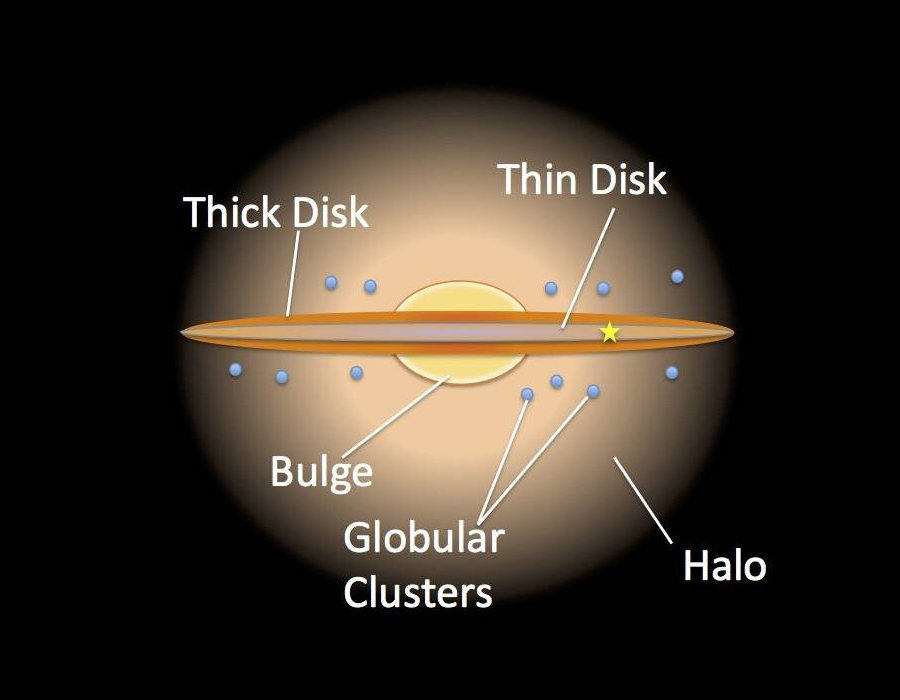
The Milky Way — like many other spiral galaxies — consists of two disc-like structures, known as thick and thin. The thick disc contains only about 20 percent of the Galaxy’s total stars, and, based on its vertical puffiness and composition, is thought to be the older of the pair.
To find out just how much older, Dr. Sharma and colleagues used a method known as asteroseismology — a way of identifying the internal structures of stars by measuring their oscillations from star quakes.
“The quakes generate soundwaves inside the stars that make them ring, or vibrate,” explains co-author Associate Professor Dennis Stello from ASTRO-3D and the University of New South Wales.
“The frequencies produced tell us things about the stars’ internal properties, including their age. It’s a bit like identifying a violin as a Stradivarius by listening to the sound it makes.”
This age-dating allows researchers to essentially look back in time and discern the period in the Universe’s history when the Milky Way formed; a practice known as Galactic-archaeology.
Not that the researchers actually hear the sound generated by star-quakes. Instead, they look for how the internal movement is reflected in changes to brightness.
“Stars are just spherical instruments full of gas,” says Sharma, “but their vibrations are tiny, so we have to look very carefully.
“The exquisite brightness measurements made by Kepler were ideal for that. The telescope was so sensitive it would have been able to detect the dimming of a car headlight as a flea walked across it.”
The data delivered by the telescope during the four years after it was launched in 2009 presented a problem for astronomers. The information suggested there were more younger stars in the thick disc than models predicted.
The question confronting scientists was stark: were the models wrong, or was the data incomplete?
In 2013, however, Kepler broke down, and NASA reprogrammed it to continue working on a reduced capacity — a period that became known as the K2 mission. The project involved observing many different parts of the sky for 80 days at a time.
The first tranche of this data represented a rich new source for Dr. Sharma and colleagues from Macquarie University, Australian National University, University of New South Wales, and the University of Western Australia. They were joined in their analysis by others from institutions in the US, Germany, Austria, Italy, Denmark, Slovenia, and Sweden.
A fresh spectroscopic analysis revealed that the chemical composition incorporated in the existing models for stars in the thick disc was wrong, which affected the prediction of their ages. Taking this into account, the researchers found that the observed asteroseismic data now fell into “excellent agreement” with model predictions.
The results provide a strong indirect verification of the analytical power of asteroseismology to estimate ages, says Professor Stello.
He added that additional data still to be analyzed from K2, combined with new information gathered by NASA’s Transiting Exoplanet Survey Satellite (TESS), will result in accurate estimates for the ages of even more stars within the disc and this will help us to unravel the formation history of the Milky Way.
Reference: “The K2-HERMES Survey: age and metallicity of the thick disc” by Sanjib Sharma, Dennis Stello, Joss Bland-Hawthorn, Michael R Hayden, Joel C Zinn, Thomas Kallinger, Marc Hon, Martin Asplund, Sven Buder, Gayandhi M De Silva, Valentina D’Orazi, Ken Freeman, Janez Kos, Geraint F Lewis, Jane Lin, Karin Lind, Sarah Martell, Jeffrey D Simpson, Rob A Wittenmyer, Daniel B Zucker, Tomaz Zwitter, Timothy R Bedding, Boquan Chen, Klemen Cotar, James Esdaile, Jonathan Horner, Daniel Huber, Prajwal R Kafle, Shourya Khanna, Tanda Li, Yuan-Sen Ting, David M Nataf, Thomas Nordlander, Mohd Hafiz Mohd Saadon, Gregor Traven, Duncan Wright and Rosemary F G Wyse, 12 October 2019, Monthly Notices of the Royal Astronomical Society.
DOI: 10.1093/mnras/stz2861
Never miss a breakthrough: Join the SciTechDaily newsletter.
Follow us on Google and Google News.