
Close Menu
    Facebook X (Twitter) Instagram
    SciTechDaily
    • Biology
    • Chemistry
    • Earth
    • Health
    • Physics
    • Science
    • Space
    • Technology
    Facebook X (Twitter) Pinterest YouTube RSS
    SciTechDaily
    Home»Science»Stem Cell Study Paves the Way for New Ovarian Cancer Therapies
    Science

    Stem Cell Study Paves the Way for New Ovarian Cancer Therapies

    By Karen N. Peart, Yale UniversityJanuary 8, 2013No Comments3 Mins Read
    Facebook Twitter Pinterest Telegram LinkedIn WhatsApp Email Reddit
    Share
    Facebook Twitter LinkedIn Pinterest Telegram Email Reddit
    link-between-stem-cell-factors-that-fuel-ovarian-cancer’s-growth-and-patient-prognosis
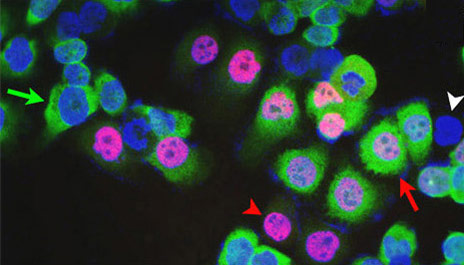
    Ovarian cancer cell nuclei highlighting stem cell factors and proteins. Credit: Yale University News

    By using sophisticated gene sequencing methods to demonstrate a regulatory link between the stem cell factor Lin28 and the signaling molecule bone morphogenic protein 4, Yale researchers are creating a path for developing new targeted ovarian cancer therapies.

    Researchers at Yale School of Medicine have identified a key link between stem cell factors that fuel ovarian cancer’s growth and patient prognosis. The study, which paves the way for developing novel targeted ovarian cancer therapies, is published online in the current issue of Cell Cycle.

    Lead author Dr. Yingqun Huang, associate professor in the Department of Obstetrics, Gynecology & Reproductive Sciences, and her colleagues have demonstrated a connection between two concepts that are revolutionizing the way cancer is treated.

    First, the “cancer stem cell” idea suggests that at the heart of every tumor there is a small subset of difficult-to-identify tumor cells that fuel the growth of the bulk of the tumor. This concept predicts that ordinary therapies typically kill the bulk of tumor cells while leaving a rich environment for continued growth of the stem cell tumor population. The second concept, dubbed “seed and soil,” defines a critical role for the tumor cells’ “microenvironment,” which is the special environment required for cancer cell growth and spread.

    “Both concepts have particular relevance for the treatment of adult solid tumors such as ovarian cancer, which has been notoriously difficult to diagnose and treat,” said co-author Nita J. Maihle, professor in the Department of Obstetrics, Gynecology & Reproductive Sciences and a member of Yale Cancer Center. “Ovarian cancer patients are plagued by recurrences of tumor cells that are resistant to chemotherapy, ultimately leading to uncontrolled cancer growth and death.”

    In this study, Huang and her colleagues were able to define a molecular basis for the interplay between these two concepts in ovarian cancer. They did this by using sophisticated gene sequencing methods to demonstrate a regulatory link between the stem cell factor Lin28 and the signaling molecule bone morphogenic protein 4 (BMP4).

    “These results are supported by the latest molecular ovarian cancer prognosis data, which also suggest an active role for the tumor microenvironment in ovarian carcinogenesis,” said Huang and Maihle. “Together these studies reveal new targets for the development of cancer therapies.”

    Reference: “Lin28 regulates BMP4 and functions with Oct4 to affect ovarian tumor microenvironment” by Wei Ma, Jing Ma, Jie Xu, Chong Qiao, Adam Branscum, Andres Cardenas, Andre T. Baron, Peter Schwartz, Nita J. Maihle and Yingqun Huang, 19 December 2012, Cell Cycle.
    DOI: 10.4161/cc.23028

    Other authors on the study include Wei Ma, Jing Ma, Jie Xu, Chong Qiao, Adam Branscum, Andres Cardenas, Andre T. Baron, Peter Schwartz, and Nita J. Maihle.

    The study was funded by a 09SCAYALE14 Connecticut Stem Cell Grant and a 1063338 Albert McKern Scholar Award to Huang, and a Yale School of Medicine “Senior Women in Medicine” Professorship to Nita J. Maihle.

    Never miss a breakthrough: Join the SciTechDaily newsletter.
    Follow us on Google and Google News.

    Cancer Stem Cells Yale University
    Share. Facebook Twitter Pinterest LinkedIn Email Reddit

    Related Articles

    This Key Protein Is Essential for Brain Cell Longevity and Growth

    Drug-Loaded Nanoparticles Offer New Approach to Treating Brain Cancer

    Researchers Identify Mutations Responsible for USC Tumors

    Disabling MicroRNAs Allows Mice to Regenerate White Cells and Platelets Depleted by Chemotherapy

    Nanoparticle Delivers a Combination of Therapeutic Agents to Tumor Sites

    Researchers Focus on Using High-Energy Electrons to Treat Cancer

    Reprogrammed Cells Suggest Path towards Alzheimer’s Early Diagnosis

    RPCI Facility Begins Research Study of a Dendritic Cell Vaccine

    New Spray Lights Up Cancer Cells

    Leave A Reply Cancel Reply

    • Facebook
    • Twitter
    • Pinterest
    • YouTube

    Don't Miss a Discovery

    Subscribe for the Latest in Science & Tech!

    Trending News

    Popular Supplement Ingredient Linked to Shorter Lifespan in Men

    Scientists May Have Found a Way To Repair Nerve Damage in Multiple Sclerosis

    “Totally Unexpected” – Scientists Discover Pancreatic Cancer’s Fatal Addiction

    A Strange Quantum Effect May Explain One of Biology’s Greatest Mysteries

    James Webb Telescope Reveals the Universe’s Hidden Cosmic Web in Stunning Detail

    Scientists Identify Simple Supplement That Greatly Reduces Alzheimer’s Damage

    You May Have a Dangerous Type of Cholesterol Even if Your Tests Look Normal

    Your Blood Pressure Reading Could Be Wrong Because of One Simple Mistake

    Follow SciTechDaily
    • Facebook
    • Twitter
    • YouTube
    • Pinterest
    • Newsletter
    • RSS
    SciTech News
    • Biology News
    • Chemistry News
    • Earth News
    • Health News
    • Physics News
    • Science News
    • Space News
    • Technology News
    Recent Posts
    • After 50 Years of Mystery, Researchers Identify New Human Blood Group
    • Leading Climate Scientist Rebuts “Factually Incorrect” US Government Climate Claims
    • You’re Breathing Plastic: Study Finds 4% of City Air Pollution Is Microplastics
    • Cancer Mystery Solved: Scientists Discover How Melanoma Becomes “Immortal”
    • Scientists Uncover Cancer-Fighting Power of Popular Fatty Liver Drug
    Copyright © 1998 - 2026 SciTechDaily. All Rights Reserved.
    • Science News
    • About
    • Contact
    • Editorial Board
    • Privacy Policy
    • Terms of Use

    Type above and press Enter to search. Press Esc to cancel.